The Wrath of the Leviathan: The Harrowing True Story of the Whaleship Essex
On a calm morning in November 1820, thousands of miles off the coast of South America, the impossible happened. A creature of flesh and blood declared war on a machine of wood and iron. The Essex, a 238-ton Nantucket whaler, was not merely sunk; it was hunted. This maritime disaster would go on to haunt the nightmares of those who survived and eventually inspire Herman Melville to write arguably the greatest American novel, Moby-Dick. But the true story of the Essex is far darker, grittier, and more desperate than fiction could ever convey.
The Attack
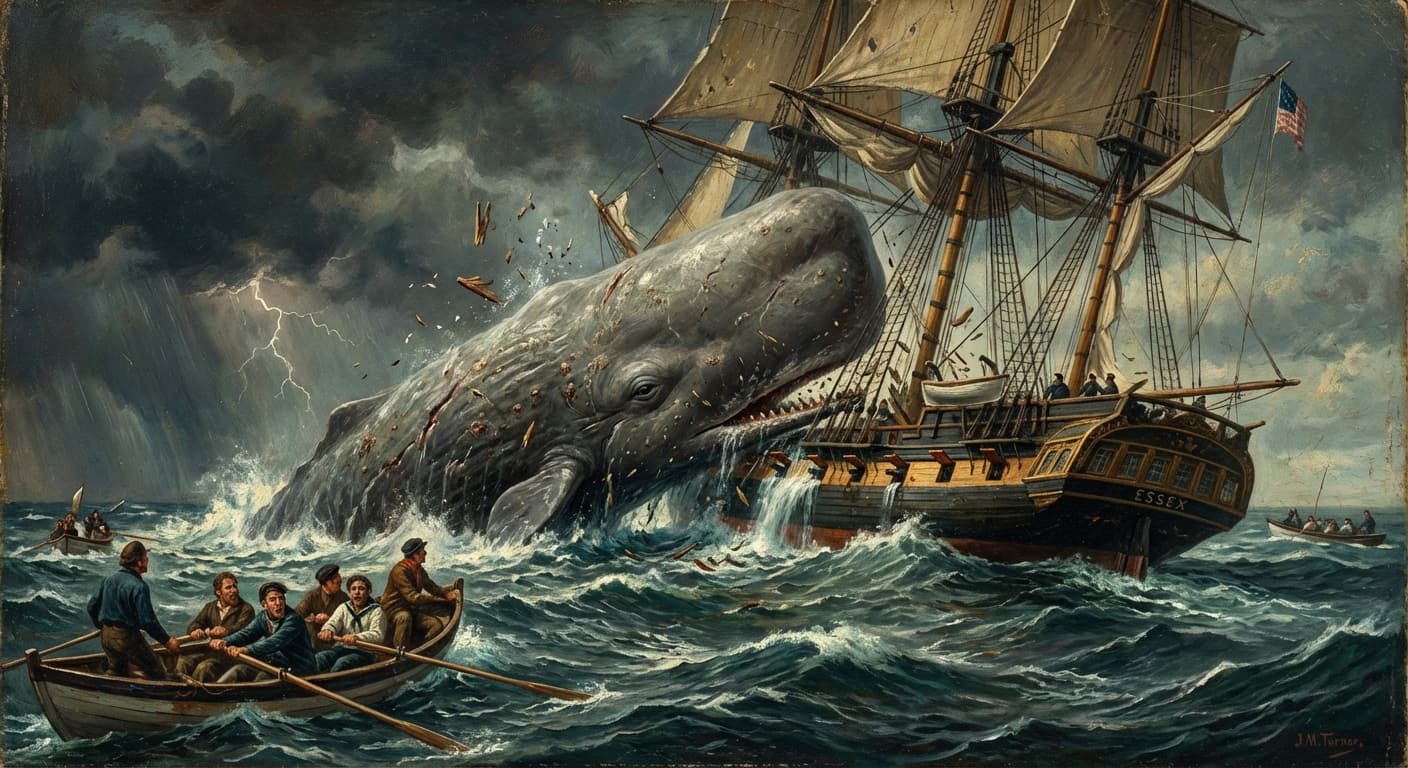
The Essex had been at sea for over a year, scouring the Pacific for sperm oil, the liquid gold that lit the lamps of the 19th century. Under the command of Captain George Pollard Jr., the crew was in the midst of a hunt when an 85-foot bull sperm whale was spotted acting strangely. Unlike the fleeing pods whalers were accustomed to, this massive leviathan turned to face the ship.
In a display of calculated aggression that stunned the crew, the whale rammed the ship’s hull, rocking the vessel violently. As the crew scrambled to operate the pumps, the whale surfaced again, seemingly dazed, before turning for a second charge. It struck the bow with cataclysmic force, crushing the heavy oak planks like matchsticks. The ship began to capsize almost immediately. The crew had just enough time to salvage navigational equipment and a small amount of food before the Essex slipped beneath the waves. The hunter had become the prey.
The Decision
Captain Pollard and First Mate Owen Chase found themselves in charge of three fragile whaleboats and twenty men, adrift in the vastest stretch of ocean on Earth. They faced a critical decision: head west toward the closest islands (the Marquesas) or east toward South America, thousands of miles away against the wind.
Driven by a terrifying rumor that the islands to the west were inhabited by flesh-eating savages, the crew voted to sail east. It was a tragic irony that would seal their fate. By avoiding the possibility of cannibalism on land, they unwittingly sailed directly toward the certainty of it at sea.
The Drift of Death
What followed was a ninety-day ordeal of exposure, dehydration, and starvation. The Pacific sun blistered their skin during the day, while storms threatened to swallow their tiny boats at night. Supplies dwindled rapidly. Within weeks, the men began to die.
At first, the bodies were committed to the deep according to maritime tradition. But as hunger gnawed away their sanity and the instinct for survival overrode societal taboos, the survivors made the gruesome choice to consume their fallen shipmates. The boats eventually became separated in a storm. In Captain Pollard’s boat, the situation deteriorated into a nightmare scenario: when the bodies of the dead were exhausted, the survivors drew lots to see who would be sacrificed to keep the others alive. Owen Coffin, the captain’s young cousin, drew the black spot. He was shot and eaten.
The Rescue and Legacy
In February 1821, nearly three months after the sinking, the Dauphin, another whaling ship, spotted a small boat bobbing in the swells off the coast of Chile. Inside were two skeletal figures—Owen Chase and one other survivor—surrounded by piles of bones. Captain Pollard and one other man were rescued by a different ship days later. Out of the twenty men who set sail in the lifeboats, only eight survived the ordeal.
The disaster of the Essex shook the whaling industry to its core. Years later, a young Herman Melville met the son of Owen Chase at sea and was given a copy of the First Mate’s memoir. The account of the angry whale ramming the ship obsessed Melville, providing the climax for Moby-Dick. While Captain Ahab’s story ends with the sinking, the crew of the Essex had to live through the horror that came after, bearing the psychological scars of a tragedy where the line between man and beast was blurred in the struggle to survive.