The Color That Changed the World: How a Teenager's Botched Malaria Cure Birthed the Synthetic Age
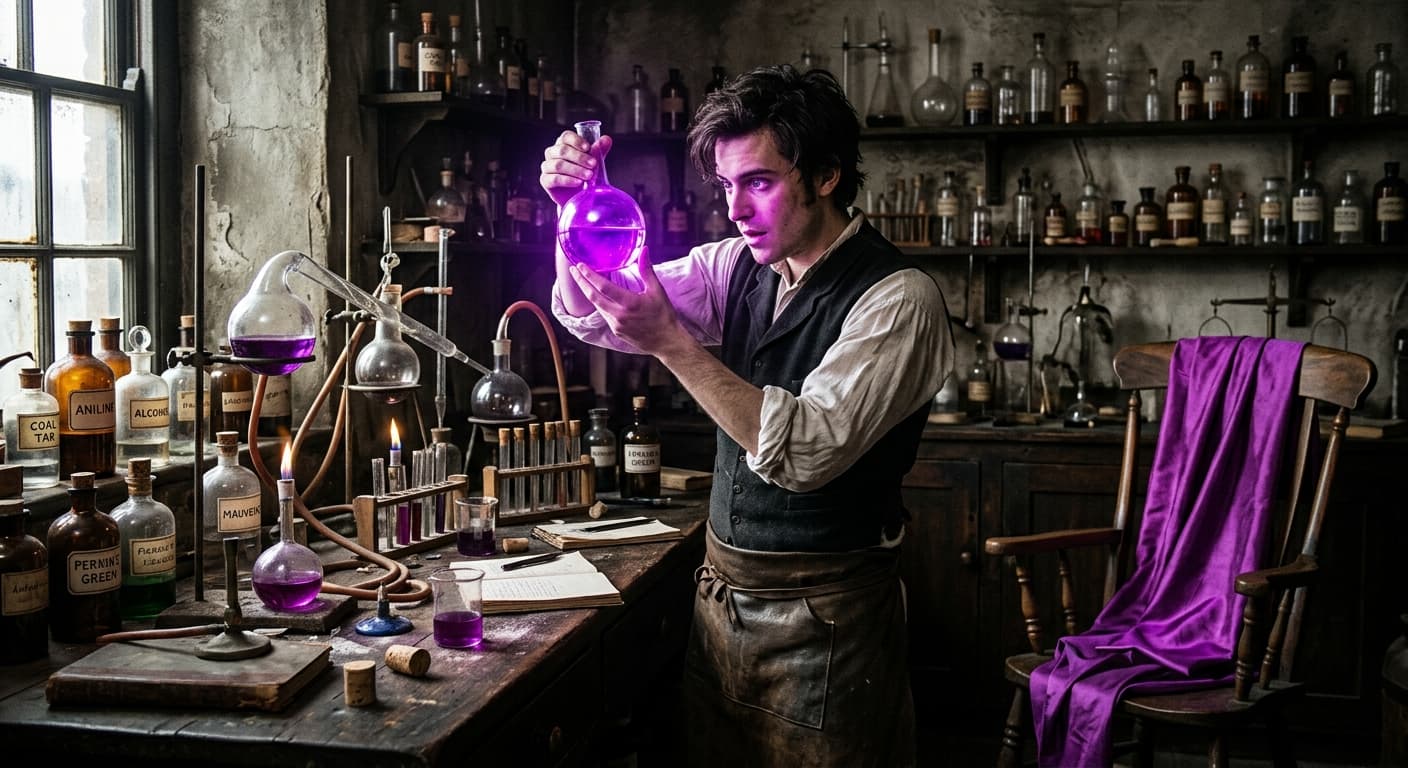
In the spring of 1856, chemistry was a messy, largely theoretical science that had yet to make a significant impact on everyday life. At the time, an 18-year-old English student named William Henry Perkin was spending his Easter holiday working in a rudimentary, makeshift laboratory he had set up in his family's London apartment. His goal was incredibly ambitious: he was trying to artificially synthesize quinine, the only known medical cure for malaria.
During the 19th century, the British Empire was rapidly expanding into tropical regions across the globe. Malaria was a deadly, pervasive obstacle to this colonial expansion. The only effective treatment, quinine, had to be painstakingly extracted from the bark of the cinchona tree, which was native exclusively to the Andes mountains in South America. The harvesting process was slow, the supply was tightly monopolized, and the resulting medicine was exorbitantly expensive. The scientific race was on to create a cheaper, artificial alternative.
Perkin was working under the direction of his prestigious mentor, the German chemist August Wilhelm von Hofmann. Hofmann had theorized that quinine could be derived from coal tar, a thick, black, incredibly abundant waste product generated by the booming gas lighting industry. Following this logic, the teenage Perkin began mixing aniline—a compound derived from coal tar—with potassium dichromate. However, instead of yielding the prized, crystalline white powder of quinine, the chemical reaction produced a dense, sticky, foul-smelling black sludge. By all conventional scientific metrics, it was a spectacular and discouraging failure.
Most sensible chemists of the era would have immediately thrown the ruined sludge away and started over. But Perkin was observant. As he was scrubbing his ruined glass flasks with alcohol, he noticed something extraordinary. The dark sludge didn't just wash away; it dissolved into a strikingly brilliant, intensely vibrant purple solution. Curious, he dipped a small piece of silk into the mysterious liquid. The fabric absorbed the color completely. Furthermore, when he washed the silk and left it out in the sun, the color refused to fade or wash out. Perkin hadn't cured malaria, but he had just discovered the world's first synthetic dye.
To understand the magnitude of this accident, one must understand the historical context of the color purple. For millennia, purple had been the most exclusive and expensive color on Earth. The legendary "Tyrian purple" of the ancient world required the crushed, rotting glands of thousands of Murex sea snails just to dye a single garment. Consequently, purple was heavily restricted by sumptuary laws to royalty, emperors, and the ultra-wealthy. Even in the 1850s, natural purple dyes were derived from exotic lichens or insects, and they were notorious for fading rapidly. Perkin's mistake had just democratized the color of kings.
Against the fierce objections of Professor Hofmann, who urged him to remain in academia, Perkin abandoned his studies at the Royal College of Chemistry. He promptly patented his discovery, originally calling it "Tyrian Purple" before pivoting to the much more fashionable French name, "Mauveine." With financial backing from his skeptical father and operational help from his brother, Perkin opened a commercial dye works in Greenford Green, near London. Because there was no existing synthetic chemical industry, Perkin had to invent entirely new industrial processes, vats, and machinery to mass-produce his dye, effectively becoming one of the world's first true chemical engineers.
Timing, as they say, is everything. Just as Perkin's factory began production, Empress Eugénie of France—the ultimate fashion icon of the Victorian era—decided that the new mauve color perfectly complemented her complexion. Shortly thereafter, Queen Victoria herself wore a magnificent mauve silk gown to her eldest daughter's wedding in 1858. The public demand exploded instantly. A societal obsession, dubbed "Mauve Measles" by satirical magazines like Punch, swept across Europe. Suddenly, every fashionable woman in London and Paris was walking the streets draped in vivid, synthetic purple.
Perkin became a fabulously wealthy man, but the true legacy of Mauveine extended far beyond the fickle world of Victorian high fashion. His commercial success sent a massive shockwave through the global scientific community. It definitively proved that chemistry wasn't just a theoretical academic pursuit—it could be immensely practical and highly profitable. This realization sparked a "chemical gold rush." Within a few years, massive chemical companies like BASF, Hoechst, and Bayer were founded in Germany specifically to create new synthetic dyes from coal tar.
More importantly, this new rainbow of synthetic dyes revolutionized modern medicine. Biologists soon discovered that different synthetic dyes could be used to selectively stain specific parts of cells or invisible microorganisms, making them suddenly visible under a microscope. Walther Flemming used these synthetic dyes to discover chromosomes and observe cell division. Later, the brilliant physician Paul Ehrlich used synthetic dyes to identify the elusive tuberculosis and cholera bacilli. Ehrlich's work with dyes eventually led him to theorize the "magic bullet"—a chemical that could target and kill specific pathogens without harming the human host—which directly birthed the modern field of chemotherapy.
William Henry Perkin's botched malaria experiment didn't save any soldiers in the tropical reaches of the British Empire. Yet, it inadvertently birthed the modern synthetic chemical industry. From the vibrant clothes we wear to the plastics we use, and the life-saving pharmaceuticals in our medicine cabinets, the modern world is inextricably built upon the foundation of that black, sticky sludge created by a curious teenager over an Easter weekend in 1856.