The Man Who Ate the Animal Kingdom: The Bizarre Appetites of William Buckland
The 19th century was an era defined by a ravenous appetite for discovery. Explorers mapped the last blank corners of the globe, engineers conquered seemingly insurmountable physical barriers, and naturalists dug into the very earth to rewrite the history of time. But for one eccentric Oxford professor, the appetite for discovery was quite literal. Enter William Buckland: a pioneering geologist, a brilliant theologian, and a man who was deeply committed to eating his way through the entire animal kingdom.
Born in 1784, Buckland spent the prime of his career in the first half of the 19th century, at a time when the lines between serious scientific inquiry and eccentric parlor tricks were delightfully blurry. As a scientist, Buckland’s credentials were unimpeachable. In 1824, he became the first person to formally describe and name a dinosaur fossil—the Megalosaurus. He was a pioneer in the study of deep time, a passionate advocate for the emerging science of geology, and the man who correctly deduced that the strange, stony nodules found by fossil hunter Mary Anning were actually fossilized dinosaur feces (which he gleefully coined "coprolites").
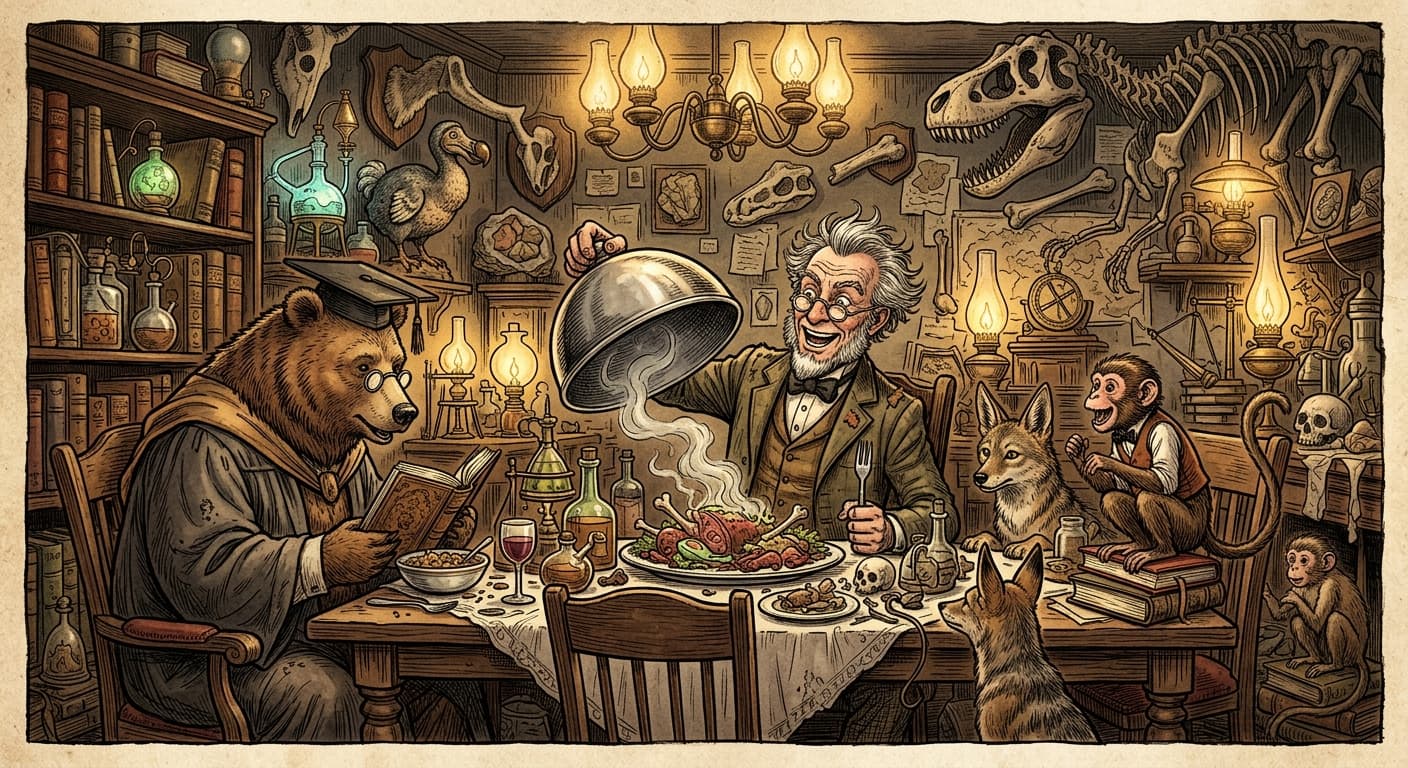
But for all his undeniable brilliance, Buckland was famously, spectacularly weird. His rooms at Christ Church, Oxford, were less an academic study and more a chaotic menagerie. Visitors reported navigating a labyrinth of geological specimens, ancient bones, and live animals. He shared his living quarters with snakes, frogs, jackals, guinea pigs, and a highly mischievous bear named Tiglath Pileser, who was known to roam the college grounds dressed in a cap and gown.
Yet, it was his dining table that cemented his legendary status among Victorian intellectuals. Buckland was a practitioner of what he called "zoophagy"—the practice of eating every conceivable animal on Earth. He believed that to truly understand the natural world, one had to experience it with all five senses, taste being paramount.
Dinner guests at the Buckland household were subjected to a terrifying culinary roulette. Depending on the day, a visiting dignitary or fellow scientist might be served panther chops, rhinoceros pie, roasted ostrich, or crocodile steaks. A particularly infamous dinner party featured a main course of "mice in batter." Some guests feigned illness; others choked down the exotic fare in the name of scientific camaraderie. Charles Darwin, a contemporary of Buckland, once attended one of these dinners and noted that the host was an engaging conversationalist, though the menu left much to be desired.
Buckland approached his bizarre diet with rigorous academic scrutiny, carefully noting the flavor profiles of his unusual meals. For years, he maintained that the worst-tasting creature on the planet was the common mole—a title it held unchallenged until he decided to try the bluebottle fly, which he subsequently declared the most repulsive thing he had ever consumed.
However, Buckland’s most famous, and perhaps most appalling, gastronomic achievement did not involve an animal at all. According to a widely circulated—and historically corroborated—legend, Buckland’s ultimate meal occurred during a visit to the home of Lord Harcourt at Nuneham House.
Harcourt possessed a macabre and priceless historical artifact: a silver locket containing a walnut-sized, mummified piece of the heart of King Louis XIV. The relic had supposedly been smuggled out of France during the plunder of the royal tombs in the French Revolution. As Harcourt proudly passed the royal organ around the room for his guests to inspect, it eventually reached William Buckland.
For a man whose life’s mission was to taste the forbidden and the extraordinary, the temptation was simply too much. Staring at the mummified remains of the Sun King, Buckland reportedly announced, "I have eaten many strange things, but have never eaten the heart of a king before." Before the horrified Harcourt could intervene, the esteemed Oxford professor popped the monarch's heart into his mouth and swallowed it whole.
William Buckland died in 1856, leaving behind a massive legacy in the world of paleontology and earth sciences. Today, he is rightfully remembered as a giant of 19th-century geology, a man who helped humanity understand the prehistoric monsters that once walked the earth. But to those who study the colorful, eccentric human history of the era, he will forever remain the mad genius of the dining room—the man who served mouse on toast, crowned the bluebottle fly as the king of bad taste, and made a snack out of the French monarchy.