The White Gold Rush: How a Global Craze for Bird Poop Saved the World and Built an Empire
When we think of the great commodity rushes of the 19th century, our minds naturally drift to the gold fields of California or the diamond mines of South Africa. However, one of the most transformative, fiercely contested, and bizarre resources of the Victorian era was not a precious metal or a glittering stone. It was bird excrement.
By the 1830s, the Western world was facing an existential crisis. The Industrial Revolution had triggered a massive population boom, and urbanization was pulling laborers away from the fields. Compounding this, centuries of intense farming had severely depleted the soil in Europe and North America. Crop yields were plummeting. Thomas Malthus's grim theory—that population growth would inevitably outpace the food supply, leading to mass starvation—seemed on the verge of becoming a terrifying reality.
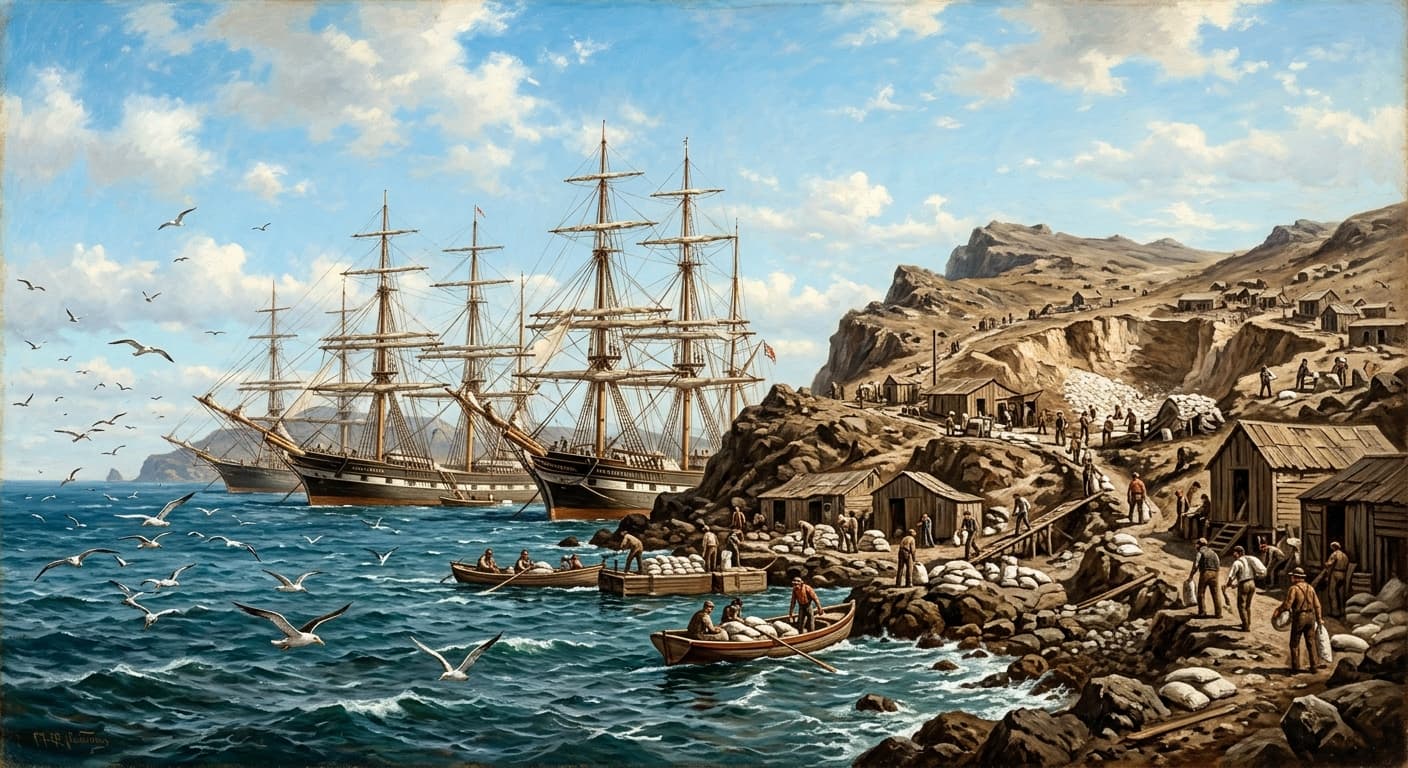
The salvation to this looming catastrophe came from the arid coast of Peru. In 1802, the famed Prussian explorer Alexander von Humboldt had observed indigenous Peruvians using a pungent, white substance to fertilize their crops. This substance was 'guano'—the accumulated droppings of millions of cormorants, pelicans, and boobies. Because the Chincha Islands off the Peruvian coast received almost no rainfall, the bird droppings had not washed away. Instead, they had baked in the sun for millennia, piling up into mountains over 150 feet deep. Rich in nitrogen, phosphate, and potassium, it was a hyper-effective natural fertilizer.
When the first commercial shipments of Peruvian guano arrived in Britain and the United States in the 1840s, the results were nothing short of miraculous. Exhausted fields suddenly yielded bumper crops, doubling or even tripling their output. Overnight, guano mania gripped the globe. It became the most sought-after commodity on Earth, often referred to as 'white gold.' Farmers clamored for it, and the Peruvian government, which held a monopoly on the Chincha Islands, became staggeringly wealthy.
However, this agricultural miracle had a dark and brutal underbelly. To mine the hardened mountains of excrement, Peru relied on the exploited labor of thousands of Chinese indentured workers, known as coolies. These men worked in horrific, sweltering conditions under the blazing Pacific sun. The ammonia dust was so thick it burned their eyes and destroyed their lungs. Many perished in the toxic, crumbling quarries, their lives traded for the continued fertility of European and American soil.
As the demand for guano skyrocketed, the desperation to secure it literally redrew the global map. Resenting the British-Peruvian monopoly and the soaring prices, American farmers demanded action. In response, the U.S. Congress passed one of the most bizarre pieces of legislation in history: the Guano Islands Act of 1856. This act allowed any American citizen to take possession of any unclaimed, uninhabited island in the world that contained guano, and declared those islands as belonging to the United States.
This obscure law birthed American overseas imperialism. Almost overnight, American entrepreneurs raced across the Pacific and the Caribbean, claiming dozens of tiny atolls. Islands like Midway, Baker, and Howland—mere specks of coral and bird droppings—were absorbed into the U.S. territory. Long after the guano was depleted, these islands would prove strategically vital, particularly during World War II.
The craze even triggered international conflict. In 1864, Spain, seeking to reclaim the immense wealth of its former colonies, seized the Chincha Islands, sparking the Chincha Islands War against Peru and Chile. The idea of nations deploying armadas and shedding blood over islands of bird poop may sound comical today, but in the 19th century, controlling guano meant controlling the global food supply.
Ultimately, the Guano Age was a victim of its own success. By the late 19th century, the mountains of white gold had been largely hollowed out. The world would soon turn to synthetic fertilizers, thanks to the invention of the Haber-Bosch process in the early 20th century, which allowed scientists to pull nitrogen directly from the air. Yet, the legacy of the guano craze remains quietly embedded in history. It delayed the Malthusian trap, fueled an agricultural revolution, and pushed a young United States to stretch its borders across the oceans—all built on the most unlikely foundation imaginable.