When Titans Clashed: The Electrifying War of the Currents
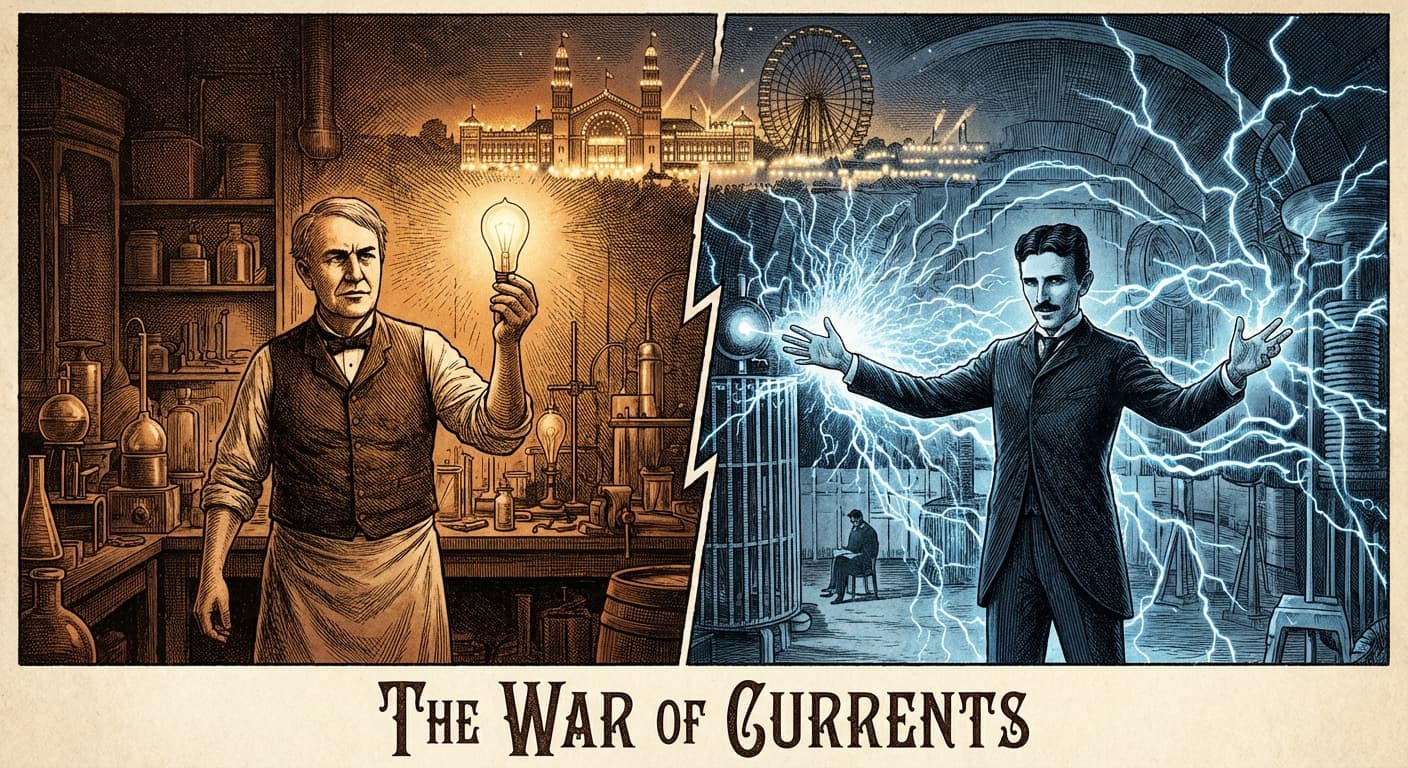
The late 19th century was a period defined by steam, steel, and a desperate race to banish the night. As gas lamps flickered in the cobbled streets of New York and London, a technological revolution was brewing that would fundamentally alter the course of human civilization. This was not a battle fought with muskets or cannons, but with copper wires, dynamos, and public opinion. It was the War of the Currents, a bitter commercial and ideological feud that pitted two of history’s greatest inventors against one another: the Wizard of Menlo Park, Thomas Edison, and the enigmatic visionary, Nikola Tesla.
At the heart of the conflict lay the question of how to best deliver electricity to the growing cities of America. Thomas Edison, already an American icon for his development of the practical incandescent light bulb, was a staunch proponent of Direct Current (DC). Edison’s General Electric was building infrastructure based on this standard, which flowed continuously in a single direction, much like water through a hose. However, DC had a fatal flaw: it could not be transmitted over long distances without significant power loss. This necessitated the construction of noisy, coal-burning power stations within every square mile of a city, a costly and inefficient logistical nightmare.
Enter George Westinghouse, a rail tycoon who saw potential in a different approach: Alternating Current (AC). Based on the brilliant patents of a young Serbian immigrant named Nikola Tesla—who had briefly worked for Edison before parting ways over unpaid bonuses and ideological differences—AC could reverse direction many times per second. Crucially, its voltage could be stepped up by transformers for efficient long-distance transmission and then stepped down for safe domestic use. Westinghouse and Tesla offered a system that could light up the world from a single, distant power source, a concept that threatened to render Edison’s DC empire obsolete.
Edison, never one to take a threat lightly, launched a ruthless propaganda campaign intended to terrify the public into rejecting AC. He argued that high-voltage AC was inherently dangerous, a lethal force that would kill innocent families in their homes. To prove his point, Edison’s associates began a gruesome series of public demonstrations. They paid schoolchildren to collect stray dogs and cats, which were then electrocuted before reporters using Westinghouse’s AC generators. This macabre theater reached its nadir with the invention of the electric chair, which Edison covertly lobbied to have powered by AC, hoping the public would associate the rival current with death. He even attempted to coin the phrase "to be Westinghoused" as a synonym for electrocution.
Despite the fear-mongering and the macabre spectacles, the superior efficiency of Alternating Current could not be denied. The turning point came in 1893 at the World’s Columbian Exposition in Chicago. Westinghouse underbid General Electric to light the fair, creating a dazzling City of Light that left millions of visitors awestruck. Tesla himself dazzled crowds by passing high-frequency currents through his body to light lamps held in his hands, proving that AC could be safe if managed correctly. Following this triumph, Westinghouse won the contract to harness the power of Niagara Falls, a project that successfully transmitted massive amounts of power to Buffalo, New York, over twenty miles away.
By the late 1890s, the War of the Currents had effectively ended. The scalability of AC made it the standard for global power grids, a status it holds to this day. Edison, though defeated in this specific battle, pivoted to other ventures like motion pictures, his reputation largely intact. Tesla, the genius who had gifted the world the 20th century, died penniless decades later, his contributions often overshadowed during his lifetime. Yet, every time we flip a switch and power travels hundreds of miles to light our rooms, we are living in the world that Tesla envisioned and Westinghouse built—a world forged in the sparks of the 19th century’s most electrifying rivalry.