The War of the Wolverines: How a Cartography Error Sparked the Ridiculous Toledo War of 1835
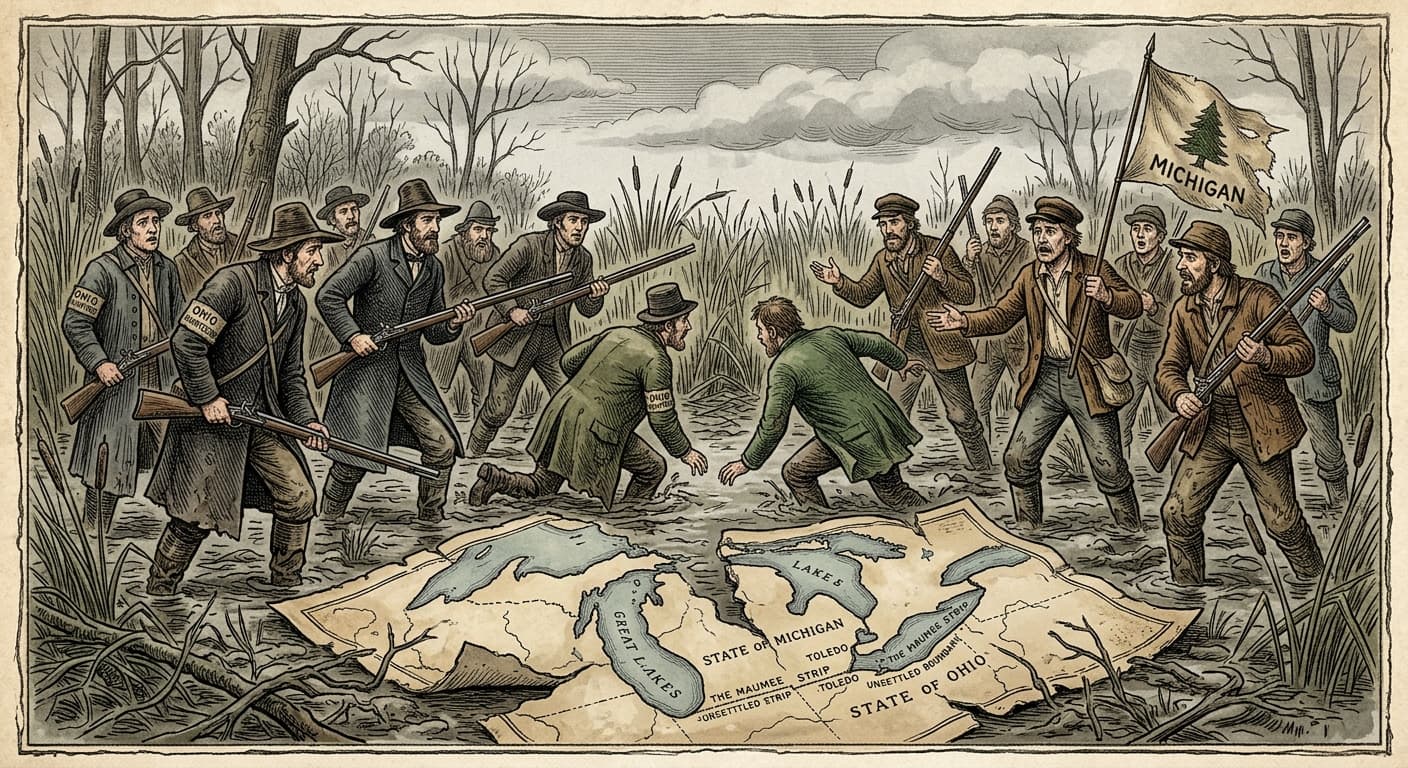
When you think of the great conflicts of the 19th century, your mind probably jumps to the Napoleonic Wars, the American Civil War, or the Crimean War. Blood, mud, and grand strategies dominate the history books. But nestled in the 1830s is a conflict so absurd, so inherently petty, that it reads more like a sitcom script than a chapter of American history. Welcome to the Toledo War of 1835, a boundary dispute between the State of Ohio and the Territory of Michigan that nearly brought two American militias to blows over a cartographical oopsie.
The roots of the Toledo War stretch back to the Northwest Ordinance of 1787. When Congress established the boundaries for future states in the region, they drew a straight horizontal line originating from the "southerly bend or extreme of Lake Michigan" straight across to Lake Erie. It sounded perfectly reasonable in an era when most mapmaking involved taking a brisk walk and making an educated guess. Unfortunately, the maps of the era, notably the Mitchell Map, were wildly inaccurate. Lake Michigan actually dipped further south than anyone realized.
By the time Ohio became a state in 1803, they realized this geographical blunder. If the original line were strictly followed, the mouth of the Maumee River—a crucial economic hub for canal shipping and Great Lakes trade—would belong to the future state of Michigan. Ohio quietly tweaked the line in their state constitution to ensure the river mouth stayed within their borders. Michigan, naturally, cried foul.
The prize was the Toledo Strip, a 468-square-mile slice of swampy land that contained the burgeoning port city of Toledo. For decades, the dispute simmered as a bureaucratic annoyance. But in 1835, Michigan decided it had the required population to apply for statehood. They submitted a constitution that proudly included the Toledo Strip. Ohio, terrified of losing their economic golden goose, used its political clout in Washington to block Michigan's statehood until the upstarts relinquished their claim.
Enter the "Boy Governor" of Michigan, Stevens T. Mason. Appointed at the tender age of 19 (and serving as acting governor at 23 during the crisis), Mason possessed all the fiery arrogance of a twenty-something with a point to prove. In response to Ohio's maneuvering, Mason passed the Pains and Penalties Act, making it a criminal offense for Ohioans to exercise any authority in the Strip. Ohio's Governor, Robert Lucas, was not to be outdone. He mobilized the Ohio state militia. Mason responded in kind, sending a thousand armed Michiganders into the swamps.
What followed was a masterclass in aggressive posturing. The two militias spent months tromping through the mud, generally avoiding each other, arresting partisan officials, and occasionally firing muskets into the air. The most brutal skirmish of the entire war was the Battle of Phillips Corners, where a Michigan posse ambushed Ohio surveyors, firing over their heads and capturing nine men. The only actual casualty of the war occurred later when a Michigan sheriff named Joseph Wood attempted to arrest a Toledo partisan named Two Stickney (yes, his brother's name was One Stickney). A scuffle broke out, and Stickney stabbed the sheriff in the leg with a penknife before fleeing into Ohio. The sheriff survived, and Stickney became a bizarre historical footnote.
The chaos finally forced President Andrew Jackson to intervene. Jackson was in a tight spot: it was an election year, and Ohio was a state with electoral votes, while Michigan was merely a territory with none. The political math was simple. Jackson removed the Boy Governor from office and proposed a compromise that heavily favored the established state.
The final deal? Ohio officially received the Toledo Strip. Michigan, in return, would be granted statehood and compensated with the entire Upper Peninsula. At the time, Michiganders felt completely robbed. They had traded a booming port city for a massive, frozen expanse of pine trees and bears. The Upper Peninsula was widely considered a worthless, barren wasteland.
Yet, history always gets the last laugh. Just a few years later, the discovery of massive copper and iron deposits in the Upper Peninsula sparked a mining boom that generated far more wealth for Michigan than the Toledo Strip ever could. Michigan ended up fueling the industrial revolution of the United States, while Ohio got to keep a swampy shipping port.
Today, the legacy of the Toledo War is mostly forgotten as a military conflict, but it lives on in spirit. The fierce, irrational hatred generated by the border dispute laid the cultural foundation for the intense modern-day rivalry between the University of Michigan and Ohio State University. Every time the Wolverines and Buckeyes clash on the football field, they are, in a way, still fighting the ridiculous, penknife-wielding, swamp-tromping war of 1835.