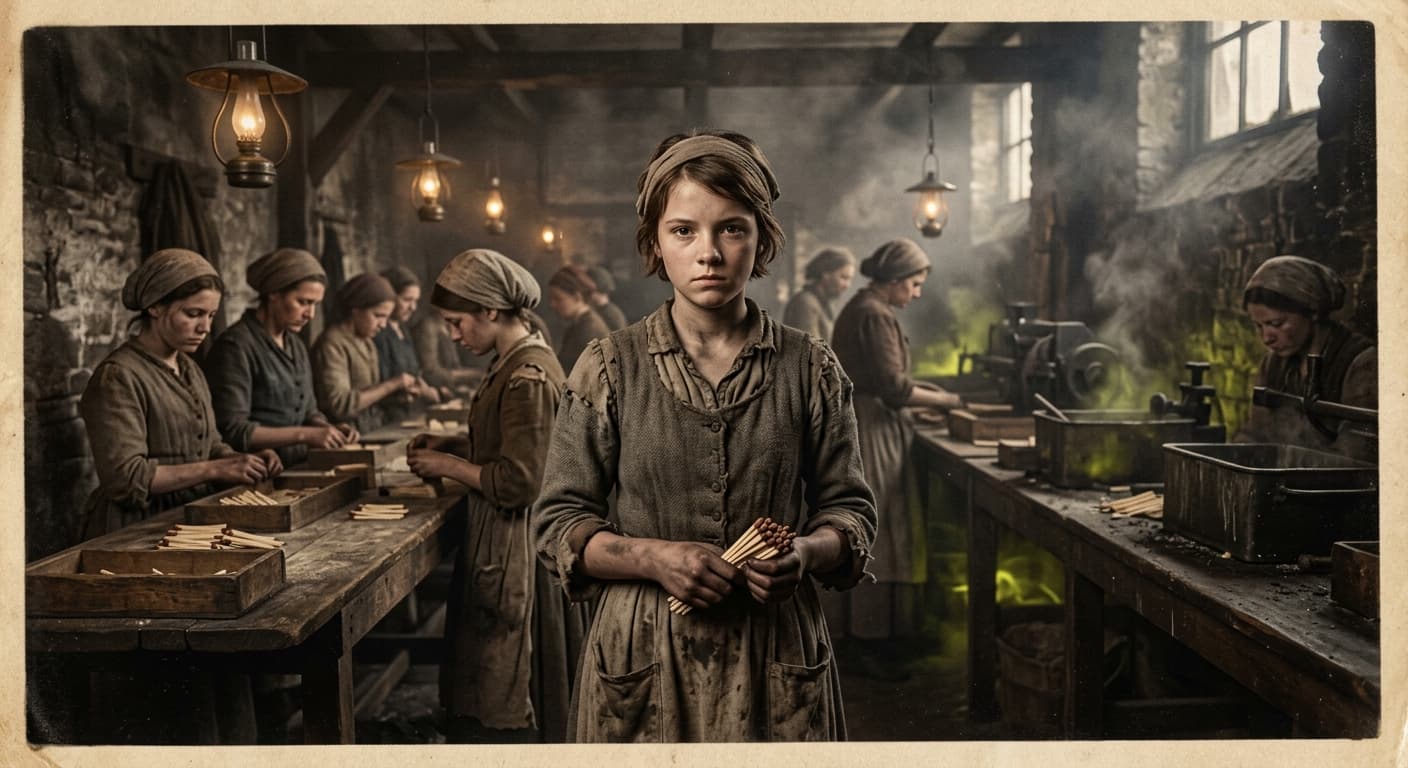
The Light That Burned the Bone: The Dark History of the Victorian Matchstick
Imagine a world without instant fire. For most of human history, conjuring a flame required the tedious striking of flint and steel, or carefully preserving glowing embers in a hearth. It wasn't until the 19th century that an accidental discovery birthed a miraculous little invention: the friction match. It was cheap, reliable, and promised to revolutionize domestic life. Yet, the mass production of this everyday convenience hid a horrifying secret. The Victorian matchstick fueled an epidemic of industrial disease that physically deformed thousands of factory workers and ultimately sparked one of the most pivotal labor uprisings of the modern era.
The story of the modern match begins with a serendipitous accident. In 1826, an English chemist named John Walker was stirring a concoction of antimony sulfide, potassium chlorate, gum, and starch with a wooden stick. When he withdrew the stick and attempted to scrape the dried chemical crust against his hearth, it violently erupted into flames. Walker began selling these "friction lights," though they were somewhat dangerous and notoriously difficult to ignite. Other inventors quickly capitalized on the idea, marketing early matches under names like "Lucifers," which were known for their explosive sparks and noxious, sulfurous odor.
The true breakthrough—and the genesis of a tragedy—occurred in 1830 when a French chemist named Charles Sauria decided to add white phosphorus to the match head recipe. This single ingredient solved all previous issues. White phosphorus matches struck easily against almost any rough surface, burned steadily, and lacked the foul stench of their predecessors. They were an immediate, massive commercial success. By the mid-19th century, enormous factories had sprung up across Europe and America, churning out millions of matches daily to satisfy an insatiable global demand.
However, the white phosphorus that made the matches so effective was incredibly toxic. The factories that produced them were predominantly staffed by desperately poor young women and teenage girls, who toiled for up to fourteen hours a day in crowded, poorly ventilated workrooms. The air they breathed was constantly thick with toxic phosphorus fumes. These vapors mixed with the workers' saliva and seeped into their bloodstreams through minor dental cavities or infected gums.
The result was a brutal occupational disease officially known as phosphorus necrosis of the jaw, but grimly dubbed "phossy jaw" by the factory workers. The condition began with terrible toothaches and swollen gums. Over time, the phosphorus literally destroyed the jawbone, causing massive abscesses, severe facial disfigurement, and a foul-smelling discharge. The necrosis was so profound that a victim's rotting jawbone would eerily glow greenish-white in the dark. In the days before antibiotics and safe anesthesia, the only known treatment was the brutal surgical removal of the affected bone. If left untreated, the poisoning would lead to agonizing organ failure and death.
Despite the widely known horrors of phossy jaw, factory owners staunchly refused to ban white phosphorus. It was simply cheaper to produce than the non-toxic red phosphorus utilized in the more expensive "safety matches" invented in Sweden. The factory floors of Victorian London, such as the notorious Bryant & May factory in the East End, were ruled by draconian discipline. The matchgirls were paid poverty-level wages and subjected to arbitrary, crippling fines for offenses as minor as dropping a match, talking to a neighbor, or taking too long in the restroom.
The breaking point finally arrived in the summer of 1888. Social reformer and journalist Annie Besant published a blistering exposé titled "White Slavery in London," which detailed the appalling wages, the cruel system of fines, and the rampant cases of phossy jaw at the Bryant & May factory. Enraged by the bad press, the factory management attempted to force their workers to sign a document repudiating Besant's claims. When a few brave women refused to sign the lie, they were promptly fired.
In an era when unskilled, impoverished women were entirely marginalized, the workers' response was unprecedented. On July 5, 1888, over 1,400 matchgirls walked off the job. This legendary strike shocked Victorian society. Unlike the established unions of skilled male craftsmen, these young women organized themselves from the ground up. They marched on Parliament, won widespread public sympathy, and successfully formed the Union of Women Match Makers. After three weeks of immense public pressure and plummeting stock prices, Bryant & May capitulated. They abolished the arbitrary fines, reinstated the fired workers, and provided a separate room for meals to reduce the accidental ingestion of phosphorus on the factory floor.
The Matchgirls' Strike of 1888 was a watershed moment in history, proving that even the most disenfranchised workers could successfully stand up against powerful industrial titans. While it would take the Berne Convention of 1906 to finally implement an international ban on the use of white phosphorus in matches, the bravery of the matchgirls laid a crucial foundation for modern labor rights. The humble Victorian matchstick illuminated the physical world, but it also cast an unforgiving light on the dark, human cost of industrial progress.