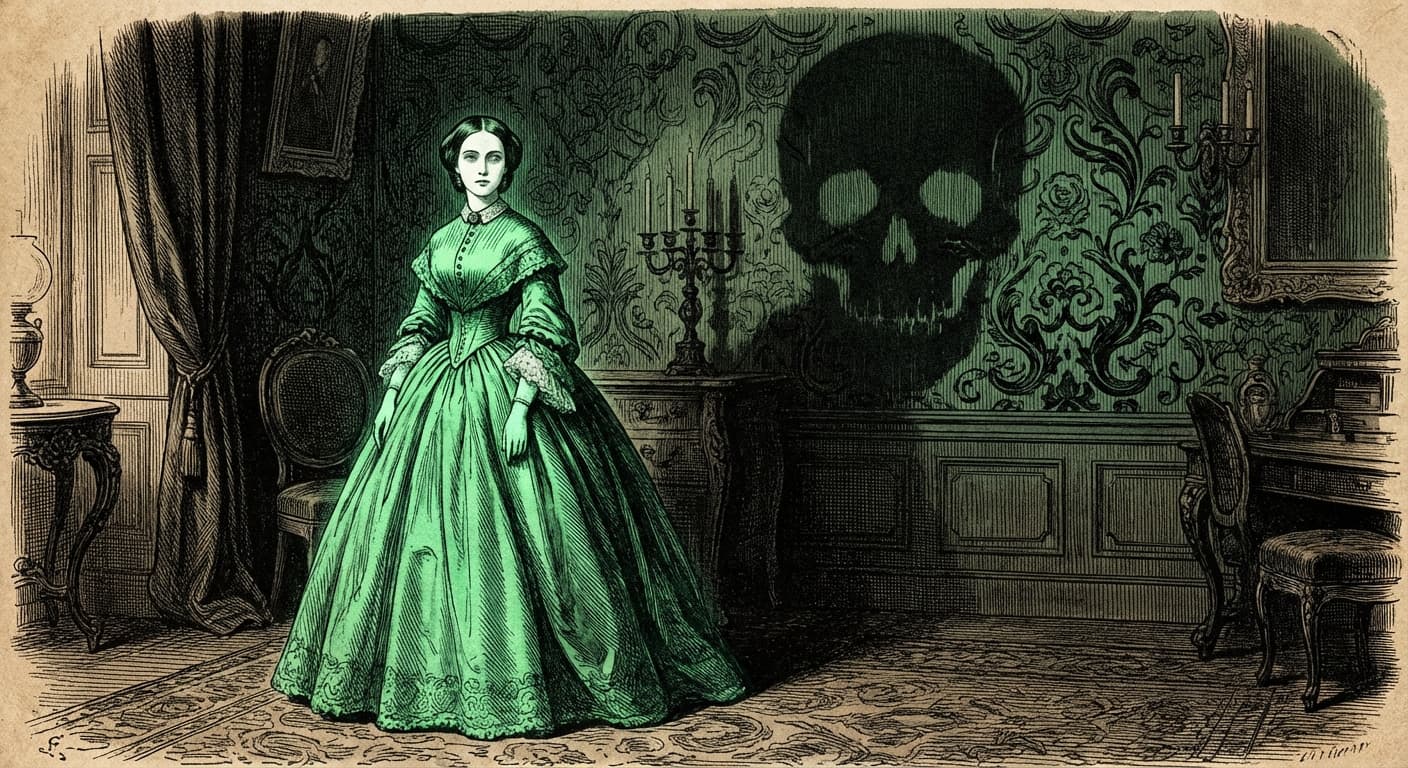
The Shade That Killed: The Deadly Allure of Victorian Arsenic Green
If you were to step into a high-society ballroom in the mid-19th century, you would be greeted by a spectacle of opulence. Gaslights flickered against gilded mirrors, music swelled from the orchestra, and the dance floor swirled with the finest fashions of the age. Among the sea of silks and satins, one color stood out with a brilliance that seemed almost supernatural: a vivid, gem-like emerald green. It was the color of the moment, adorning everything from evening gowns and gloves to hair wreaths and shoes. But this mesmerizing hue, known as Scheele’s Green or Paris Green, hid a sinister secret. To achieve that electric vibrancy, chemists had married copper with a deadly partner: arsenic.
For centuries, green had been a notoriously difficult color to capture in fabric. Vegetable dyes were dull and prone to fading, often resulting in muddy browns or pale olives. That changed in 1775 when a Swedish chemist named Carl Wilhelm Scheele invented a new pigment using copper arsenite. By the Victorian era, improved versions of this pigment had taken the world by storm. It was cheaper and more brilliant than any natural dye, and the Victorians, starving for a touch of nature in their soot-choked industrial cities, became obsessed. They didn't just wear it; they lived in it. The color was painted onto children’s toys, dusted onto artificial flowers, and, perhaps most dangerously, printed onto the wallpaper that lined their bedrooms and parlors.
The danger of arsenic green was not that it was merely present in the fabric; it was that it wasn't chemically bound to it. The pigment was applied as a powder mixed with paste. When a lady in an emerald ballgown whirled across the dance floor, the friction caused invisible clouds of arsenic dust to billow off the dress, settling in the lungs of her partners and the bystanders. A popular medical report from the time wryly noted that a woman in a green dress carried enough poison in her skirts to kill half the admirers in the ballroom. While the wearers often suffered from rashes, nausea, and headaches, they were usually spared the worst fate. The true victims were the workers.
The plight of the "flower makers" remains one of the darkest chapters of Victorian labor history. These were typically young women and girls employed to create the intricate artificial foliage that adorned bonnets and dining tables. To make the leaves look realistic, they dusted them with the green arsenic powder, often using their bare hands. They inhaled the dust day in and day out. The medical accounts of their suffering are harrowing: convulsions, vomiting green bile, and the whites of their eyes turning a sickly shade of green. In 1861, the death of 19-year-old Matilda Scheurer, an artificial flower maker, caused a scandal. Her post-mortem revealed that her internal organs were saturated with arsenic, and the public outcry began to turn the tide against the deadly fashion.
The domestic sphere was no safer. As moisture and mold interacted with the arsenic-laden wallpaper in damp British homes, a chemical reaction released a toxic gas called arsine. Families would mysteriously waste away, suffering from "wasting disease" or "gastric fever" that miraculously vanished when they went to the seaside for fresh air, only to return when they came home. There is a persistent historical theory that Napoleon Bonaparte’s death on St. Helena was hastened by the arsenic vapors leaching from the green-and-gold wallpaper in his damp island prison. Samples of his hair tested in modern times have shown high levels of arsenic, lending credence to the idea that the former Emperor was slowly poisoned by his own decor.
By the late 19th century, the undeniable evidence of arsenic’s lethality—championed by doctors and publicized by a sensationalist press—finally broke the spell. satirical cartoons depicted skeletons asking ladies for a dance, and the "arsenic waltz" became a grim joke. Alternative, non-toxic dyes were eventually synthesized, allowing the world to enjoy the color green without the accompanying body count. Today, the Victorian obsession with Scheele’s Green serves as a chilling reminder of the era's dangerous relationship with progress, where the pursuit of aesthetic beauty often outpaced the understanding of scientific consequence.