The Wall Street Clairvoyant Who Ran for President: The Audacious Life of Victoria Woodhull
It is the fall of 1872. Ulysses S. Grant is locked in a fierce battle for reelection to the highest office in the United States. But the most fascinating candidate on the ballot is not a decorated general, a wealthy patrician, or a career politician. In fact, this candidate is not even legally allowed to cast a ballot. Her name is Victoria Woodhull, and she is the first woman in American history to run for President.
Born into poverty in 1838 in rural Ohio, Woodhull's early life read like a Dickens novel set on the American frontier. Her father, Reuben 'Buck' Claflin, was a snake-oil salesman and suspected arsonist, while her mother was a religious zealot. Recognizing early on that Victoria and her younger sister, Tennessee, possessed a charismatic charm, their father forced them to work as traveling clairvoyants, holding seances and peddling magnetic healing elixirs. At fifteen, hoping to escape her family's exploitation, Victoria married an alcoholic doctor named Canning Woodhull. The disastrous marriage would profoundly shape her radical views on women's rights and the legal traps of Victorian matrimony.
In 1868, Victoria and Tennessee moved to New York City, a metropolis buzzing with the spiritualist movement. Through a stroke of sheer audacity, the sisters managed to secure a meeting with Cornelius Vanderbilt. The aging railroad tycoon, devastated by the loss of his wife and son, was desperately seeking spiritual guidance. The sisters provided him with seances and 'magnetic healing,' and in return, Vanderbilt provided them with incredibly lucrative stock tips and enormous financial backing.
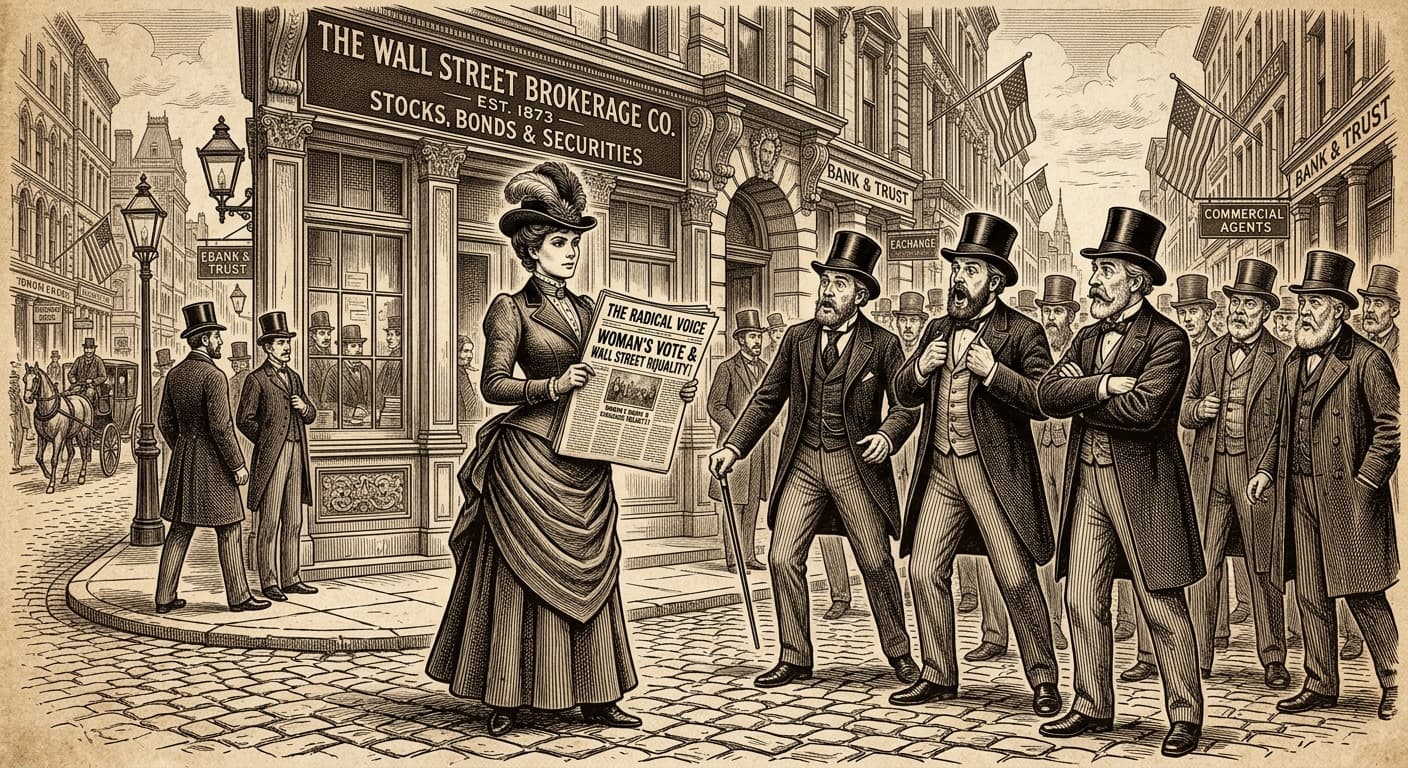
Armed with Vanderbilt's money and their own sharp intellects, the sisters shocked the financial world in 1870 by opening Woodhull, Claflin & Company—the first female-owned brokerage firm on Wall Street. The press went wild, dubbing them the 'Bewitching Brokers' and the 'Queens of Finance.' Men crowded outside their Broad Street offices just to catch a glimpse of women buying and selling gold and railroad stocks. Against all societal expectations, the firm was a massive success, making the sisters millionaires in a domain completely dominated by men.
But Woodhull was not satisfied with mere wealth; she wanted a revolution. Using their Wall Street profits, the sisters launched a radical newspaper called 'Woodhull & Claflin's Weekly.' The publication became a lightning rod for controversy. It advocated for the eight-hour workday, a graduated income tax, women's suffrage, and vegetarianism. Most shockingly, it championed 'free love'—the deeply controversial belief that a woman should have the legal right to marry, divorce, and bear children entirely free from government interference or societal ruin. The paper even published the first English translation of Karl Marx's 'Communist Manifesto' in the United States.
By 1872, Woodhull had leveraged her immense public profile to launch a bid for the Presidency under the newly formed Equal Rights Party. To balance the ticket, she boldly nominated abolitionist leader Frederick Douglass as her vice-presidential running mate. Although Douglass never acknowledged the nomination or campaigned with her, the gesture was profoundly symbolic, uniting the struggles for gender and racial equality on a single national platform.
The establishment, however, was terrified of her influence and sought to destroy her. Prominent figures, including the immensely popular and influential Reverend Henry Ward Beecher, publicly condemned her moral character. In retaliation against his hypocrisy, Woodhull published a spectacular exposé in her newspaper detailing Beecher's secret affair with his best friend's wife. The resulting scandal was the most explosive of the 19th century and dominated national headlines.
Her enemies finally had their excuse. Just days before the presidential election, federal marshals arrested Victoria and Tennessee under the newly passed Comstock Laws, which made it a federal crime to send 'obscene' materials through the mail. Consequently, on Election Day in 1872, the first woman to ever run for the presidency of the United States sat in a damp, cold cell in the Ludlow Street Jail.
Though she received no electoral votes and her popular votes were either unrecorded or discarded, Victoria Woodhull's audacious run shattered the boundaries of Victorian society. She was eventually acquitted of all charges, moved to England, married a wealthy banker, and lived to the age of 88. A century and a half later, her legacy remains a testament to the power of unyielding courage—a pioneer who dared to demand the highest office in the land decades before her country even recognized her right to vote.