The Cruise of Death: How a Presidential PR Stunt Aboard the USS Princeton Altered American History
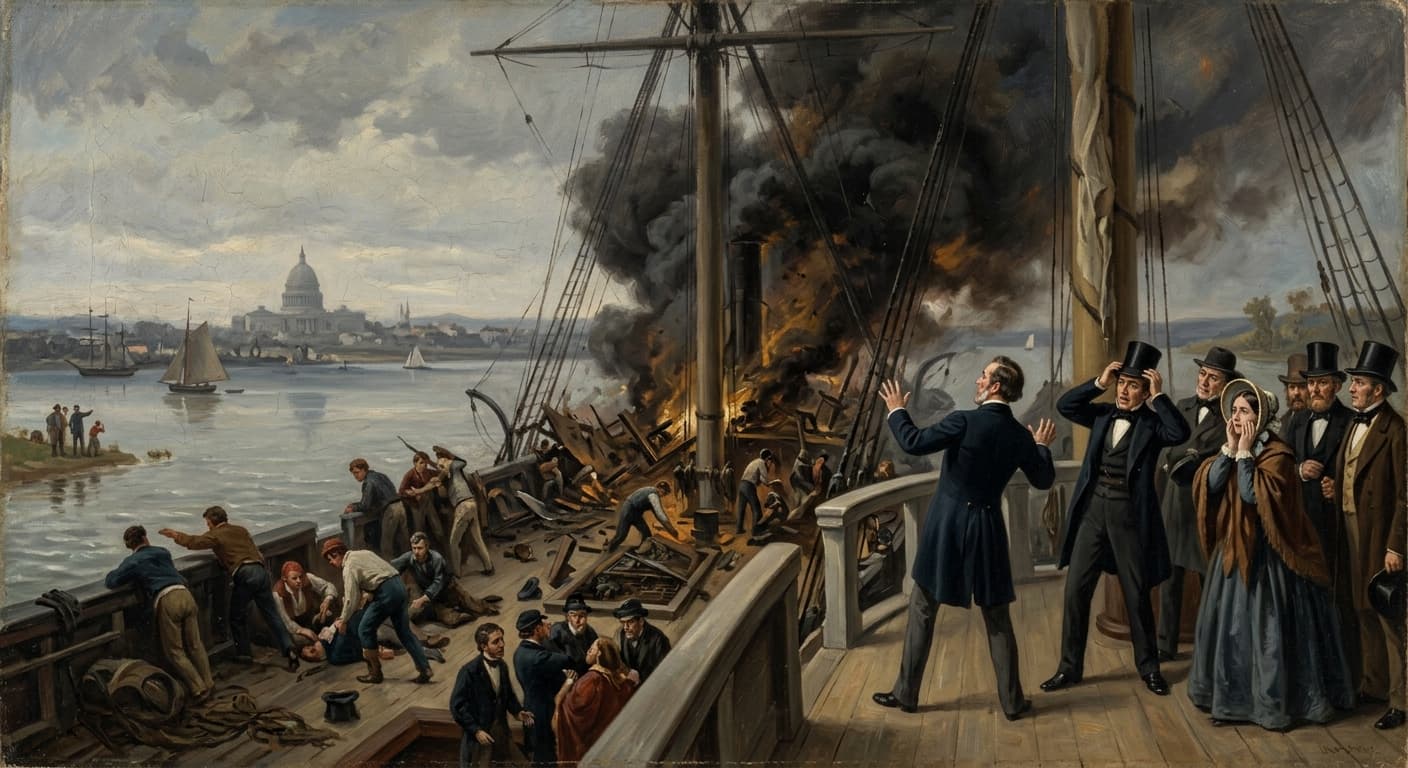
On the brisk afternoon of February 28, 1844, the Potomac River played host to what was supposed to be the ultimate celebration of American naval innovation and political prestige. President John Tyler, his cabinet, Dolly Madison, and nearly 400 members of Washington’s elite gathered aboard the newly minted USS Princeton. It was to be a luxurious pleasure cruise, a floating gala designed to showcase the technological might of the United States. Instead, it became the site of a horrifying disaster that nearly wiped out the executive branch and profoundly altered the trajectory of the nation.
At the center of this spectacle was the USS Princeton itself, an engineering marvel. It was the United States Navy’s first screw-propelled steam frigate, a radical departure from the vulnerable paddle-wheelers of the era. Commanded by the ambitious Captain Robert F. Stockton, the ship was a testament to modernity. But the true star of the show sat on the vessel’s deck: a massive, 12-inch naval gun dubbed the "Peacemaker." Weighing in at 27,000 pounds, it was the largest naval cannon in the world, capable of firing a 225-pound iron ball over two miles.
However, the Peacemaker harbored a fatal flaw born of hubris. The ship’s original designer, the brilliant Swedish engineer John Ericsson (who would later design the famous ironclad USS Monitor), had built a scientifically reinforced cannon for the ship named the "Oregon." Not to be outdone, Captain Stockton—who lacked Ericsson’s metallurgical expertise—decided to have a second, even larger gun forged. He scaled up Ericsson’s design but omitted the crucial reinforced iron bands that prevented the barrel from bursting under pressure. Stockton’s ego was quite literally a ticking time bomb.
For most of the afternoon, the cruise was a resounding success. The Princeton glided effortlessly down the river. Below deck, the VIPs indulged in a lavish feast, with champagne flowing freely and toasts being made to the President and the ship's captain. To the delight of the crowd, Stockton had the Peacemaker fired several times, each deafening blast sending a massive water spout into the air and drawing cheers from the mesmerized onlookers.
As the ship made its return journey toward the Washington Navy Yard late in the afternoon, Secretary of the Navy Thomas Gilmer requested one final demonstration of the mighty gun. The crowd gathered on the deck. President Tyler, who was making his way upstairs to witness the shot, paused on the ladder to listen to his son-in-law sing a popular ditty about Washington and Lafayette. That brief pause saved the President’s life.
On deck, Stockton gave the order to fire. But this time, the Peacemaker could not withstand the pressure of the 25-pound gunpowder charge. The left side of the cannon violently ruptured, sending massive shards of red-hot iron ripping through the dense crowd of onlookers. The explosion instantly transformed the festive deck into a gruesome scene of carnage and panic.
The casualties were staggering, particularly given the victims’ prominence. Secretary of State Abel P. Upshur and Secretary of the Navy Thomas Gilmer were killed instantly. Also among the dead were Captain Beverley Kennon, Chief of the Bureau of Construction; Virgil Maxcy, a prominent diplomat; David Gardiner, a wealthy New York politician; and the President’s enslaved valet, Armistead, who had been serving drinks near the gun. Dozens of others were severely wounded, their eardrums shattered and bodies mutilated by shrapnel.
President Tyler rushed onto the deck, weeping at the horrific sight. The bodies were laid out in the dining room that had, just an hour earlier, been the site of joyous celebration. The disaster cast a dark pall over Washington, leading to a massive state funeral and a period of deep national mourning.
Yet, the explosion aboard the Princeton did far more than shatter a cannon; it profoundly reshaped American history. At the time of his death, Secretary of State Upshur was secretly negotiating the annexation of the Republic of Texas. Following the disaster, President Tyler appointed the fiercely pro-slavery South Carolinian John C. Calhoun to replace Upshur. Calhoun aggressively championed the Texas annexation not as a matter of national expansion, but explicitly as a means to expand and protect the institution of slavery.
This aggressive, polarizing shift fractured the national political landscape. It directly paved the way for the Mexican-American War, intensified the bitter sectional divide over slavery, and dramatically accelerated the country's march toward the Civil War. Furthermore, President Tyler, consoling the grieving daughter of victim David Gardiner, soon married her; Julia Gardiner Tyler would go on to establish many of the modern traditions of the role of the First Lady.
The tragedy of the USS Princeton remains a stark reminder of the dangers of technological arrogance. Captain Stockton, protected by his wealth and immense political influence, was never court-martialed for his reckless engineering. But his "Peacemaker" left an indelible, bloody mark on the 19th century, proving that sometimes the most pivotal moments in history turn not on the battlefield, but on a single moment of devastating hubris.