Ships of the Desert: The Bizarre and Forgotten History of the U.S. Camel Corps
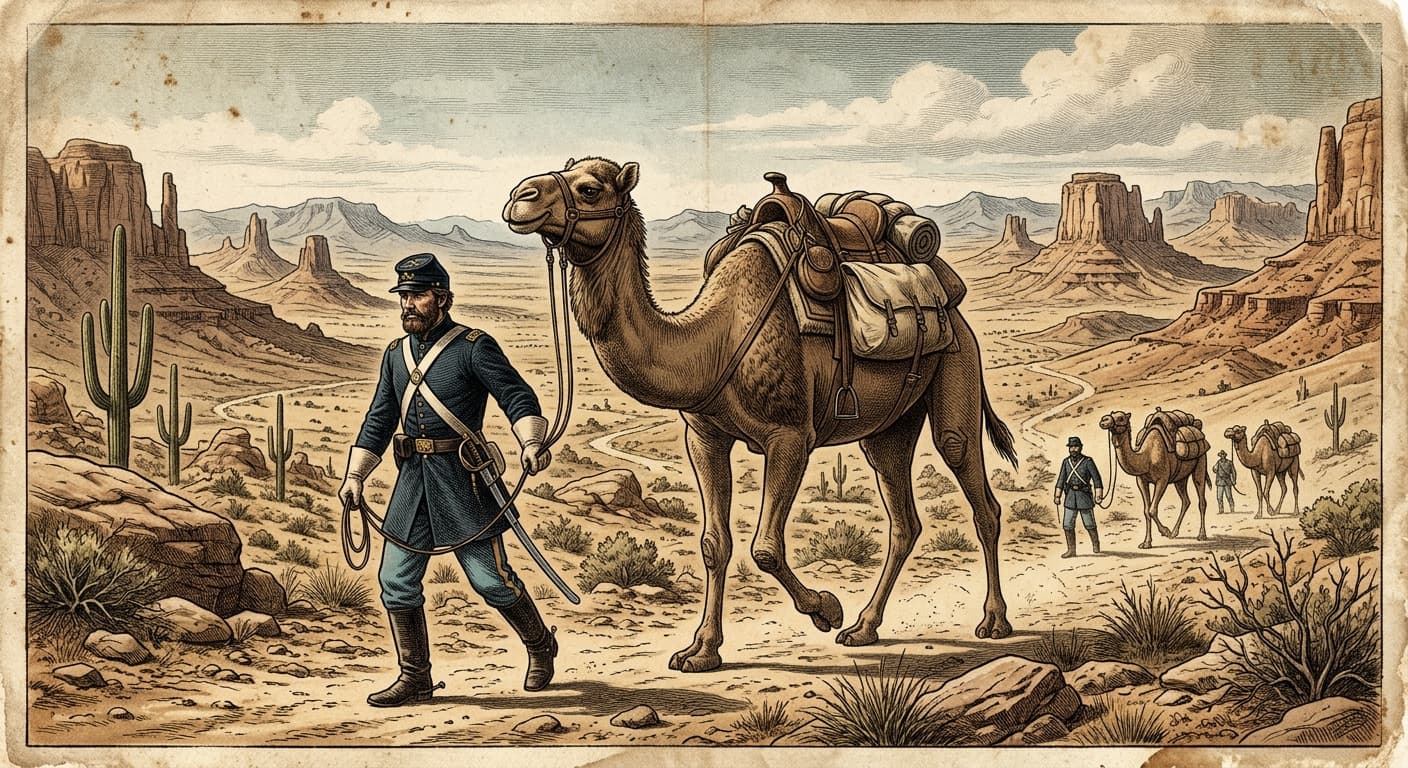
When you picture the American Wild West in the mid-19th century, certain images immediately come to mind: dusty cowboys, galloping horses, rugged stagecoaches, and... camels? It might sound like a mirage, but for a brief, bizarre period in the 1850s, the United States military employed a fleet of Middle Eastern camels to conquer the American frontier. This forgotten chapter of history—known as the United States Camel Corps—remains one of the most eccentric and surprisingly successful experiments of the 19th century.
The story begins in the aftermath of the Mexican-American War. By 1848, the United States had acquired a massive swath of new territory, stretching from Texas to California. The discovery of gold shortly after triggered an unprecedented westward migration. However, getting there was a logistical nightmare. The American Southwest was a vast, arid, and unforgiving desert. Traditional pack animals like horses and mules struggled under the blistering sun, dying of exhaustion and thirst by the thousands. The military desperately needed a better way to transport heavy supplies and maintain communication lines across this brutal, uncharted landscape.
Enter Jefferson Davis. Years before he would become the President of the Confederacy, Davis served as the U.S. Secretary of War under President Franklin Pierce. Davis was a pragmatic thinker who realized that the climate and terrain of the American Southwest were remarkably similar to the deserts of the Middle East and North Africa. If camels were the undisputed 'ships of the desert' in the Sahara, why couldn't they serve the exact same purpose in the Mojave? Despite facing widespread skepticism and mockery from his peers in Washington, Davis relentlessly lobbied Congress for funding. In 1855, he finally secured a $30,000 appropriation to test his radical idea.
Major Henry C. Wayne and Navy Lieutenant David Dixon Porter were tasked with this highly unusual shopping trip. Sailing the USS Supply to the Mediterranean and the Levant, they purchased over seventy camels—a mix of single-humped Dromedaries and double-humped Bactrians—along with a handful of experienced, native camel drivers to help manage the exotic beasts. The most famous of these handlers was a man named Hadji Ali, whom the American soldiers, struggling with the pronunciation, quickly nicknamed 'Hi Jolly.' Upon arriving in Texas in 1856, the animals were put to the ultimate test.
To the absolute shock of the skeptics, the camels were a resounding triumph of logistics. During a grueling 1857 surveying expedition led by Edward Fitzgerald Beale, who was tasked with charting a new wagon road from New Mexico to California, the camels proved their immense worth. They could effortlessly carry up to 600 pounds—nearly twice the load of a standard military pack mule. They happily devoured thorny scrub brush and cacti that horses outright refused to touch. Best of all, they could go for days without a single drop of water, easily traversing volcanic rock and shifting sand dunes that crippled conventional livestock.
So, why don't we have cowboys riding camels today? The ultimate downfall of the Camel Corps was not a failure of the animals themselves, but rather a stubborn clash of cultures and catastrophic timing. American soldiers, accustomed to the relatively docile and familiar nature of horses, despised dealing with the stubborn camels. The beasts possessed a nasty habit of biting, kicking, and spitting foul-smelling cud at their handlers when aggravated. Furthermore, the camels' pungent odor and deeply unusual gait terrified the military's horses and mules, frequently causing massive, chaotic stampedes whenever they were brought into camp.
The final nail in the coffin was the outbreak of the American Civil War in 1861. When Jefferson Davis left Washington to lead the seceding Confederacy, the Union Army swiftly abandoned his pet project. The military suddenly had far more pressing concerns than wrangling exotic animals in the distant southwestern deserts. The camels were unceremoniously auctioned off to circuses, sold to private mining companies, or simply turned loose to fend for themselves in the untamed wilderness.
For decades after the war, miners, prospectors, and rail workers would report surreal sightings of wild camels wandering the badlands of Nevada, Arizona, and California. These feral survivors quickly birthed local frontier legends, most notably the terrifying 'Red Ghost'—a massive, vicious camel said to roam the desert at night with a human skeleton strapped to its back. The last of the original Camel Corps animals allegedly died in captivity in 1934, finally closing the book on an audacious experiment. Today, the U.S. Camel Corps stands as a fascinating testament to the strange, innovative spirit of the 19th century, proving that sometimes the wildest ideas actually work—even if the world isn't quite ready to accept them.