The Unkillable Queen: How Victoria Survived Eight Bizarre Assassination Attempts
When we picture Queen Victoria, the image that usually comes to mind is that of a dour, unsmiling widow clad in perpetual black mourning attire. She is remembered as the strict matriarch of a sprawling global empire and the namesake of an era defined by extreme moral rigidity. However, beneath the lace and the severe reputation was a woman who lived a life akin to a 19th-century action hero. Over the course of her 63-year reign, Queen Victoria was the target of no fewer than eight separate assassination attempts. Rather than retreating into the safety of her palaces, she met these terrifying brushes with death with an astonishing, almost reckless bravery.
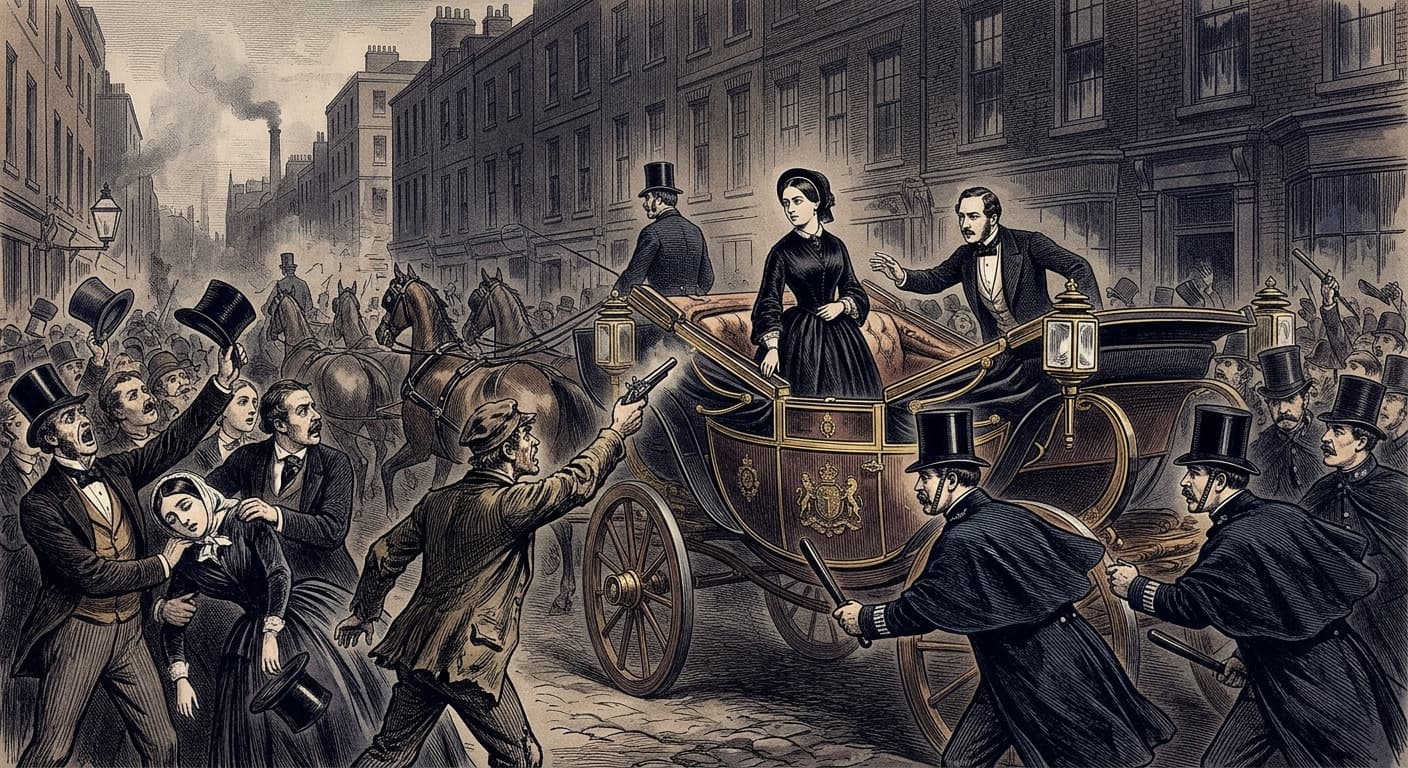
The first attempt on the monarch's life occurred in June 1840, just months after her wedding. A 21-year-old, heavily pregnant Victoria was taking an evening ride in an open carriage with Prince Albert along London's Constitution Hill. Suddenly, a teenager named Edward Oxford stepped out from the crowd, drew a dueling pistol, and fired. He missed. As Oxford drew a second pistol, Victoria did not duck or scream. Instead, she stood up to get a better look at her attacker. Albert had to yank her down back into the seat just as the second shot rang out. Oxford was immediately swarmed by bystanders. In a move that secured her immense popularity, the royal couple ordered the driver to continue their ride through Hyde Park as if nothing had happened, much to the awe of the British public.
This remarkable stoicism quickly became Victoria's trademark. In May 1842, a man named John Francis aimed a pistol at her carriage but failed to fire before fleeing into Green Park. When the police informed her of the near-miss, the Queen refused to hide. Instead, she devised a plan that was as audacious as it was dangerous. The very next day, she deliberately took the exact same route in the same open carriage, essentially using herself as bait to lure the would-be assassin out of hiding. Her carriage was surrounded by plainclothes police officers, but the risk was immense. Francis took the bait, stepped out, fired, and missed again. He was immediately tackled by the undercover officers, and Victoria's calculated bravery became the stuff of legend.
Not all of the would-be assassins were hardened killers with grand political motives; many were deeply eccentric, misguided, or profoundly incompetent. Just weeks after the John Francis incident, a teenager with a spinal deformity named John William Bean fired at the Queen. His weapon of choice was a pistol loaded not with a lead bullet, but with a chaotic, sputtering mix of gunpowder, paper, and broken pieces of a clay tobacco pipe. In 1849, an unemployed, desperate bricklayer named William Hamilton fired a pistol packed only with gunpowder at the royal carriage. He didn't actually want to hurt the Queen; he simply wanted to be arrested and transported to an Australian penal colony to escape his crushing poverty.
Because these attempts were becoming a bizarre trend, Parliament passed the Treason Act of 1842 at Victoria's urging. The new law made it a lesser offense to simply point a firearm at the Queen or attempt to alarm her, punishable by imprisonment and a public whipping, rather than the death penalty. Victoria felt that turning these incompetent, often mentally ill men into executed martyrs would only encourage more copycats.
However, the most damaging attack involved no gunfire at all. In 1850, a well-dressed, former Army officer named Robert Pate approached the Queen's carriage while it was stationary. Without warning, he struck her forcefully on the head with a brass-tipped cane. The blow was so severe that it crushed her bonnet, drew blood, and left her with a permanent scar on her forehead. Yet, true to her iron-willed form, Victoria appeared at the Royal Opera House that very same evening. When she entered her royal box, the astonished crowd erupted into a roaring standing ovation.
As the years went on, Victoria became practically unfazed by the threat of violence. In 1872, an Irish teenager named Arthur O'Connor scaled the fence at Buckingham Palace with a defective pistol, hoping to hold the Queen hostage to force the release of Fenian political prisoners. Before he could even raise his weapon, he was tackled to the ground by Victoria's fiercely loyal personal servant, John Brown. The Queen calmly noted in her journal that the boy looked "wretched."
By the time the final attempt occurred in 1882—when a disgruntled, mentally ill poet named Roderick Maclean fired a revolver at her train at Windsor railway station because she had rejected a poem he mailed to her—Victoria was more annoyed than afraid. Maclean was swiftly beaten down by a group of schoolboys armed with umbrellas before the police could even reach him.
In an era when monarchs were increasingly insulated from their subjects, Victoria's repeated encounters with assassins only brought her closer to the people. These chaotic, bizarre incidents reveal a side of the famous monarch that history books often overlook. Queen Victoria was not just an untouchable symbol of an empire; she was a hardened survivor made of iron, who absolutely refused to let a few stray bullets dictate the course of her reign.