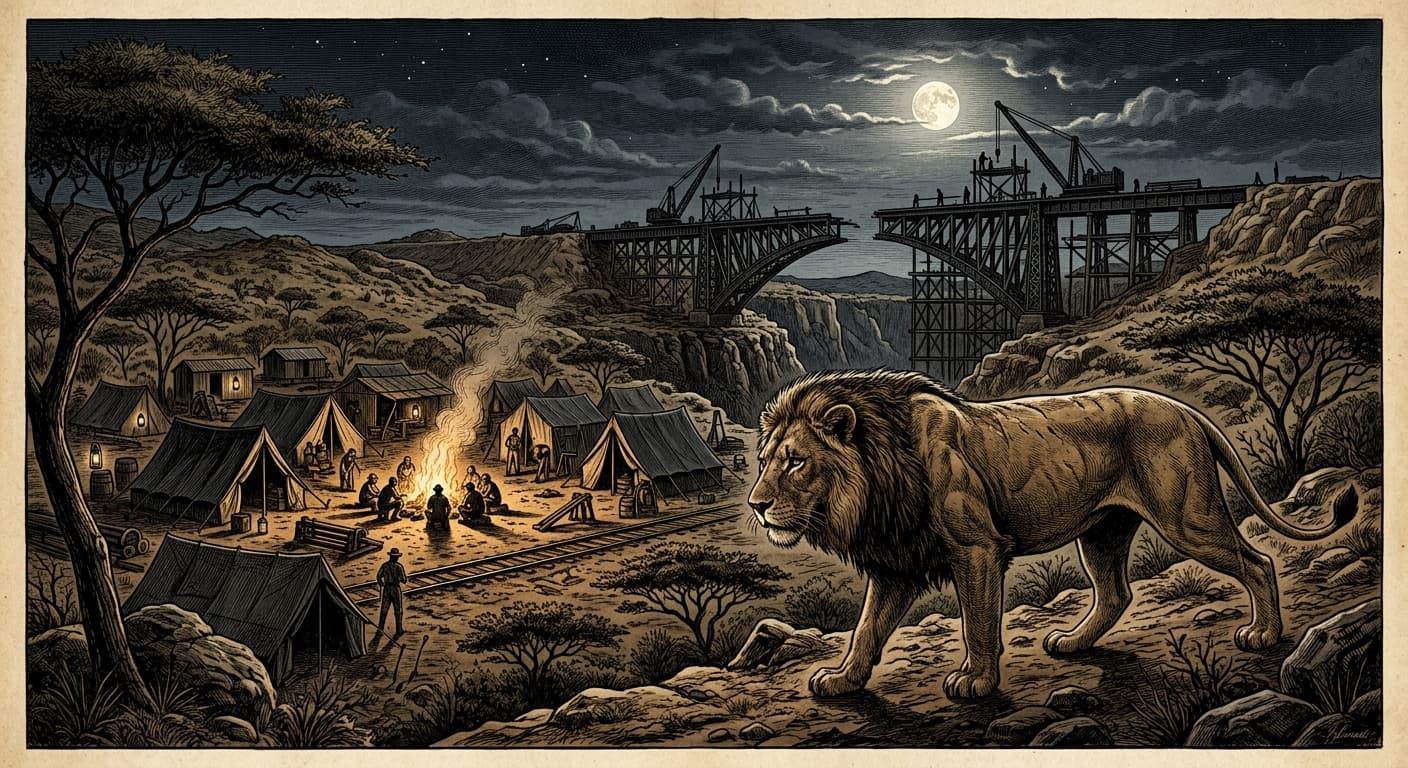
The Ghost and the Darkness: How Two Man-Eating Lions Brought the British Empire to a Standstill
In the closing years of the 19th century, the British Empire embarked on an engineering marvel so ambitious and perilous that it earned the nickname "The Lunatic Express." The goal was to build a railway stretching from the sun-baked coast of Mombasa, Kenya, into the deep interior of Uganda. It was a monumental display of imperial hubris, designed to cement British dominance in East Africa. But in 1898, this seemingly unstoppable industrial juggernaut was brought to a grinding, terrifying halt by an enemy no one anticipated: two extraordinarily large, maneless lions with an insatiable taste for human flesh.
The nightmare began in March 1898, when Lieutenant-Colonel John Henry Patterson, a British civil engineer, arrived at the Tsavo River. His mission was to oversee the construction of a critical railway bridge. The workforce consisted of thousands of Indian laborers, or "coolies," alongside local African workers. For the first few days, progress was steady. But soon, whispers of a dark presence began to ripple through the sprawling camps. The region of Tsavo, whose name local legends claimed meant "place of slaughter," was about to live up to its ominous reputation.
The attacks started quietly. A worker would vanish in the dead of night, leaving behind nothing but a torn tent flap and a gruesome trail of blood leading into the impenetrable thorn scrub. Initially, Patterson believed the disappearances were the work of crocodiles or perhaps foul play among the men. But as the frequency of the abductions escalated, the chilling truth became undeniable. Two colossal lions were stalking the camp. Unlike typical lions, these beasts were maneless, a common trait among the Tsavo breed, giving them a sleek, serpentine, and unusually terrifying appearance.
What made these lions so horrifying was their unprecedented behavior. They were not desperate, solitary man-eaters acting out of starvation. They were a coordinated duo, working together to systematically hunt the largest prey available: humans. They showed a chilling disregard for fire, loud noises, and the impenetrable walls of thorny acacia branches, known as bomas, that the workers built to protect their camps. The lions would casually leap over or crawl through the deadly thorns, snatch a screaming man from his bed, and drag him into the night, often devouring him within earshot of his terrified companions.
By late fall, the camp had descended into absolute panic. The relentless, systematic nature of the slaughter convinced the workers that the lions were not animals at all, but rather angry spirits or demons sent to punish them for scarring the earth with the railway. Hundreds of workers fled on the very trains that had brought them, flatly refusing to return. The mighty British Empire’s prized infrastructure project completely stalled. For nearly a month, the bridge at Tsavo stood silent, abandoned to the wilderness and its two monstrous overlords.
Faced with a mutiny and the collapse of his project, Lieutenant-Colonel Patterson realized that construction could only resume if he personally eliminated the threat. Thus began a grueling, psychological war between man and beast. Patterson spent countless sleepless nights perched precariously in trees or hiding inside baited box traps, enduring the biting cold and mosquito swarms. The lions proved remarkably cunning, repeatedly outsmarting Patterson, avoiding his traps, and striking exactly where he wasn't.
The breakthrough finally came in December 1898. On the night of December 9, after months of terror and near-misses, Patterson managed to shoot and fatally wound the first lion as it stalked him near a bait animal. The beast was absolutely massive, requiring eight men to carry its carcass back to the camp. Three weeks later, after another harrowing night of being hunted by the surviving lion, Patterson fired a volley of shots that finally brought down the second creature. The reign of terror, which had claimed the lives of an estimated 35 to 135 men, was over.
With the man-eaters dead, the workers slowly returned, and the Tsavo bridge was successfully completed in 1899. Patterson later published a thrilling account of the ordeal, The Man-Eaters of Tsavo, which captivated readers worldwide and secured the lions’ place in history. Today, the preserved skins and skulls of the Tsavo lions are on permanent display at the Field Museum of Natural History in Chicago. Modern scientific analysis of their remains has revealed severe dental disease in one of the lions, which likely hindered its ability to hunt traditional prey and pushed it toward slower, softer targets: humans. Yet, for those who lived through the nightmare of 1898, the lions were forever remembered as something far more sinister—the undeniable ghosts and darkness of the African bush.