The Tsar Who Dodged Six Assassinations: The Bloody Cat-and-Mouse Game of Alexander II
Imagine surviving an assassin's bullet, a targeted train bombing, and an explosion in your own dining room, only to be undone by a stroll in the snow. This was the dark, dramatic reality of Tsar Alexander II, a ruler who liberated millions yet became the most hunted man in 19th-century Europe. The decades-long pursuit of the Russian Emperor by his own subjects remains one of the most intense cat-and-mouse games in modern history.
Alexander II ascended the Russian throne in 1855, inheriting an empire humiliated by the Crimean War and anchored in the feudal past. Recognizing that his nation would collapse without modernization, he did the unthinkable: in 1861, he abolished serfdom, emancipating 23 million people with the stroke of a pen. But sweeping reform is a dangerous game. For conservative nobles, the "Liberator Tsar" had gone far too far. For radical students and anarchists, he hadn't gone nearly far enough. Thus began the era of Narodnaya Volya, or "The People's Will," a pioneering terrorist organization whose sole, obsessive objective became the destruction of the Tsar.
The deadly game began long before The People's Will formally organized. In 1866, a radical student fired at the Tsar but missed when a peasant bumped his elbow. The following year, a Polish nationalist took a shot in Paris, only to have his gun inexplicably misfire. By 1879, the attempts grew increasingly theatrical and desperate. A former student named Alexander Soloviev ambushed the Tsar during a morning walk. In a scene bordering on the absurd, the autocratic Emperor of All Russia was forced to zig-zag across Palace Square, dodging five consecutive pistol shots like a seasoned acrobat.
Frustrated by their lack of success, The People's Will turned to a new, devastating weapon: dynamite. In late 1879, the conspirators meticulously tunneled under a railway track to derail the imperial train returning from Crimea. The trap was perfectly laid, but poor intelligence led them to blow up a baggage locomotive while the Tsar slept soundly in a different carriage entirely.
Their most audacious plot unfolded in February 1880. A member of The People's Will, working as a carpenter in the Winter Palace, managed to smuggle small amounts of dynamite into the royal residence day by day, hiding it beneath his bedding. He placed the massive charge two floors directly below the Tsar's private dining room. The bomb detonated with devastating force, obliterating the guardroom and killing eleven people. However, fate once again intervened: the Tsar's dinner guest was running late, keeping Alexander out of the dining room at the crucial moment.
By early 1881, the Tsar was living on borrowed time. Recognizing the need to pacify the simmering nation, he agreed to sign the Loris-Melikov constitution, a historic document that would have established Russia's first rudimentary parliament. He signed the proclamation on the morning of March 13, 1881, hoping it would chart a new, peaceful course for his volatile empire.
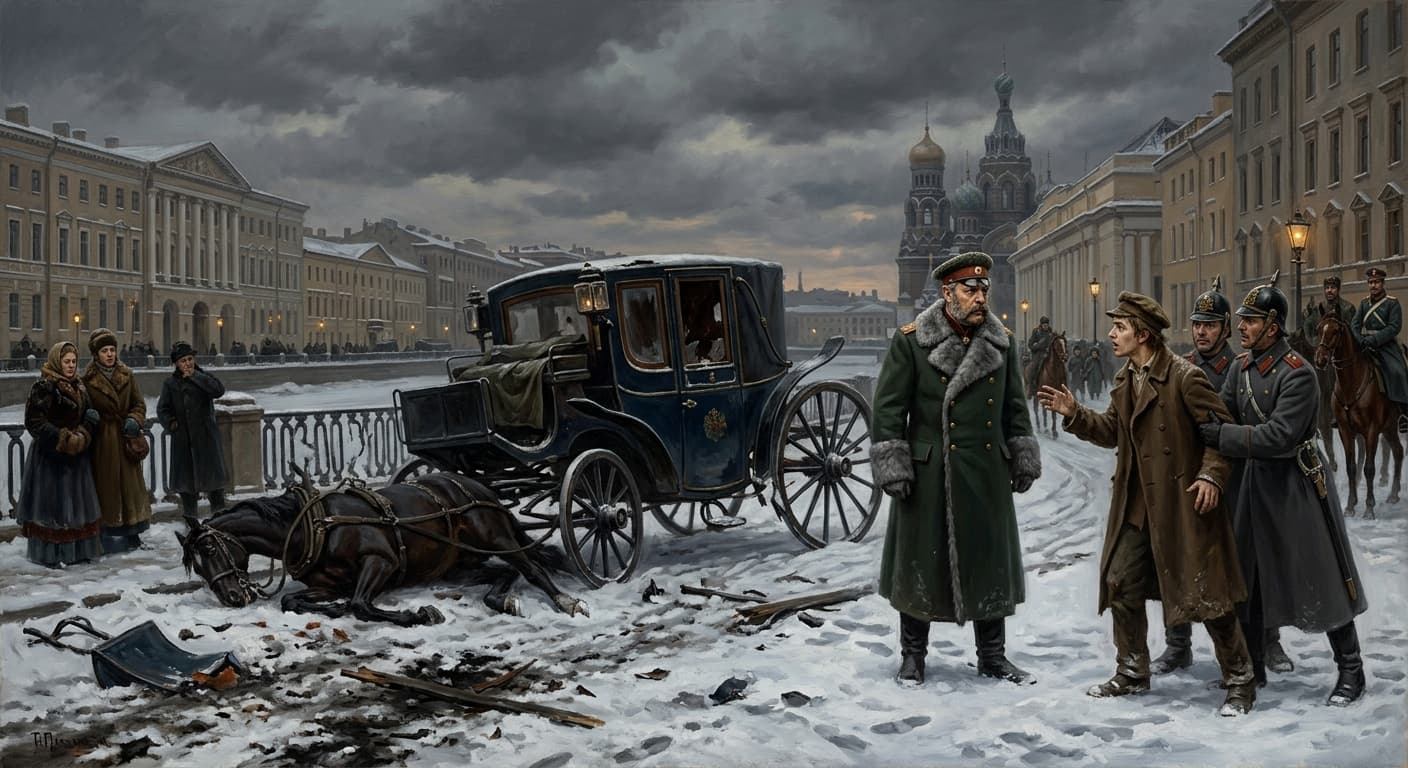
That afternoon, the Tsar traveled through St. Petersburg in a closed, bulletproof carriage gifted to him years earlier by Napoleon III. The People's Will had laid a multi-layered trap along his route. As the carriage rolled alongside the frozen Catherine Canal, a young revolutionary named Nikolai Rysakov threw a bomb beneath the horses. The massive explosion shattered the carriage, killed one of the Tsar's Cossack guards, and wounded several bystanders.
True to his nature, the Tsar was miraculously unhurt. Despite the frantic pleas of his surviving guards to flee the scene immediately, Alexander stepped out of the splintered carriage to survey the damage, comfort the wounded, and confront his captured attacker. Looking at the carnage, the Tsar crossed himself and declared to his guards, "Thank God, I am untouched."
But the assassins had planned for this exact scenario. Leaning against the canal railing was a second bomber, Ignacy Hryniewiecki. As the Tsar walked past, Hryniewiecki raised both arms and threw a second bomb directly between the Emperor's feet, allegedly shouting, "It is too early to thank God!" The resulting explosion was deafening. When the smoke cleared, both the assassin and the Emperor lay mortally wounded in the blood-stained snow.
Alexander II's legs were shattered, and he was rushed back to the Winter Palace, where he bled to death hours later. The irony of the assassination was profound and tragic. By murdering the most progressive Tsar in Russian history, The People's Will did not ignite the democratic revolution they desired. Instead, Alexander's son, Alexander III, immediately tore up his father's constitution, instituted a brutal police state, and crushed all dissent. The bombs that killed the Liberator Tsar effectively doomed the Romanov dynasty, setting Russia on a dark and inescapable collision course with the cataclysm of 1917.