The Theatre of Death: When the Paris Morgue Was the Hottest Show in Town
In any guide to Paris written today, you will find the Eiffel Tower, the Louvre, and Notre-Dame Cathedral listed as must-see destinations. However, if you were a tourist in the late 19th century, your itinerary would likely have included a far more macabre attraction, one that rivaled the great monuments in popularity and exceeded them in shock value: the Paris Morgue.
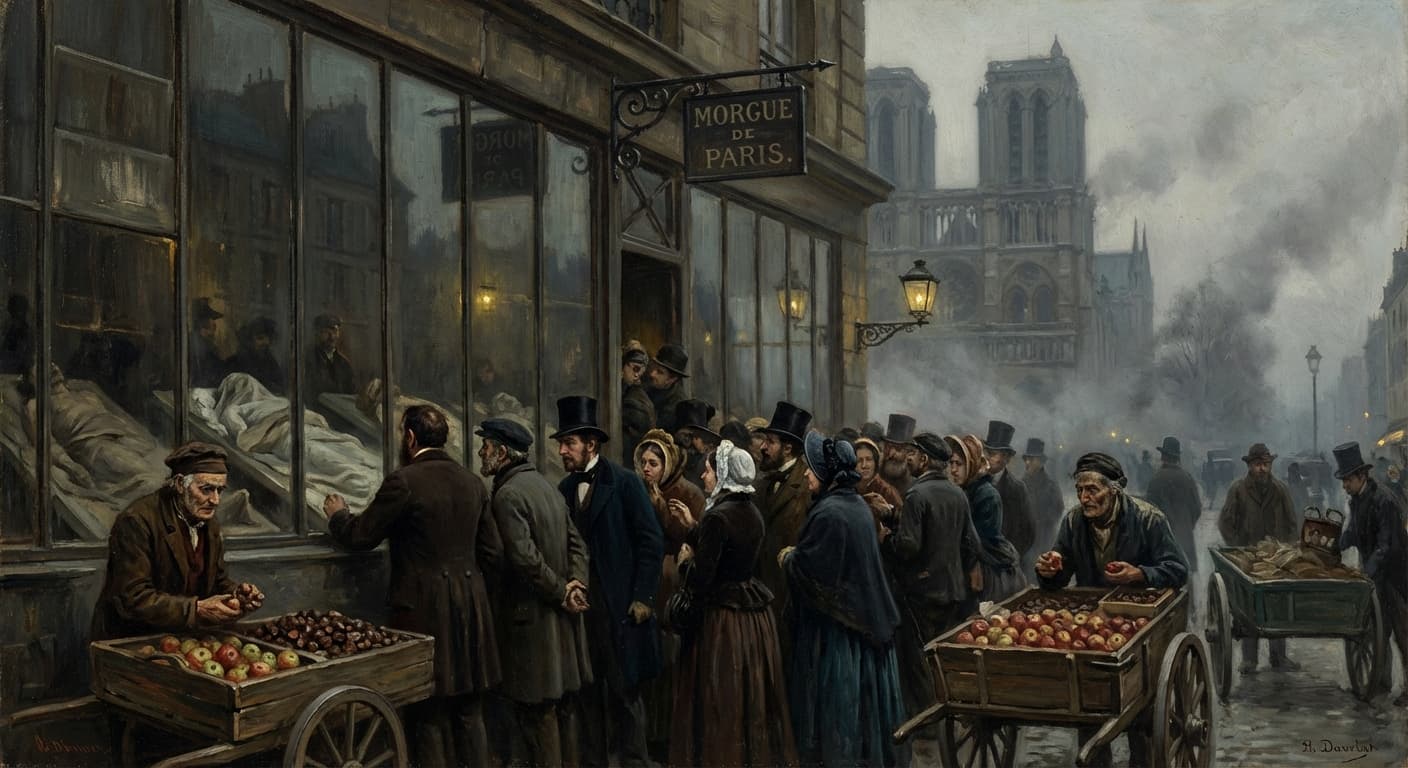
Located on the Île de la Cité, just a stone's throw from the spiritual sanctuary of Notre-Dame, the Morgue was a squat, nondescript building that housed a bizarre intersection of civic duty and grotesque entertainment. Originally, the purpose of the facility was purely practical. In an era before DNA testing or fingerprint databases, the police needed the public’s help to identify the anonymous dead found in the streets or pulled from the Seine. To facilitate this, the bodies were displayed behind large glass windows in a chilled room known as the salle d'exposition. The authorities hoped that a passing relative or neighbor might recognize a face and provide a name.
What the authorities created, however, was not just an identification center, but the first reality television show. The Morgue became a spectacle, a theater of the real where the drama was life and death itself. It was open seven days a week from dawn until dusk, and admission was entirely free. This accessibility made it the most democratic pastime in Paris. On any given afternoon, the crowd pressing their noses against the glass partition included aristocrats in silk, laborers in dust-covered tunics, thrill-seeking tourists, and even families with children. It was estimated that up to 40,000 people would visit on a busy day, particularly when a notorious crime had been committed.
The atmosphere outside the building was akin to a carnival. Street vendors set up stalls along the quay, selling apples, gingerbread, and "Coco" (a licorice drink) to the queuing masses. Because the wait to get inside could last for hours, the street economy thrived on the morbid curiosity of the populace. Inside, the mood was a strange mix of hushed horror and critical review. The bodies were laid out on slanted marble slabs, often dressed in the clothes in which they were found, with their possessions hung above them on pegs. A continuous stream of water trickled over the slabs to slow decomposition, adding a shimmering, surreal quality to the grisly display.
The Morgue even had its own "stars." The press, rapidly expanding in the 19th century, fueled the frenzy by publishing sensationalized stories about the bodies on display. When a particularly mysterious or gruesome corpse arrived—such as the "Woman Cut in Two" in 1876—the crowds would swell to riotous proportions, blocking traffic on the bridges. The most enduring legend to emerge from the glass windows was that of L'Inconnue de la Seine (The Unknown Woman of the Seine). Her peaceful, enigmatic smile in death captivated the artistic community; casts of her face became a fashionable wall decoration in bohemian homes across Europe, eventually serving as the model for the face of the first CPR doll, "Resusci Anne."
Critics of the era debated the morality of the institution. Was it a necessary evil for solving crimes, or was it degrading the moral fabric of the city? The flâneur—the observant stroller of city streets—found in the Morgue a perfect microcosm of modern urban life: anonymous, tragic, and spectacularly visible. It was a place where the barriers between the private tragedy of death and the public sphere completely collapsed.
As the 19th century gave way to the 20th, sensibilities began to shift. The spectacle of death came to be viewed as vulgar rather than educational. Public pressure and evolving ideas about hygiene and privacy eventually forced the authorities to hang curtains over the windows. In March 1907, the doors were finally closed to the general public, transforming the Morgue back into a purely administrative facility. For decades, however, the Paris Morgue had stood as a chilling testament to the Victorian era's complex, obsessive, and often voyeuristic relationship with death.