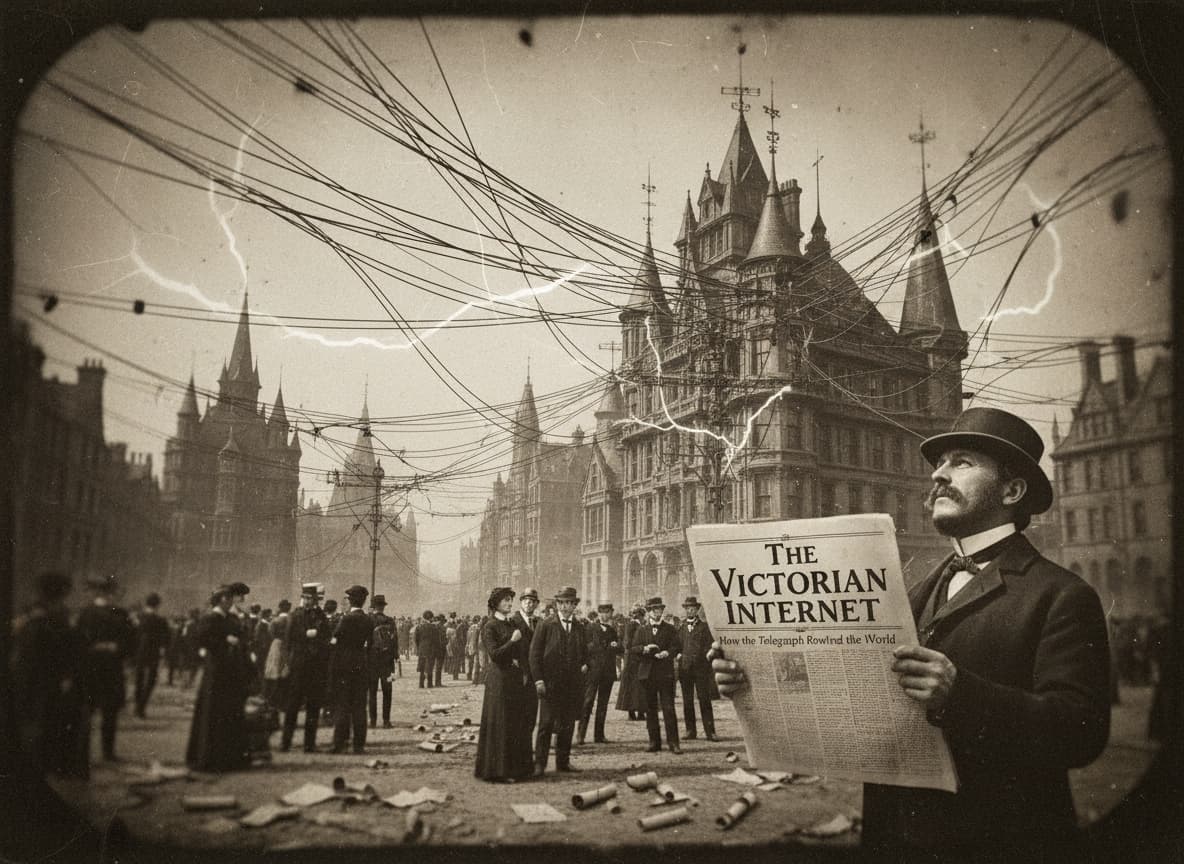
The Victorian Internet: How the Telegraph Rewired the World
Imagine a world where news travels only as fast as a horse can gallop or a ship can sail. A world where a message from London to New York took weeks, sometimes months. This wasn't some distant past; it was the everyday reality for millennia, right up until the mid-19th century. Then, something utterly revolutionary emerged from the burgeoning age of electricity: the electric telegraph. It wasn't just an invention; it was a seismic shift, earning it the moniker 'the Victorian Internet,' and it permanently shrank our planet.
Before dots and dashes zipped through copper wires, human communication across vast distances was an exercise in patience and often, peril. Empires rose and fell, wars were waged, and fortunes were made or lost, all while messages lumbered along. A merchant in Liverpool wouldn't know the price of cotton in Calcutta for weeks. A general couldn't coordinate forces miles away without dispatch riders. This fundamental slowness placed severe limitations on everything from commerce to governance, stifling efficiency and often leading to missed opportunities or catastrophic delays.
While many brilliant minds contributed to the foundational understanding of electricity and its potential, it was Samuel F.B. Morse, an American painter and inventor, who, along with Alfred Vail, really brought the electric telegraph to practical life. After years of dedicated experimentation and numerous challenges, they publicly demonstrated their system in 1837. But it was the famous message, 'What Hath God Wrought?', transmitted between Washington D.C. and Baltimore in 1844, that truly launched the era of instantaneous communication into the public consciousness. The secret weapon? Morse code – an elegant, efficient system of dots and dashes representing letters and numbers, allowing complex messages to be conveyed with remarkable simplicity over electrical pulses.
The impact on business was immediate and staggering. Stock markets, once bound by the speed of physical messengers, began to react almost in real-time to events happening thousands of miles away. Commodity prices could be checked across continents within hours, enabling new forms of arbitrage and truly global trade. Banks could verify transactions, and companies could manage far-flung operations with unprecedented efficiency. The telegraph was, quite literally, the nervous system of industrial capitalism, accelerating economic development and integrating markets like never before. It made the world a smaller, more interconnected marketplace, driving prosperity and competition.
For journalism, the telegraph was nothing short of a revelation. Before, news was often stale by the time it arrived at readers' doorsteps. Now, reports from battlefields, political capitals, and disaster zones could be dispatched within minutes of an event. This led to the creation of powerful wire services like the Associated Press and Reuters, which aggregated news from around the globe and distributed it to newspapers, transforming how information was gathered, processed, and consumed. The public became more informed and engaged with current events, and the very concept of 'breaking news' was born.
Governments and militaries quickly recognized the immense strategic advantage the telegraph offered. Commanders could receive vital intelligence and issue precise orders across vast distances in real-time, greatly improving coordination and responsiveness in warfare. Diplomats could communicate instantly with their home offices, enabling quicker responses to international crises and influencing global relations with unprecedented speed. The velocity of information became a critical component of national power and statecraft.
The dream of connecting continents via telegraph, however, was an audacious one. Imagine laying thousands of miles of insulated copper cable across the crushing depths of the Atlantic Ocean! Early attempts were fraught with epic failures, with cables breaking during deployment or failing soon after they were laid. But led by determined visionaries like Cyrus West Field, and utilizing colossal steamships like the SS Great Eastern – then the largest ship in the world – the monumental task was finally achieved in 1866. This triumph of Victorian engineering was a testament to human ingenuity, perseverance, and the boundless ambition of the era, effectively connecting the Old World and the New in an instant.
From its humble beginnings, the telegraph evolved into a vast global network, crisscrossing landmasses and spanning oceans. It was the undisputed backbone of communication for decades until the telephone and then radio began to supersede it in certain applications. Yet, its legacy is undeniable. The telegraph laid the conceptual and infrastructural groundwork for every subsequent communication revolution, from the telephone to the internet. It introduced us to the idea of instant global connectivity, fundamentally altering our perception of distance and time.
So, the next time you send an instant message or browse the web, spare a thought for those flickering dots and dashes, for the dedicated engineers, and for the visionaries of the 19th century. They didn't just invent a machine; they invented a new way for humanity to interact, effectively shrinking the world and kickstarting the age of information we inhabit today. The 'Victorian Internet' truly rewired the world in ways that continue to echo.