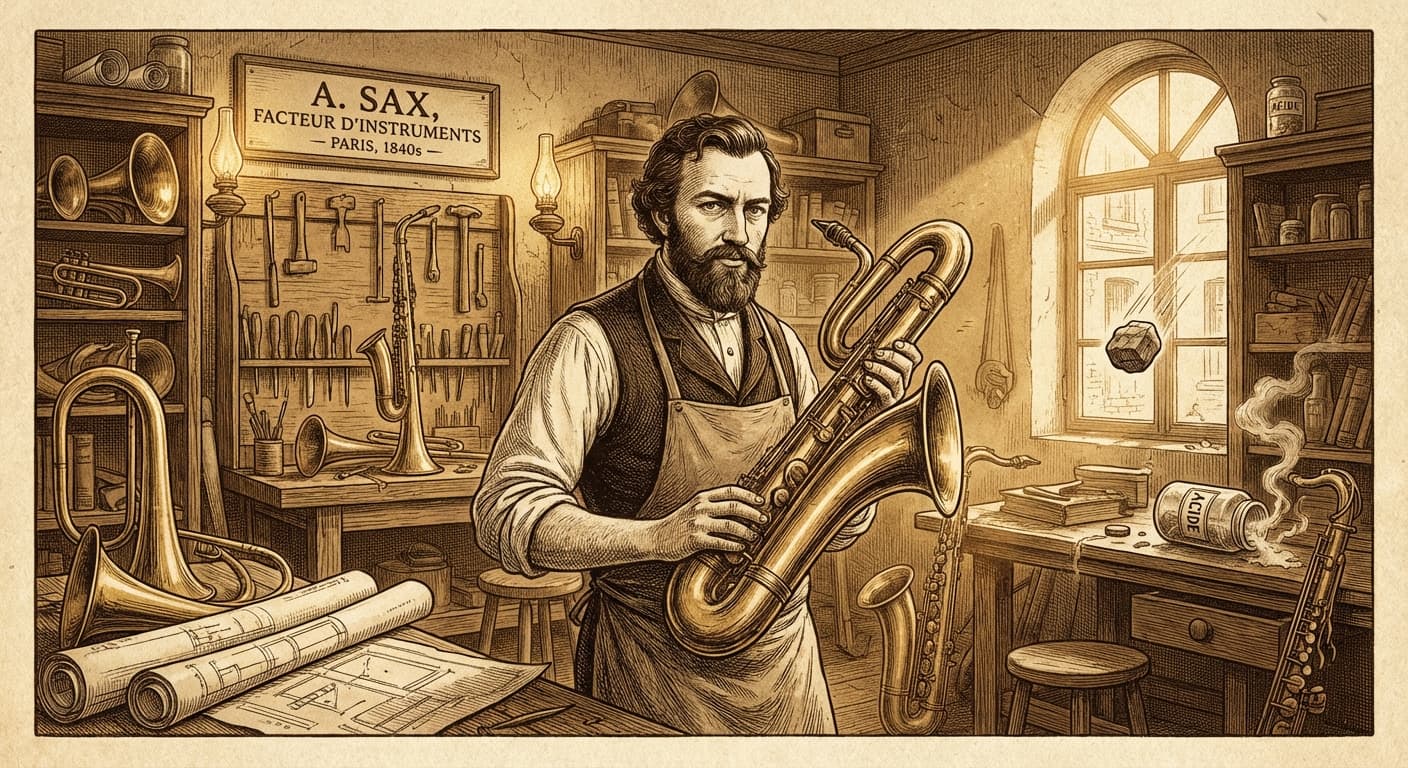
The Unkillable Adolphe Sax: The Chaotic Life Behind the Smooth Sound
When we think of the saxophone today, our minds often drift to smoky jazz clubs, the smooth melodies of John Coltrane, or perhaps the energetic solos of 1980s pop ballads. The instrument represents cool, sophisticated expression. However, the origin story of this brass-woodwind hybrid is far from smooth. In fact, it is a miracle that the instrument exists at all, primarily because it is a miracle that its inventor, Adolphe Sax, survived long enough to build it. The life of the 19th-century Belgian inventor was a slapstick comedy of errors, a series of narrow escapes from death, and a battle against a musical establishment that seemingly wanted him dead.
Born Antoine-Joseph Sax in Dinant, Belgium, in 1814, the man later known as Adolphe seemed destined for an early grave. His childhood reads like a list of cautionary tales for negligent babysitters. Before he reached adulthood, Sax had fallen from a third-story window (striking his head on a stone), swallowed a bowl of vitriolized water (sulfuric acid) thinking it was milk, swallowed a pin, been burned severely by a gunpowder explosion, fallen onto a hot cast-iron frying pan, and nearly drowned in a river. As if the universe were testing his durability, he was also poisoned by varnish fumes in his father's workshop and hit in the head by a falling cobblestone. His own mother once lamented, "Adolphe is a child condemned to misfortune; he won't live." Yet, live he did, displaying a resilience that would define his professional career.
Sax was the son of an instrument maker, and he inherited his father's talent for tinkering. By the early 19th century, orchestras were distinctly divided. You had the woodwinds, which were agile and vocal but lacked power, and the brass, which were powerful but crude and inflexible. Sax envisioned a missing link—an instrument with the vocal projection of the woodwinds and the powerful resonance of the brass. In the early 1840s, working in Paris, he unveiled his creation: the saxophone. It was a brass body played with a single-reed mouthpiece. The sound was revolutionary, described by his supporter Hector Berlioz as possessing "passionate accents" and a "vague sadness."
Unfortunately, the musical community of Paris was less enthusiastic than Berlioz. Rival instrument makers, threatened by Sax's genius and his potential monopoly on military band contracts, launched a vicious campaign against him. This wasn't just a matter of bad reviews; it was industrial sabotage. His workshop was set on fire. An assassin attempted to kill him. His workers were bribed or intimidated into quitting. When he secured a patent for the saxophone in 1846, his rivals sued him repeatedly, draining his finances in endless court battles. At one point, a rival even challenged him to a musical duel in the Champ de Mars, pitting a traditional military band against a band using Sax's instruments. Sax won the crowd, but the legal harassment never ceased.
Despite the hostility, Sax persisted. He secured a position teaching at the Paris Conservatoire and saw his instruments adopted by French military bands, which gave the saxophone its first true foothold. However, the relentless litigation drove him into bankruptcy not once, but twice—first in 1852 and again in 1877. He spent his final years in destitute conditions, surviving on a small pension arranged by another supporter, Emperor Napoleon III.
Adolphe Sax died in 1894, having spent a lifetime cheating death and fighting for recognition. He never lived to see his invention become the defining voice of Jazz in the 20th century. He never heard Charlie Parker or Coleman Hawkins. Yet, every time a saxophonist takes a breath to play a soaring melody, they are channeling the spirit of the most resilient, unluckiest, and brilliant inventor of the 19th century. The next time you hear that smooth, golden sound, remember the explosions, the falls, and the lawsuits that failed to silence it.