The Underground Duke: How the 19th Century's Most Eccentric Aristocrat Built a Subterranean Empire
The Victorian era was a golden age for eccentricity, a time when immense wealth and strict social conventions occasionally combined to produce individuals of profound peculiarity. Yet, in the crowded pantheon of eccentric British aristocrats, few can hold a candle to William John Cavendish-Scott-Bentinck, the 5th Duke of Portland. Inheriting vast estates and an unimaginable fortune, the Duke chose not to conquer high society, but to completely disappear from it. He did so not by fleeing to a remote island, but by employing an army of workers to dig a massive, elaborate subterranean world beneath his ancestral estate in Nottinghamshire, Welbeck Abbey.
Born in 1800, the Duke ascended to his title in 1854. Almost immediately, he began to withdraw from the world. Afflicted by severe social anxiety, a rumored skin condition, or perhaps profound agoraphobia, he decided that the best way to avoid human contact was to build down. Over the next two decades, he initiated one of the most bizarre and ambitious private engineering projects of the 19th century, creating a labyrinth of over 15 miles of tunnels and underground rooms.
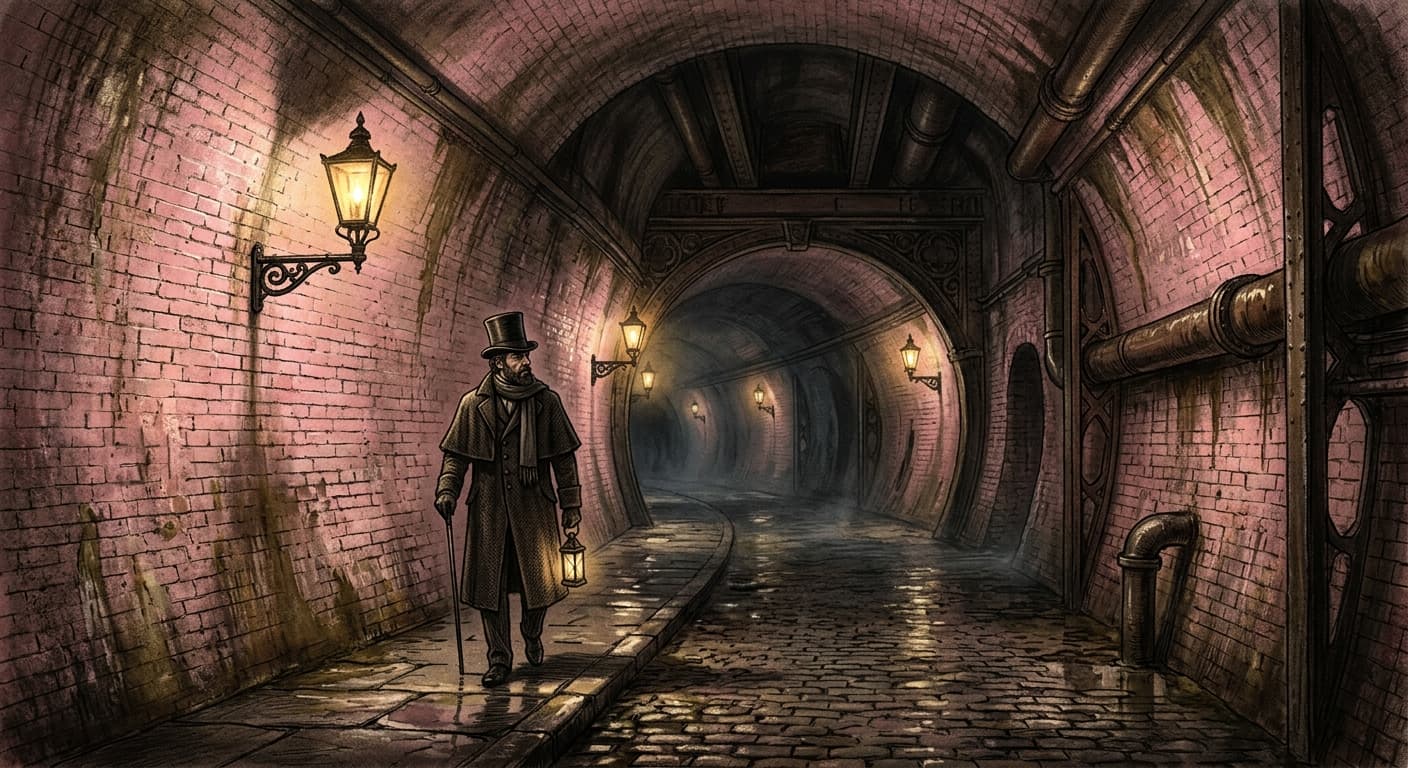
The sheer scale of the Duke’s subterranean complex was staggering. He commissioned a 1,000-foot-long underground ballroom, large enough to accommodate 2,000 guests, which he naturally never used for a single dance. The room was accessible via a hydraulic lift and illuminated by thousands of gaslights. He also built a massive subterranean library, a billiard room, and an observatory with a glass roof. To move about his estate without being seen, he constructed a carriage tunnel a mile and a quarter long. It was wide enough to fit two horse-drawn carriages side by side and was painted pale pink, lit by skylights by day and gas lamps by night.
The carriage tunnel led directly to the local railway station. When the Duke needed to travel to his London residence, he would board his carriage, the carriage would be driven through the tunnel, and then the entire vehicle would be loaded onto a specialized train car. Upon arriving in London, the carriage would be driven directly into the courtyard of his home, the doors closing behind it before he finally stepped out. Through this elaborate logistical dance, he could travel from Nottinghamshire to the heart of London without ever being seen by the public.
His desire for invisibility extended strictly to his own staff. He communicated with his servants exclusively through a double-doored letterbox installed in his bedroom door. Only his valet was permitted to enter his presence. When the Duke did occasionally venture above ground to inspect his vast estate, he wore three heavy coats—even in the heat of summer—a tremendously tall top hat, and an oversized umbrella to shield his face. He famously required his workers to sign contracts stipulating that they must never acknowledge him. If a worker made eye contact or tipped their hat to the Duke, they were fired on the spot.
Despite his total refusal to interact with his employees, the Duke of Portland was paradoxically known as an incredibly generous employer. He paid his workmen well above the standard wage, provided them with umbrellas to stay dry, and even bought donkeys for them to ride so they would not have to walk to the estate. He poured millions of pounds into the local economy through his endless construction projects, keeping thousands of men employed during harsh economic times. His peculiar diet, consisting almost entirely of roasted chicken, required a specialized kitchen from which a heated trolley ran on underground rails directly to his dining room.
The Duke died in 1879, leaving behind no heir and a labyrinth of silent, gas-lit tunnels. His bizarre legacy eventually sparked the famous "Druce-Portland Affair" at the turn of the century, a sprawling legal circus in which a widow claimed that her deceased father-in-law, a London upholsterer named Thomas Druce, was actually the Duke living a double life. The case was only put to rest when Druce's grave was exhumed, proving he was indeed buried there and not a fictional persona of the reclusive aristocrat.
Today, the story of the Underground Duke stands as a fascinating psychological mystery wrapped in Victorian engineering. It is a poignant, bizarre testament to how extreme wealth can isolate a person, enabling a man to build a literal underground fortress to protect himself from a world he could not bear to face.