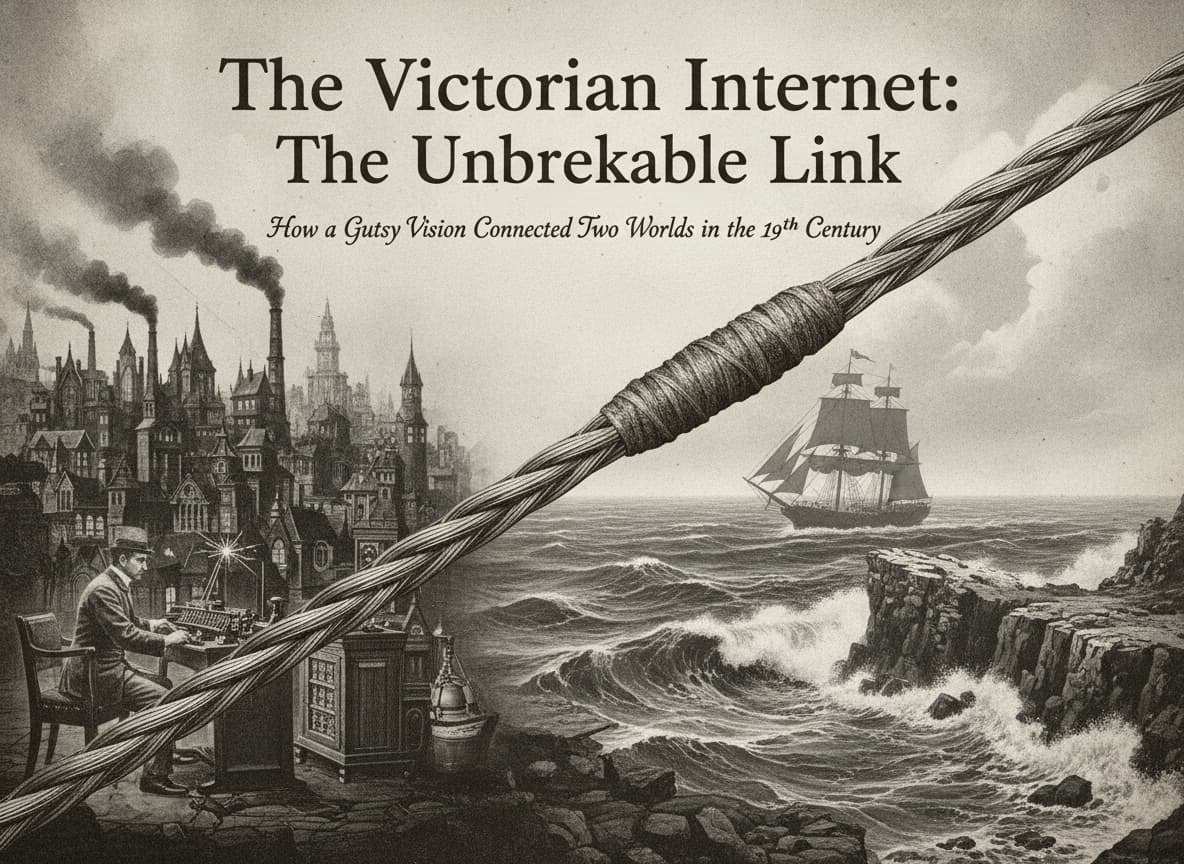
The Unbreakable Link: How a Gutsy Vision Connected Two Worlds in the 19th Century
Imagine a world where news from across the ocean took weeks, sometimes months, to arrive. A world where financial markets operated on delayed, speculative information, and diplomatic crises could escalate beyond repair simply due to the agonizing slowness of communication. This was the reality for most of the 19th century. Then, a seemingly impossible dream began to take shape: an instant, electric link between the Old World and the New. This is the story of the Transatlantic Telegraph Cable, a tale of audacious ambition, staggering engineering, heartbreaking failures, and ultimate triumph that literally shrank the globe.
At the heart of this monumental endeavor was Cyrus West Field, a New York businessman, not an engineer or a scientist, but a man possessed of an almost manic conviction. After successfully laying a telegraph cable connecting Newfoundland to the mainland North American system in 1856, Field's gaze turned eastward, across the vast, terrifying expanse of the Atlantic. The idea of an underwater cable stretching 2,000 miles from Ireland to Newfoundland was scoffed at by many as a lunatic fantasy. Yet, Field, armed with little more than an unshakeable belief and an uncanny ability to charm investors, formed the Atlantic Telegraph Company.
But dreaming big was one thing; achieving it was another. The engineering challenges were colossal. The proposed cable, a sophisticated bundle of copper wires insulated with gutta-percha and armored with iron strands, was itself an unprecedented feat of manufacturing. Then came the task of laying it across an ocean floor plunging to depths of over two miles, navigating treacherous currents, and enduring unpredictable weather. The technology for deep-sea cable laying was rudimentary, relying on trial-and-error and sheer grit.
Initial attempts were fraught with disaster. In 1857, two ships, HMS Agamemnon and USS Niagara, loaded with sections of the massive cable, set out to meet mid-ocean, splice their halves, and deploy. Only 300 miles into the journey, the cable snapped. Field and his team refused to be deterred. A second attempt in 1858 saw them try again, this time managing to lay the entire cable. On August 16, 1858, the impossible happened: Queen Victoria sent a telegraphic message to U.S. President James Buchanan. The 98-word message, wishing him success, took 16 hours to transmit, but it was there, across the ocean, in minutes rather than weeks. Celebrations erupted on both sides of the Atlantic.
Yet, the joy was tragically short-lived. Just three weeks after its monumental success, the signal from the cable faltered and died completely. A combination of excessive voltage used by overzealous operators and a manufacturing fault sealed its fate. Despair set in. Critics, who had only recently been silenced by the cable's brief triumph, gloated. Cyrus Field was ridiculed, his dream seemingly dead, his investors facing ruin, and his name synonymous with failure.
But Cyrus Field was not a man to be defeated. For the next six years, he campaigned tirelessly, crossing the Atlantic dozens of times, raising new capital, and battling skepticism. He learned from past mistakes, advocating for better cable design, improved insulation, and more robust laying techniques. Crucially, he secured the use of the SS Great Eastern, Isambard Kingdom Brunel's magnificent, colossal steamship. The Great Eastern, initially a commercial flop, found its true calling: its immense holds could carry the entire 2,300 miles of a new, thicker, stronger cable in one go, a capability no other ship possessed.
The 1865 expedition with the Great Eastern was agonizingly close to success. After laying 1,200 miles of cable, it too snapped and was lost in the abyss. For most, this would have been the final straw. But Field, despite being financially ruined and emotionally drained, managed to raise funds for one more attempt. In July 1866, the Great Eastern set sail again, this time with a perfectly manufactured cable and refined laying procedures. Against all odds, the cable was successfully laid, and a permanent, reliable connection was established.
In an incredible epilogue, the Great Eastern then returned to the site of the 1865 break, grappled for weeks, and eventually located, retrieved, and repaired the lost cable from the ocean floor. By September 1866, two fully operational transatlantic telegraph cables spanned the ocean. The impact was immediate and profound. News that once took weeks now arrived in minutes. Financial markets could react almost instantly, global trade accelerated, and diplomacy found a new, urgent tempo. It was the birth of truly global communication, shrinking the world and laying the groundwork for the interconnected planet we inhabit today.
The Transatlantic Telegraph Cable stands as a testament not just to technological ingenuity, but to sheer human perseverance. It’s a story of visionaries who refused to accept limits, engineers who pushed the boundaries of the possible, and investors who, despite repeated setbacks, kept faith in a dream. It reminds us that often, the greatest leaps forward are forged not in unbroken success, but in the crucible of repeated failure, ultimately creating an unbreakable link that changed the course of history forever.