The Thirty-Eight Minute War: When Britain and Zanzibar Broke the Speed Limit for Conflict
History is usually measured in eras, epochs, and years. The Hundred Years' War, despite its name, dragged on for over a century. The Napoleonic Wars consumed a generation. Even the relatively brief Spanish-American War lasted nearly four months. But on August 27, 1896, the British Empire and the Sultanate of Zanzibar engaged in a conflict so brief that if you had blinked—or perhaps taken a leisurely tea break—you might have missed the entire affair. This is the story of the Anglo-Zanzibar War, officially recorded as the shortest war in human history, clocking in at a staggering 38 to 45 minutes.
To understand how two nations could go from peace to war and back to peace in less than an hour, one must look at the geopolitical climate of the late 19th century. It was the height of the "Scramble for Africa," and the major European powers were carving up the continent with imperial abandon. Zanzibar, an island archipelago off the coast of East Africa, was a jewel in the Indian Ocean—a vital trade hub for spices, ivory, and slaves. By 1890, Britain and Germany had signed the Heligoland-Zanzibar Treaty, which effectively established Zanzibar as a British protectorate. The deal was simple: the Sultan could rule, provided his decisions aligned perfectly with British interests.
For several years, this arrangement worked. Hamad bin Thuwaini, a pro-British Sultan, sat on the throne and kept the colonial administrators happy. However, the delicate balance shattered on August 25, 1896, when Sultan Hamad died suddenly—and suspiciously. While the British grieved their puppet, Hamad’s nephew, Khalid bin Barghash, wasted no time. Within hours, Khalid moved into the ceremonial palace, seized command of the local guard, and declared himself the new Sultan.
There was just one problem: Khalid had not asked for British permission. Under the treaty, any succession required the approval of the British Consul. Khalid, a man of independent spirit who resented European interference, decided he didn't need a permission slip to rule his own country. The British diplomatic representative on the island, Basil Cave, disagreed profoundly.
Diplomacy happened fast. Basil Cave ordered Khalid to stand down and disband his troops. Khalid responded by barricading himself inside the palace with nearly 3,000 defenders—a mix of palace guards, civilians, and slaves—along with a modest artillery battery and the Sultan’s armed yacht, the HHS Glasgow, anchored in the harbor.
Cave, not a man to be trifled with, telegraphed London for authorization to use force. While waiting for a reply, he gathered a formidable naval task force that happened to be nearby. This included the cruisers HMS Philomel, HMS St George, and HMS Raccoon, along with gunboats HMS Thrush and HMS Sparrow. By the morning of August 27, the authorization arrived from Her Majesty's government: "Do whatever is necessary."
Cave issued a final ultimatum: lower the flag and leave the palace by 9:00 AM, or face the consequences. Khalid, seemingly convinced the British were bluffing, sent a messenger at 8:00 AM stating, "We have no intention of hauling down our flag and we do not believe you would open fire on us."
Cave’s reply was stiff-upper-lip politeness masking lethal intent: "We do not want to open fire, but unless you do as you are told, we shall certainly do so."
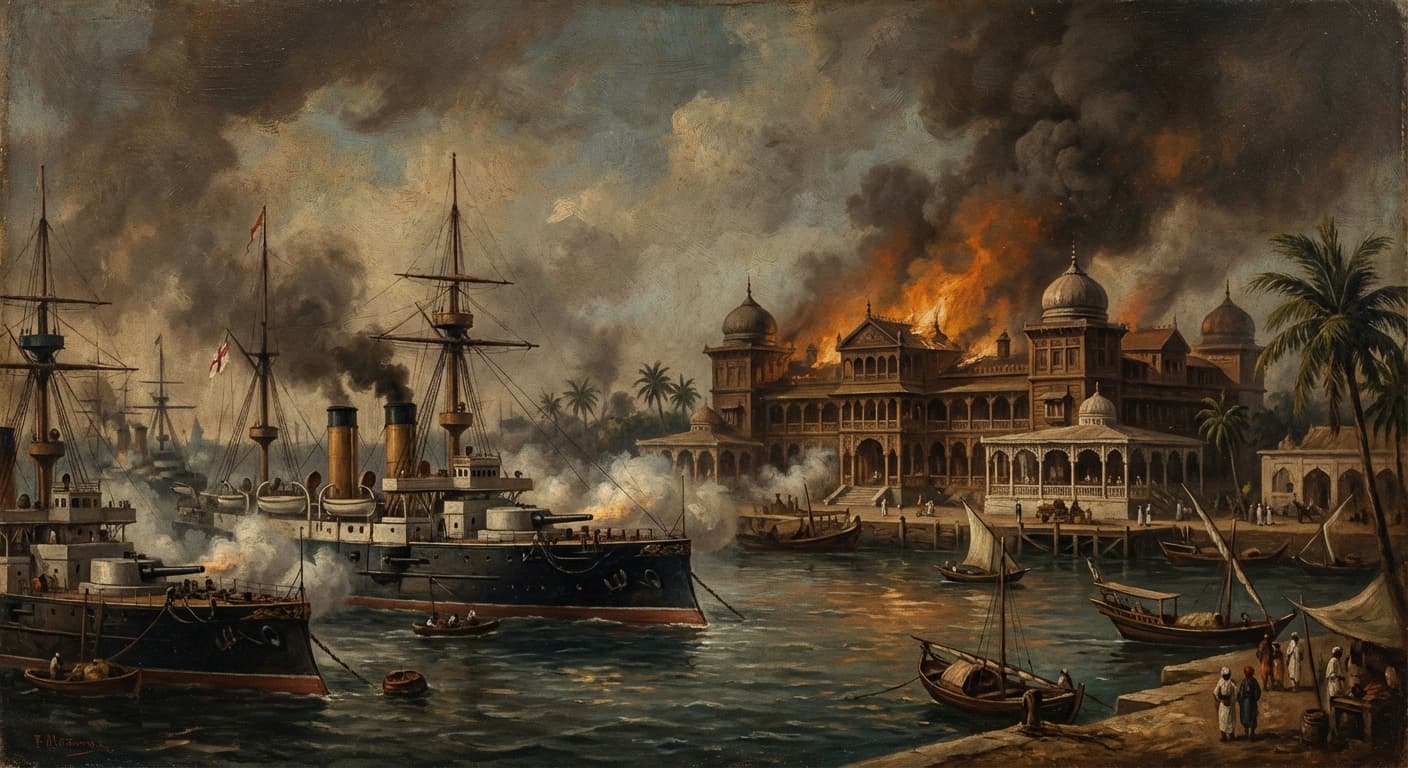
At 8:55 AM, the silence in the harbor was deafening. British sailors stood at their stations; the guns were trained on the wooden palace structure. At 9:00 AM sharp, the ultimatum expired. At 9:02 AM, the order was given.
The resulting bombardment was less of a battle and more of a demolition. The British warships unleashed a torrent of high-explosive shells. Within two minutes, the palace's artillery was silenced. The wooden structure began to collapse and catch fire, burying defenders under the rubble. In the harbor, the Sultan's yacht, the Glasgow, bravely fired its small guns at the massive British cruiser St George. The British returned fire, sinking the yacht almost immediately, its masts protruding from the shallow water for years afterward.
The carnage was horrific for the defenders. Roughly 500 of Khalid’s men and women were killed or wounded within minutes. On the British side, one sailor on the Thrush was slightly injured. It was a disparity of firepower that perfectly encapsulated the terrifying efficiency of industrial imperialism.
Sultan Khalid, realizing the magnitude of his miscalculation, managed to escape the burning palace through a back exit. He sought asylum at the German consulate, surviving to live in exile for decades. Back at the palace, the shelling ceased around 9:40 AM when the Sultan’s flag was finally shot down or lowered.
By early afternoon, the British had already installed a new, more obedient Sultan, Hamoud bin Mohammed, effectively ending the independence of the Zanzibar monarchy forever. In less time than it takes to watch a sitcom episode, a government had been toppled, a palace destroyed, and a fleet sunk. The Anglo-Zanzibar War remains a bizarre, tragic, and fascinating footnote in history—a stark reminder of the era of Gunboat Diplomacy, where the fate of nations could be decided between breakfast and brunch.