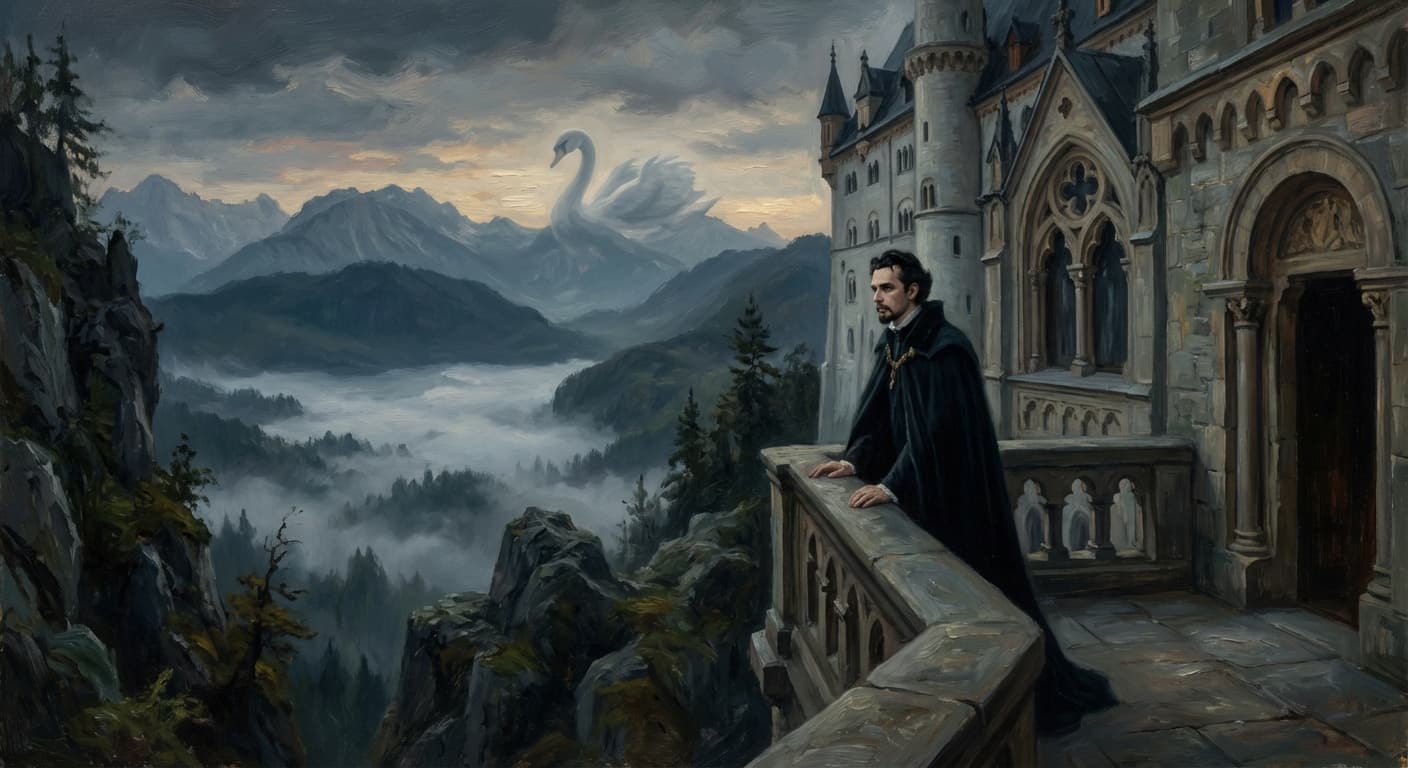
The Swan King’s Last Aria: The Madness and Mystery of Ludwig II
In the latter half of the 19th century, while the rest of Europe was busy industrializing, forging steel, and drawing borders with blood and gunpowder, one monarch decided to simply opt out of reality. He was King Ludwig II of Bavaria, a man who found the drudgery of ruling a kingdom utterly tedious compared to the mythical worlds of knights, dragons, and swans. Known to history as the "Swan King" or the "Fairy Tale King," Ludwig’s reign was a bizarre, tragic, and architecturally magnificent rebellion against the modern world.
The Reluctant Monarch
Ludwig ascended to the Bavarian throne in 1864 at the tender age of 18. Tall, dashing, and visibly uncomfortable in military uniform, he was the heartthrob of Europe’s royal courts. However, the young king possessed a soul ill-equipped for the jagged edges of 19th-century Realpolitik. While Prussia was maneuvering to unify Germany under the iron fist of Bismarck, Ludwig was busy retreating into his imagination. He detested public functions, hated the noise of Munich, and preferred the solitude of the Alps.
His first major act as king was not a military decree or an economic reform, but a fan letter. Ludwig was obsessed with the composer Richard Wagner, whose operas dramatized the Germanic legends Ludwig adored. Upon becoming king, Ludwig summoned the debt-ridden, controversial composer to court and paid off his creditors. Without Ludwig’s patronage, masterpieces like Tristan und Isolde and the Ring Cycle might never have been completed. For Ludwig, Wagner’s music was not just entertainment; it was the soundtrack to the alternate reality he was trying to build.
A Kingdom of Stone and Dreams
As Prussia swallowed Bavaria’s sovereignty following the Austro-Prussian War and the subsequent Franco-Prussian War, Ludwig withdrew further. Stripped of real political power, he decided to create a dominion where his word was still absolute: a world of architecture. He embarked on a building spree that would eventually empty the royal coffers and alarm his ministers.
His projects were staggering in their ambition and detachment from the times. There was Linderhof Palace, a jewel-box tribute to the absolutism of the French Sun King, Louis XIV. There was Herrenchiemsee, a replica of Versailles built on an island, meant to outshine the original. But the crown jewel was Neuschwanstein. Perched on a rugged cliff in the Bavarian Alps, it was a literal realization of a medieval fantasy—a castle designed not for defense, but for theatrical effect. It was filled with murals of Wagnerian legends, artificial caves, and a throne room that lacked a throne, as Ludwig died before it could be installed. It is the very structure that would later inspire Walt Disney’s Sleeping Beauty castle, a testament to Ludwig’s enduring vision.
The Diagnosis of Doom
By 1885, Ludwig was millions of marks in debt. He wasn't spending state funds—he was borrowing against his own royal allowance—but his refusal to stop building led his ministers to take drastic action. They decided to depose him. To do so constitutionally, they needed to prove he was insane.
A panel of psychiatrists, led by Dr. Bernhard von Gudden, drafted a medical report declaring Ludwig paranoid and mentally unfit to rule. The diagnosis was a farce; none of the doctors had examined him personally. They relied on gossip from servants who claimed the king bowed to statues, dined with imaginary ghosts, and took sleigh rides in the middle of the night dressed in medieval costume. While eccentric, modern historians argue Ludwig was likely not "mad" in the clinical sense, but merely a deeply introverted homosexual man living in a fantasy world to escape a reality he couldn't control.
The Mystery at Lake Starnberg
On June 12, 1886, a government commission seized Ludwig at Neuschwanstein and transported him to Berg Castle on the shores of Lake Starnberg. The following day, June 13, remains one of history’s great unsolved mysteries. That evening, Ludwig went for a walk along the lakeshore with Dr. von Gudden. The doctor, confident in his authority, dismissed the guards.
They never returned. Hours later, their bodies were found floating in shallow water. Ludwig’s death was officially ruled a suicide by drowning, yet the autopsy found no water in his lungs. Furthermore, Dr. von Gudden’s body showed signs of a struggle and a blow to the head. Did Ludwig murder the doctor and then try to escape, only to die of a heart attack? Was he shot by assassins lurking in the bushes, as some claimed to have seen? Or was it a desperate suicide pact?
The truth died in the water that night. In a final twist of irony, the castles that bankrupted Ludwig and were cited as proof of his madness are now the most profitable tourist attractions in Germany, paying for themselves a million times over. The Swan King may have lost his throne, but he left behind a legacy of stone that has long outlasted the empires that tried to crush his dreams.