The Stolen Stone: How a Missing Rock and a Secret Society Stalled the Washington Monument
If you visit Washington, D.C. today and cast your gaze up the staggering 555-foot height of the Washington Monument, you will notice an architectural quirk. About a third of the way up—precisely at the 152-foot mark—the shade of the marble distinctly changes color, shifting from a lighter stone at the bottom to a slightly darker hue at the top. This striking visual transition is not a deliberate design choice, nor is it a mere trick of the light. It is the visible scar of a 22-year halt in construction, triggered by anti-immigrant paranoia, a bizarre political coup, and the midnight theft of a single, highly controversial rock.
The story begins in 1848, when the Washington National Monument Society, a private organization, finally began construction on a grand obelisk dedicated to America's first president. The society had a grand vision but suffered from a chronic lack of funding. To keep construction moving and to foster a sense of national unity, the society devised a clever crowdfunding scheme: they invited states, territories, municipalities, and even foreign nations to donate commemorative stones. These blocks would be incorporated into the interior walls of the monument, allowing donors to physically cement their legacy within the structure.
Stones poured in from all over the world. There were blocks from the ruins of Carthage, stones from Swiss cantons, and a piece of native copper from Michigan. But in 1854, a particular donation arrived that sent shockwaves through the more radical political factions of the United States. Pope Pius IX donated a beautiful, three-foot block of marble sourced from the ancient Roman Temple of Concord. For the Pope, it was a gesture of international goodwill. For a growing American political faction known as the "Know-Nothings," it was nothing short of a declaration of war.
The 1850s saw a massive influx of Catholic immigrants to the United States, primarily from Ireland and Germany. In response, the Native American Party—popularly called the "Know-Nothings" because members were sworn to reply "I know nothing" when asked about their secret activities—rose to prominence. They were fiercely anti-immigrant and anti-Catholic, peddling conspiracy theories that the Pope was actively plotting to overthrow the American republic. To the Know-Nothings, the Pope's stone was not a gift; it was a papist plot to defile the great monument to George Washington.
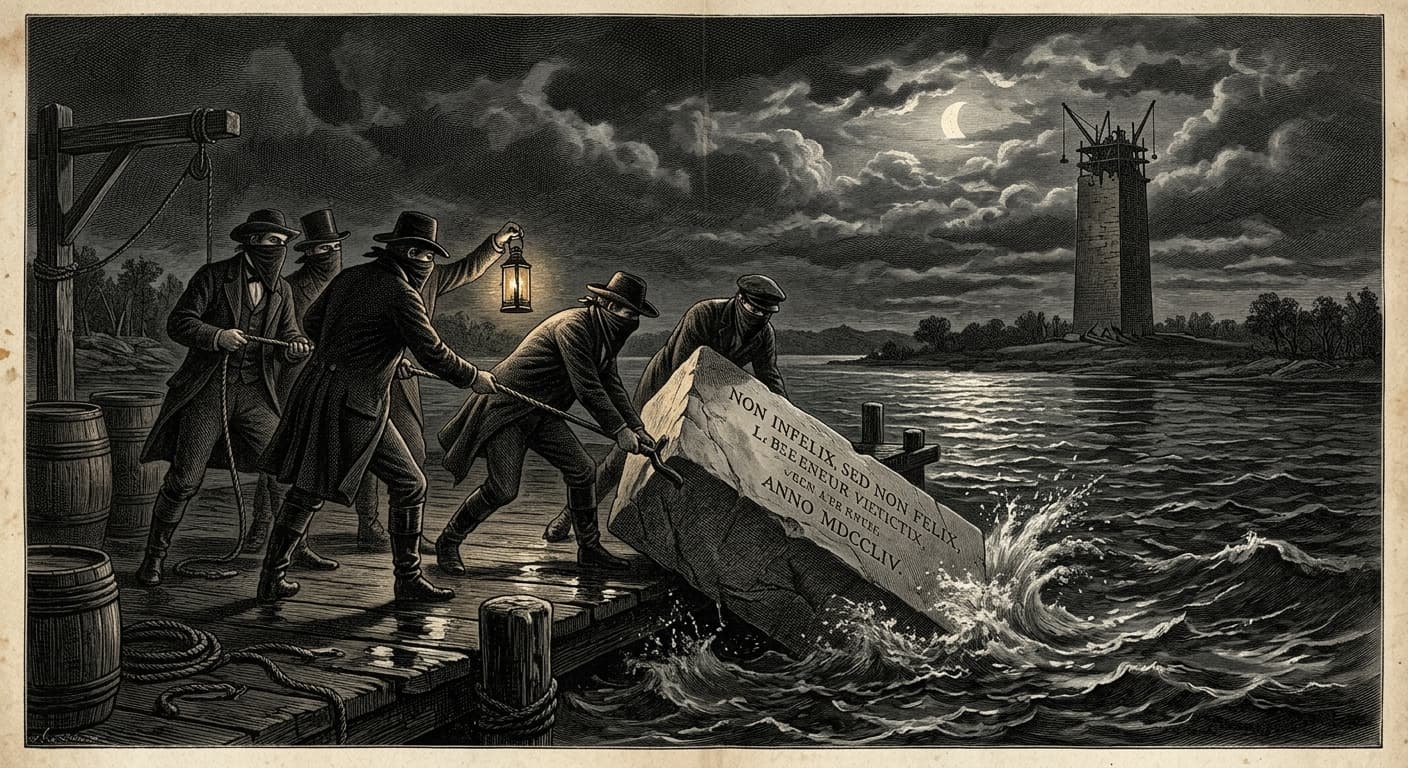
The tensions reached a boiling point on the frigid night of March 5, 1854. Between 1:00 and 2:00 in the morning, a group of eight to ten men, their faces obscured, descended upon the monument grounds. They ambushed the elderly night watchman, tied him up at gunpoint, and locked him in his wooden guard shack. The men then rolled the massive, 900-pound papal stone onto a handcart and wheeled it away into the darkness. According to most historical accounts, they hauled the marble block down to the banks of the nearby Potomac River, smashed it into pieces with sledgehammers, and dumped the fragments into the murky water.
The heist of the "Pope's Stone" was an audacious crime, but the Know-Nothings were just getting started. Empowered by their successful vandalism, the faction decided that the current Monument Society was entirely too tolerant. Later that same year, they organized a hostile takeover. Exploiting a loophole in the society's voting rules, members of the Know-Nothing party flooded a leadership election and effectively voted themselves into absolute control of the monument.
The fallout was immediate and disastrous. Outraged by the theft and the subsequent political coup, the federal government swiftly turned its back on the project. Congress, which had been on the verge of appropriating $200,000 to finish the obelisk, immediately tabled the resolution and withdrew all support. Public donations, tainted by the scandal, dried up completely.
For the next two decades, the Washington Monument became an embarrassment. The Know-Nothings attempted to continue construction, adding a few courses of cheap, inferior masonry, but they soon ran out of money and abandoned the project. The monument sat as a 152-foot, flat-topped stump through the entirety of the American Civil War. It became a grazing pasture for cattle and a national joke. Author Mark Twain famously visited the site and derisively described it as a "hollow, oversized chimney."
It wasn't until 1876—spurred by the nation's centennial celebrations—that Congress finally agreed to reclaim the project. The U.S. Army Corps of Engineers was brought in to finish the job. Because so much time had passed, the original quarry in Maryland could no longer provide the same shade of marble. The engineers had to source new stone from a quarry in Massachusetts, and later a third quarry near Baltimore, permanently etching a visible line of demarcation into the facade.
When the Washington Monument was finally completed in 1884, it stood as a towering testament to the nation's first president. But if you know where to look, it also stands as a permanent reminder of a deeply strange chapter in 19th-century history—a time when political paranoia ran so high that a stolen rock managed to bring the construction of America's most famous landmark to a grinding, multi-decade halt.