The Sea Wolf: How a Disgraced British Captain Conquered Three Navies
If you've ever thrilled to the naval exploits of Jack Aubrey in Master and Commander or Horatio Hornblower, you owe a debt of gratitude to a flesh-and-blood 19th-century mariner named Thomas Cochrane. Nicknamed "The Sea Wolf" by Napoleon himself, Cochrane was a brilliant, audacious, and relentlessly insubordinate Scottish nobleman. His real-life exploits on the high seas were so outrageous that fiction writers simply borrowed them wholesale—because making up anything more spectacular would have seemed unbelievable.
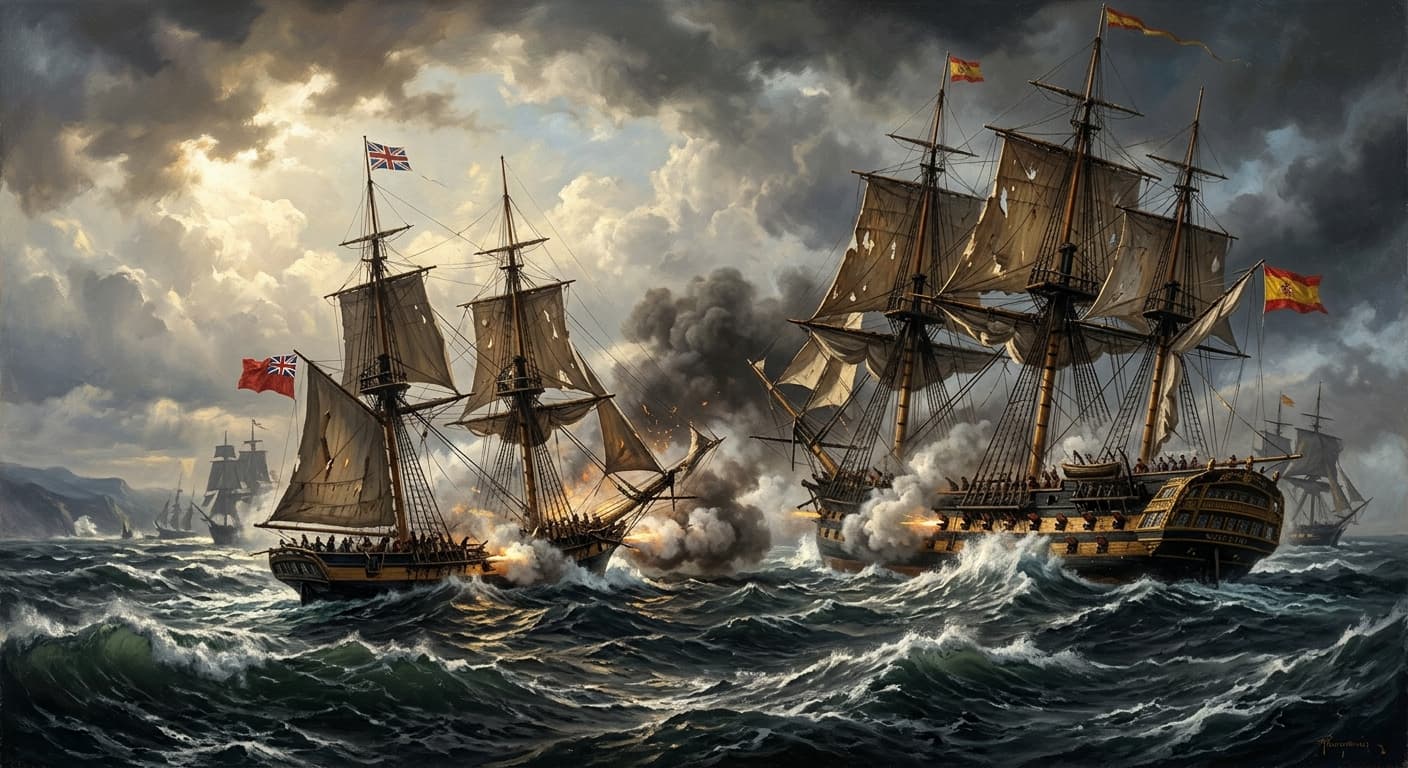
Cochrane’s legend was forged in the fiery crucible of the Napoleonic Wars. His early defining moment came in May 1801 while commanding HMS Speedy, an absurdly small brig equipped with just fourteen 4-pounder cannons and a crew of 54 men. Off the coast of Spain, he encountered the El Gamo, a massive Spanish frigate boasting 32 heavy guns and over 300 men. A sensible captain would have fled. Cochrane, instead, flew an American flag to confuse the enemy, sailed close enough to avoid their cannons' downward trajectory, and led his heavily outnumbered crew in a boarding action. To sow absolute chaos, he ordered half his men to paint their faces black with soot and scream like banshees as they swung aboard. The terrified Spanish crew surrendered in sheer bewilderment.
Despite his brilliance, Cochrane had a fatal flaw: he absolutely loathed authority and possessed no filter. He constantly bickered with his commanding officers and exposed rampant corruption within the British Admiralty. His tactical masterpiece came at the Battle of the Basque Roads in 1809, where he unleashed devastating explosion vessels—essentially massive, floating bombs—into a heavily fortified French fleet. The attack caused panic, driving the French ships aground. However, his commanding officer, Admiral Gambier, hesitated and refused to press the advantage. Never one to let a grudge go, Cochrane publicly accused Gambier of cowardice. The political fallout, combined with a highly suspicious stock exchange scandal in 1814 for which Cochrane was framed, led to his utter disgrace. He was stripped of his knighthood, kicked out of the Royal Navy, and thrown in prison.
For a lesser man, this would have been the end of the story. For Thomas Cochrane, it was merely the end of the first act. By 1818, unable to sail for Britain, he accepted an invitation to cross the Atlantic and take command of the fledgling Chilean Navy, which was fighting for independence from Spain. When he arrived, the "navy" consisted of a handful of dilapidated ships and untrained crews. Undeterred, Cochrane quickly whipped them into shape and resumed doing what he did best: achieving the impossible.
His crowning achievement in South America was the 1820 capture of Valdivia, a heavily fortified Spanish stronghold in southern Chile known as the "Gibraltar of the Pacific." Defended by a complex network of forts and hundreds of cannons, it was deemed utterly impregnable from the sea. Cochrane didn't care. He led a small amphibious force of just over 300 men, attacking the forts in the dead of night. Using the element of surprise, his men overran the outermost fort, then chased the fleeing Spanish soldiers into the next fort, and the next, capturing the entire network in a breathtaking cascade of psychological warfare and brute courage.
Having secured Chilean naval dominance, Cochrane wasn't ready to retire. In 1823, he was hired to lead the Imperial Brazilian Navy in their own war of independence against Portugal. With a notoriously mutinous and under-equipped fleet, Cochrane managed to bluff a massive Portuguese armada into fleeing across the Atlantic, effectively securing Brazil's independence without fighting a major fleet action. A few years later, he was off to the Mediterranean, commanding the Greek Navy in their fight against the Ottoman Empire. He had become the world's premier naval mercenary, a revolutionary sword-for-hire fighting for liberty across two hemispheres.
Eventually, time and shifting political tides healed old wounds. In 1832, after a change in the British government, Cochrane was granted a royal pardon, reinstated in the Royal Navy, and eventually promoted to the rank of Admiral of the Red. He spent his twilight years advocating for the adoption of steam power and designing early iterations of biological and chemical weapons, predicting the grim future of industrial warfare long before the First World War.
Thomas Cochrane died in 1860 at the age of 84, having lived a life of almost impossible adventure. He fought on four continents, liberated three nations, and terrified an entire empire. While his name may not be as universally recognized today as Horatio Nelson's, his towering legacy lives on every time a dashing, rebellious naval captain sails across the pages of a novel or the silver screen, proving that history is often much stranger—and vastly more exciting—than fiction.