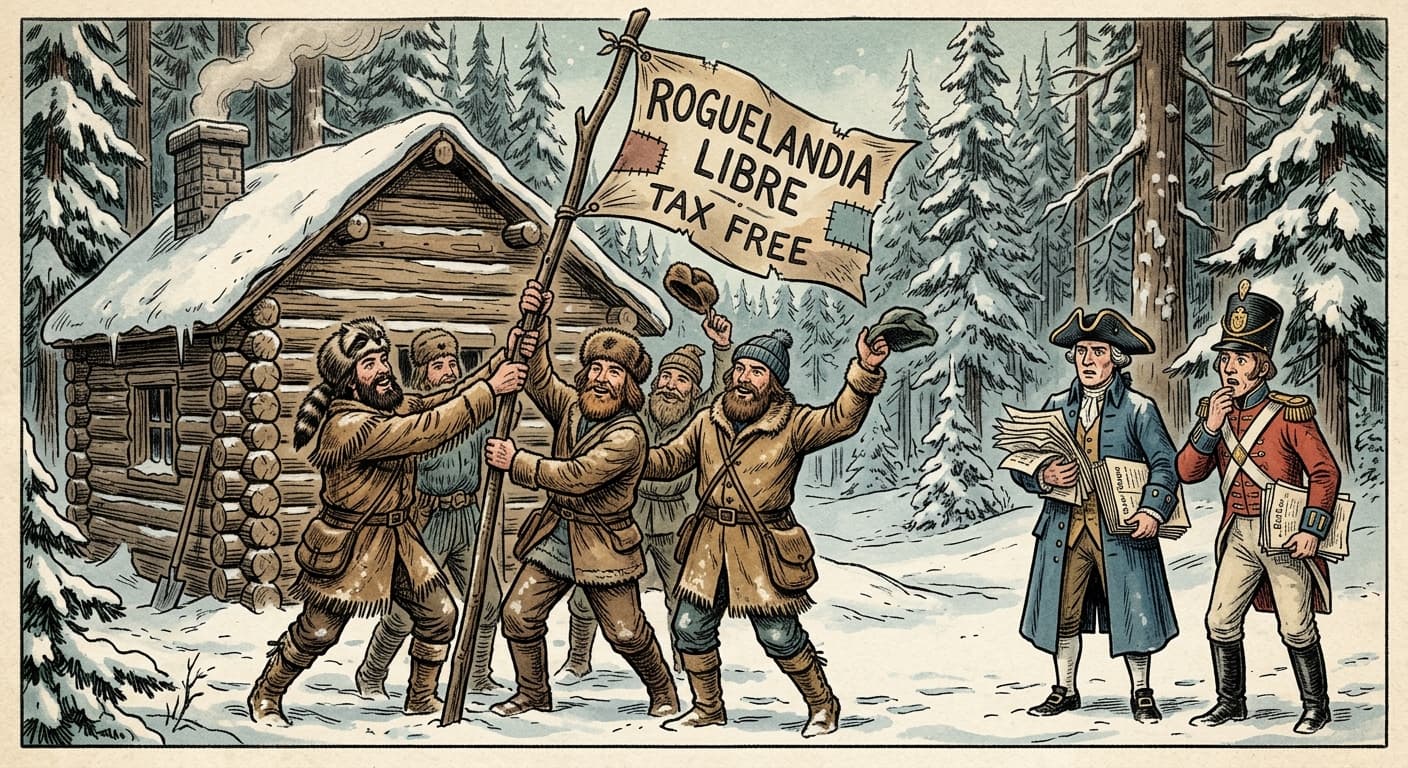
The Micro-Nation Born of a Typo: The Absurd and Forgotten Republic of Indian Stream
Imagine being so utterly fed up with paying taxes that you simply declare your neighborhood an independent country. While that sounds like the plot of a modern political satire, it was a very real, and very absurd, reality in the early 19th century. Nestled deep in the dense, freezing forests between New Hampshire and Lower Canada, a rugged group of pioneers did exactly that. Tired of being squeezed by two different empires, they threw up their hands and gave birth to the Republic of Indian Stream—a fully functioning micro-nation born entirely out of a cartographical typo.
To understand how this geopolitical anomaly came to be, we have to look back to the end of the American Revolution. When the United States and Great Britain signed the Treaty of Paris in 1783, they had to draw a border between the newly minted United States and British North America (Canada). Relying on the notoriously inaccurate Mitchell Map of 1755, the treaty defined the border as the "northwesternmost head of the Connecticut River." There was just one massive problem: the Connecticut River doesn't have a single northwesternmost head. It has several branches that fan out across the wilderness.
Naturally, the Americans surveyed the westernmost branch (Halls Stream) and claimed everything to the east of it. The British surveyed the easternmost branch (the Connecticut Lakes) and claimed everything to the west of it. This created a 200-square-mile wedge of contested no-man's-land. For a few decades, this wasn't an issue because the area was largely populated by moose and pine trees. But by the 1820s, a few hundred hardy settlers had moved in to farm, log, and build a life in the valley of the Indian Stream.
Because both the United States and Great Britain claimed the land, both governments felt entitled to tax its residents. Soon, the bewildered farmers found themselves being harassed by tax collectors from Coos County, New Hampshire, on one day, and magistrates from Quebec the next. If a settler paid the American tax, the British would threaten to seize their property for tax evasion. If they paid the British, the Americans would do the exact same thing. To make matters worse, the disputed territory became a haven for smugglers and fleeing debtors, as local sheriffs from either side were often too confused about their jurisdiction to make arrests.
By 1832, the roughly 300 residents of the territory had endured enough double taxation and bureaucratic chaos. On July 9 of that year, they gathered at a local schoolhouse and made a radical decision: if neither the US nor Britain could agree on who owned the land, then the land belonged to the people who lived on it. They formally declared independence and established the "United Inhabitants of Indian Stream."
This wasn't just a symbolic protest; they built a legitimate government. The citizens drafted a robust constitution, established a bill of rights, and formed a bicameral legislature. They created their own court system to handle local disputes, passed laws regarding everything from debt collection to property boundaries, and even formed a 40-man standing army equipped with muskets and pitchforks to protect their newly won sovereignty. For three glorious years, the Republic of Indian Stream operated as an independent, unrecognized nation in the heart of the North American wilderness.
The utopian experiment began to unravel in 1835, thanks to a trivial dispute over a hardware store debt. A local man owed money, and a British magistrate named Alexander Rea sent a Canadian deputy to arrest an American sympathizer named Richard Blanchard over the dispute. Outraged by this foreign incursion into their "country," a heavily armed posse from New Hampshire invaded the Republic, crossed the border into Canada, and engaged in a wild brawl with the Canadian authorities. During the melee, the posse successfully rescued Blanchard and shot Magistrate Rea in the thigh.
Realizing that this ridiculous frontier skirmish over a tiny debt could accidentally ignite a third war between the United States and Great Britain, the governor of New Hampshire decided playtime was over. He dispatched the state militia to occupy the Republic of Indian Stream. Facing an overwhelming force, the tiny nation's government quickly voted to dissolve itself and yield to American jurisdiction.
The border dispute remained a tense standoff until 1842, when the Webster-Ashburton Treaty finally clarified the boundary once and for all. The British conceded the territory, and the former republic was officially absorbed into the United States, eventually becoming the modern-day town of Pittsburg, New Hampshire. Today, the Republic of Indian Stream is largely forgotten, a footnote in diplomatic history. Yet, it remains a brilliant, uniquely 19th-century testament to the frontier spirit—and a hilarious reminder of the extreme lengths to which people will go to avoid the tax man.