The Planet Found With a Pen: How Mathematics Discovered Neptune
In the early 19th century, the universe was a giant, predictable clockwork machine. Thanks to the towering genius of Isaac Newton, scientists believed they had the cosmos completely figured out. But by the 1840s, there was one massive, icy problem lurking in the dark reaches of the solar system: the planet Uranus was breaking all the rules.
Discovered in 1781 by William Herschel, Uranus was the first new planet found since antiquity. However, as decades passed and astronomers carefully charted its orbit, they noticed something highly disturbing. Uranus was not following the precise path dictated by Newtonian gravity. Sometimes it sped up; sometimes it slowed down. For a Victorian-era scientist, this was akin to finding a glitch in reality itself. Was Newton—the undisputed god of modern physics—wrong?
Instead of discarding the laws of gravity, a few radical thinkers proposed a different, audacious solution: what if something else, something massive and entirely unseen, was tugging at Uranus? What if there was a hidden eighth planet?
This hypothesis set the stage for one of the most thrilling and dramatic scientific races of the 19th century. It wasn't a race of giant telescopes or daring spaceflight, but of pure mathematics. Two men, working completely independently of one another, picked up their pens to hunt for a ghost world.
In England, a young, brilliant, and agonizingly shy Cambridge student named John Couch Adams began working on the celestial problem in 1843. Using nothing but raw calculation, Adams successfully deduced the approximate mass and orbit of the hypothetical planet. However, when he presented his findings to the Astronomer Royal, George Biddell Airy, he was met with bureaucratic apathy. Adams was a virtual nobody, and Airy wasn't about to waste precious telescope time searching for a phantom planet based on a student’s scribbles.
Meanwhile, across the English Channel, the formidable French mathematician Urbain Le Verrier had tackled the exact same problem. Unlike the timid Adams, Le Verrier was fiercely ambitious, highly connected, and commanded respect. By the summer of 1846, he had pinpointed the exact location of the mystery planet. Yet, ironically, Le Verrier faced the exact opposite problem as Adams: the French astronomical establishment respected his math, but none of them actually wanted to spend the tedious, freezing hours at the telescope to go look for it.
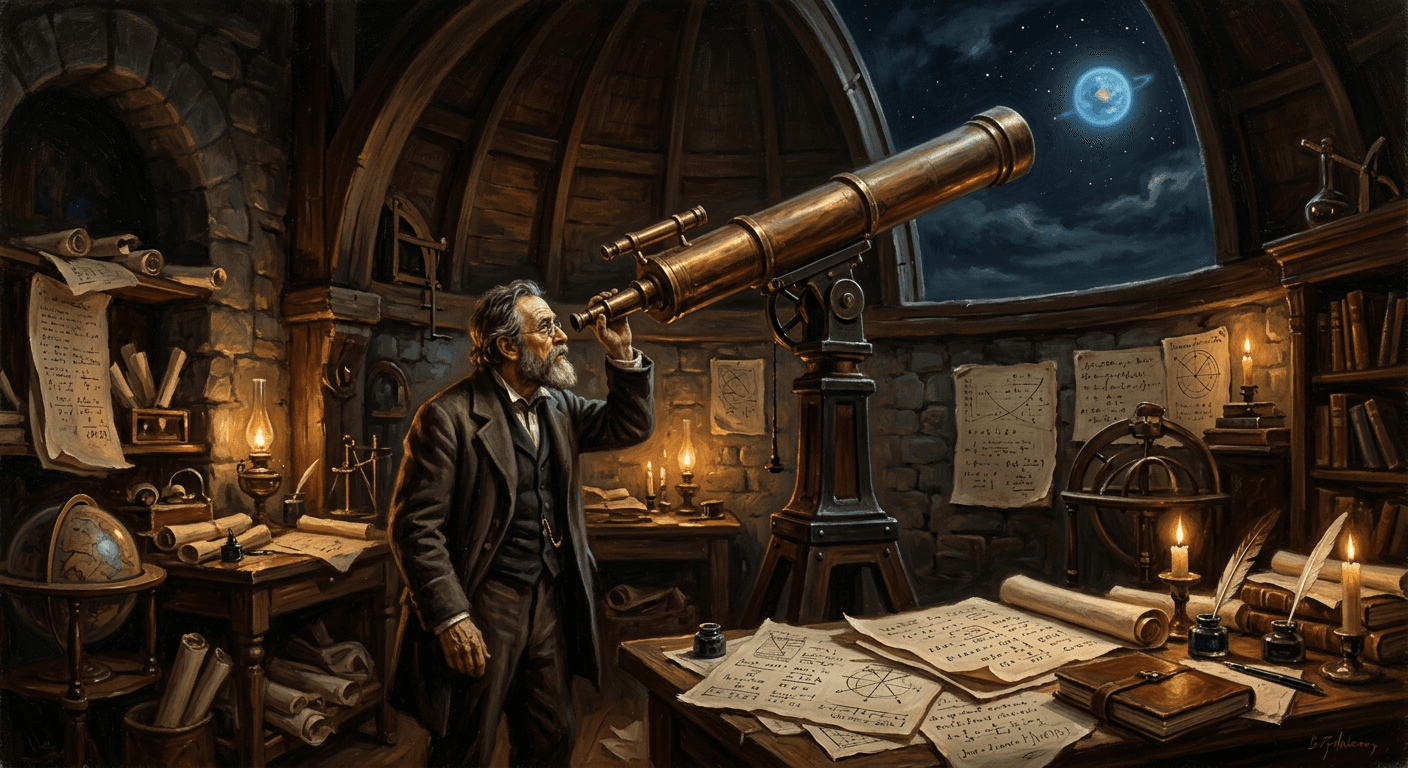
Frustrated by his countrymen's apathy, Le Verrier mailed his precise coordinates to the Berlin Observatory, specifically writing to an eager German astronomer named Johann Gottfried Galle. The letter arrived on September 23, 1846. Galle, thrilled by the prospect, immediately sought permission from his director and aimed the observatory's Fraunhofer refractor telescope at the exact patch of sky Le Verrier had indicated.
It took less than an hour. Just past midnight, Galle and his assistant Heinrich d'Arrest spotted a tiny blue disk floating in the darkness. It was not on their star maps. They double-checked the coordinates. The new planet—later named Neptune—was exactly where Le Verrier said it would be, off by a mere single degree.
The discovery sent shockwaves through the scientific world. François Arago, a prominent French astronomer, famously declared that Le Verrier had discovered a planet "with the point of his pen." It was arguably the greatest triumph of Newtonian mechanics in history; gravity wasn't just an abstract theory, it was a predictive tool that could find invisible worlds billions of miles away.
However, the scientific triumph quickly descended into a petty nationalistic squabble. When the British realized they had possessed Adams's remarkably similar calculations months before Le Verrier's discovery, they scrambled to claim co-discovery rights. The French were understandably furious, accusing the British establishment of trying to steal their hard-won glory. The ensuing "Neptune Controversy" dominated scientific circles for years, severely straining Anglo-French relations.
Today, both Adams and Le Verrier are generally credited with the mathematical discovery, though Le Verrier's math proved far more accurate. Yet the true glory belongs to the sheer power of 19th-century deduction. In an era before computers, calculators, or advanced imaging, humanity reached out into the deep dark of the solar system and found a giant, guided only by numbers on a page.