The Pauper Who Became Emperor: The Curious Reign of Joshua Norton
In the annals of American history, there are presidents, generals, and tycoons whose names are etched into stone monuments across the country. But in the foggy, gold-dusted streets of 19th-century San Francisco, there reigned a monarch whose authority was derived not from bloodlines or ballots, but from the sheer force of his own delusion and the benevolent indulgence of a city. This is the story of Joshua Abraham Norton, the self-proclaimed Emperor of the United States and Protector of Mexico.
The Rise of a Monarch
Before he was royalty, Joshua Norton was a businessman. Born in England and raised in South Africa, he arrived in San Francisco in 1849, swept up in the fervor of the Gold Rush. He didn't come to dig, however; he came to build a fortune in commodities and real estate. For a time, he was successful, amassing a significant net worth. But hubris is a cruel mistress. In an attempt to corner the rice market, Norton lost everything when ships from Peru arrived with cheap imports, crashing prices. The resulting lawsuits and financial ruin drove him into seclusion.
When he re-emerged in September 1859, the businessman was gone. In his place stood a man who walked into the offices of the San Francisco Bulletin and handed the editor a proclamation that began: "At the peremptory request and desire of a large majority of the citizens of these United States, I, Joshua Norton... declare and proclaim myself Emperor of these United States."
In any other city, or perhaps in any other era, Norton might have been institutionalized. But San Francisco in the mid-1800s was a place of eccentrics, gamblers, and dreamers. The editor ran the proclamation, likely as a joke to boost circulation. To everyone's surprise, the city didn't laugh at him; they decided to play along.
The Imperial Life
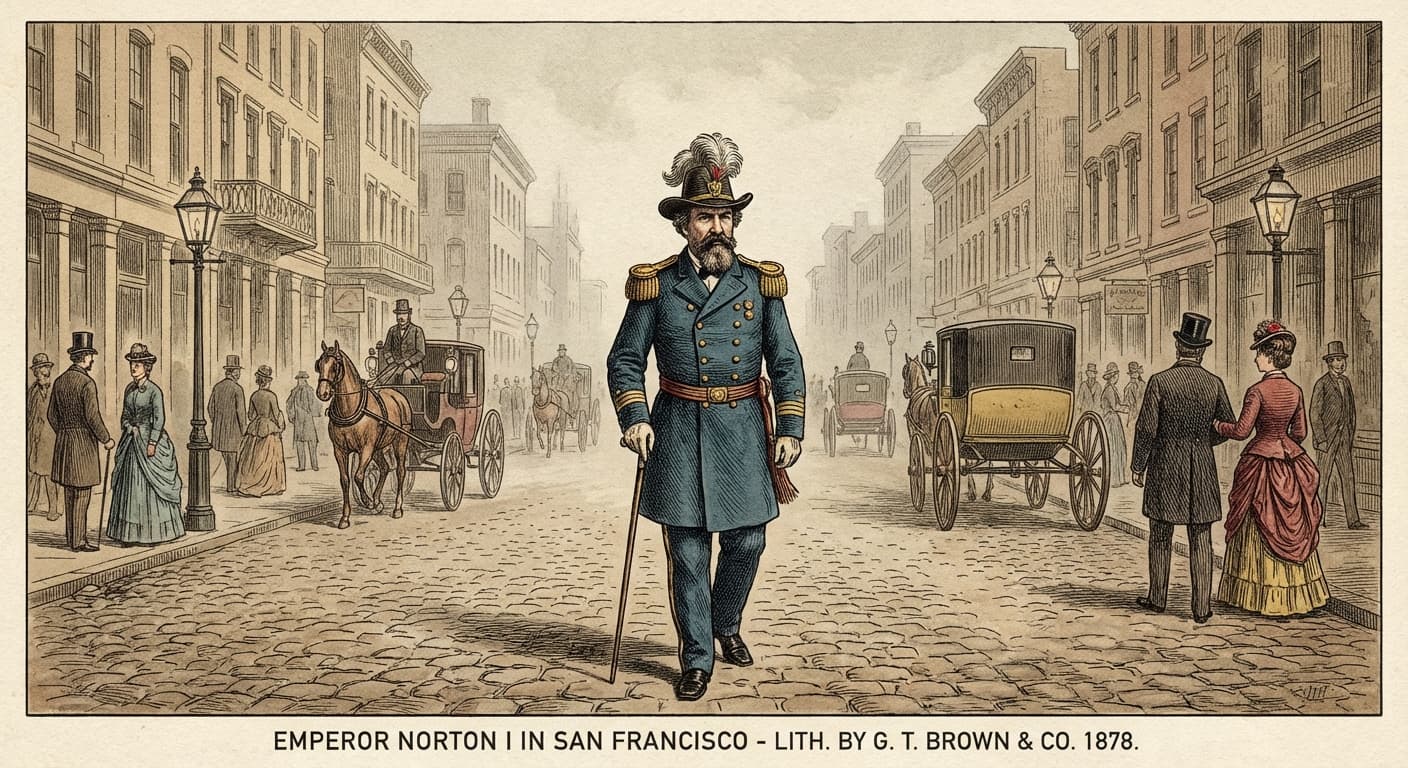
For the next twenty-one years, Emperor Norton I walked the streets of San Francisco clad in an elaborate, epaulet-adorned blue uniform (often donated by officers at the Presidio) and a beaver hat decorated with peacock feathers. He inspected the condition of the sidewalks and cable cars, ensuring the city was running up to his imperial standards. When he entered a theater, the audience would rise, and plays would often be reserved for him. Restaurants allowed him to dine for free, placing brass plaques in their windows declaring "By Appointment to his Imperial Majesty, Emperor Norton I."
He even issued his own currency—imperial promissory notes—which local businesses accepted as legal tender. These notes are now rare collector's items worth thousands of dollars, far more than their face value of fifty cents or ten dollars. But Norton was not merely a mascot; he was a benevolent ruler. He famously intervened during an anti-Chinese riot, standing between the angry mob and their targets, reciting the Lord’s Prayer until the crowd dispersed in shame.
Visionary Decrees
Though his title was imaginary, some of his decrees were surprisingly prescient. Norton famously ordered the dissolution of the U.S. Congress (on grounds of corruption and fraud) and, when they refused to disband, ordered the Army to clear the halls—an order the Army politely ignored.
Most notably, he issued a decree ordering the construction of a bridge connecting Oakland and San Francisco, as well as a tunnel under the bay. At the time, the idea was dismissed as the raving of a madman. Decades later, the San Francisco–Oakland Bay Bridge and the Transbay Tube would become vital arteries of the region, vindicating the Emperor’s infrastructure plan long after his death.
A Royal Farewell
When Emperor Norton collapsed on a street corner and died in 1880, his pockets contained only a few dollars in gold and some fake telegrams from Tsar Alexander II of Russia. Yet, his death sent shockwaves through the city. The headline of the San Francisco Chronicle read, "Le Roi est Mort" (The King is Dead).
His funeral was not that of a pauper, but of a head of state. It is estimated that nearly 30,000 people lined the streets of San Francisco to pay their respects—a staggering number for the time. Rich and poor, banker and beggar, they all came to salute the man who had brought a touch of whimsical nobility to the rough-and-tumble West.
Joshua Norton’s reign reminds us of the unique spirit of the 19th century, a time when the lines between reality and performance could blur in the most delightful ways. He was a madman, yes, but he was a madman who preached tolerance, demanded fair play, and dreamed of bridges where others saw only water. In the end, he may have been the most successful emperor in history: he reigned for two decades, shed no blood, and left his subjects smiling.