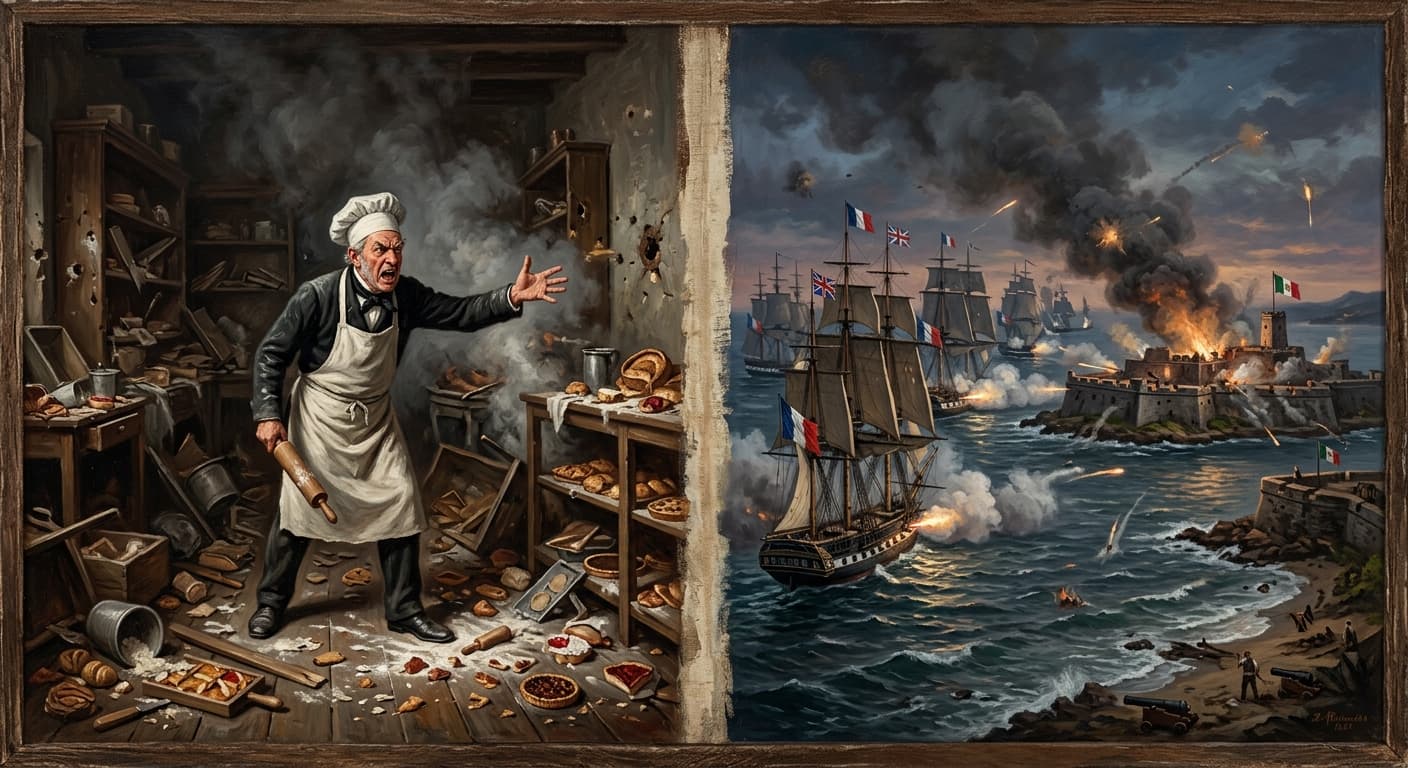
The Pastry War: How a Ruined Bakery Sparked an International Conflict
History is filled with wars fought over grandiose ideas: liberty, territory, religion, and resources. But if you look closely at the year 1838, you’ll find an international conflict sparked by something far more delicate: ruined pastries. This is the bizarre, true story of the Guerra de los Pasteles, or the Pastry War, a geopolitical clash between Mexico and France that proves truth is often stranger than fiction.
To understand how a bakery could ignite a war, one must look at the chaotic state of Mexico in the 1820s. Having recently won its hard-fought independence from Spain, the young nation was struggling to find its footing. It was an era defined by revolving-door presidencies, military coups, and widespread civil unrest. Factions routinely clashed in the streets of Mexico City and its surrounding towns, leaving collateral damage in their wake.
Unfortunately for foreign expatriates living in Mexico, this chaos often meant their businesses were looted or destroyed. The Mexican government, practically bankrupt and drowning in debt, routinely ignored requests for compensation. Enter Monsieur Remontel, a French pastry chef living in Tacubaya, a bustling district near Mexico City.
In 1828, a group of off-duty—and reportedly highly intoxicated—Mexican military officers broke into Remontel's pastelería. They locked the chef in a room, devoured his exquisite French pastries, and trashed the establishment. It was undoubtedly an infuriating experience for the baker, but his reaction was arguably out of proportion. Remontel demanded 60,000 pesos from the Mexican government in damages.
To put this astronomical figure into perspective, a typical Mexican laborer at the time earned roughly one peso per day. The idea that a single bakery contained 60,000 pesos worth of croissants and éclairs was laughable. Predictably, the Mexican government ignored his outrageous claim. But Remontel was a man of sheer, unyielding stubbornness. For ten years, he petitioned both Mexican and French authorities, refusing to let the incident go.
By 1838, his incessant complaints finally reached the desk of King Louis-Philippe of France. As it happened, the King was already looking for an excuse to aggressively collect millions of pesos in unpaid loans that Mexico owed to France. Remontel's ruined bakery became the perfect, albeit absurd, casus belli. France issued a formal ultimatum to Mexican President Anastasio Bustamante: pay 600,000 pesos—a sum that included Remontel’s 60,000-peso claim—or face the wrath of the French Navy.
When Bustamante flatly refused, declaring that Mexico would not pay for pastries with the republic's honor, France took action. A French naval squadron commanded by Admiral Charles Baudin arrived off the coast of Veracruz. They initiated a blockade of all Mexican ports from the Yucatán Peninsula to the Rio Grande, effectively strangling Mexico's already fragile economy. When diplomatic talks failed, the French warships opened fire on the formidable fortress of San Juan de Ulúa in late 1838, quickly forcing its surrender and occupying the city of Veracruz.
The conflict also resurrected the career of one of Mexico's most infamous historical figures: General Antonio López de Santa Anna. Disgraced following his defeat at the Battle of San Jacinto and the loss of Texas, Santa Anna had been living in political exile on his estate. Smelling an opportunity for a comeback, he rushed to Veracruz to lead the defense against the French.
During a chaotic skirmish, Santa Anna was severely wounded in the leg by French grapeshot. The leg had to be amputated, a personal tragedy that Santa Anna brilliantly spun into a political triumph. He played the role of the mutilated martyr, eventually giving his severed leg a full state military funeral complete with cannon fire and poetry. The sympathy he garnered catapulted him right back into the center of Mexican politics.
Ultimately, the Pastry War was brought to an end not by military triumph, but by British annoyance. Great Britain, eager to resume its lucrative trade in the region, dispatched diplomats to broker a peace. In March 1839, a treaty was signed. Mexico reluctantly agreed to pay the full 600,000 pesos, and the French fleet withdrew, allowing the blockaded ports to reopen.
Monsieur Remontel finally received his exorbitant payday, disappearing into the annals of history as the only baker to ever summon an armada. The Pastry War remains a fascinating testament to the absurdity of 19th-century gunboat diplomacy, proving once and for all that you should never underestimate the geopolitical power of a good croissant.