The Men Who Touched the Edge of Space: The Near-Fatal Balloon Ascent of 1862
In the mid-19th century, the map of the world was rapidly filling in. Explorers were hacking their way through dense jungles, trekking across scorching deserts, and charting the icy expanses of the polar regions. But while the horizontal world was being conquered, the vertical world remained a terrifying, breathable void. The sky was the final frontier, and Victorian scientists were determined to tame it. Enter James Glaisher, a meticulous 53-year-old meteorologist, and Henry Coxwell, a daring aeronaut. Together, in the late summer of 1862, they embarked on a hot air balloon flight so audacious, it nearly cost them their lives—but it forever changed our understanding of the Earth's atmosphere.
The Need to Look Up
By 1862, meteorology was in its infancy. Scientists understood the basics of weather, but the upper atmosphere was a total mystery. What happened to temperature and humidity as you climbed higher? Where did the clouds end? The British Association for the Advancement of Science wanted answers, and they tapped James Glaisher, the Superintendent of the Meteorological and Magnetic Department at the Royal Observatory in Greenwich, to find them.
Glaisher was a man of science, not a daredevil. He needed a pilot. He found Henry Coxwell, a seasoned balloonist who had built a colossal, 80,000-cubic-foot balloon appropriately named the Mammoth. Together, the unlikely duo prepared to take a floating laboratory higher than anyone had ever gone before.
The Ascent Begins
On September 5, 1862, Glaisher and Coxwell lifted off from Wolverhampton, England. The basket was crammed with delicate, state-of-the-art Victorian instruments: barometers, thermometers, hygrometers, and compasses. As the Mammoth soared through the industrial smog and broke into the clear blue sky, Glaisher immediately went to work. He frantically recorded data, marveling at the sudden drops in temperature and the absolute silence of the upper atmosphere.
Within an hour, they had surpassed 20,000 feet. The temperature plummeted to 18 degrees Fahrenheit (-8 degrees Celsius). Today, we know this region as the "death zone," where atmospheric pressure is so low that human lungs cannot absorb enough oxygen. But in 1862, the concept of hypoxia was entirely unknown. They were sailing straight into invisible peril.
The Invisible Enemy
As the balloon climbed past 29,000 feet—higher than the summit of Mount Everest—the thin air began to take its toll. Glaisher, still stubbornly staring at his instruments, suddenly realized he could no longer read the numbers. His vision blurred, transforming the dials into illegible smudges.
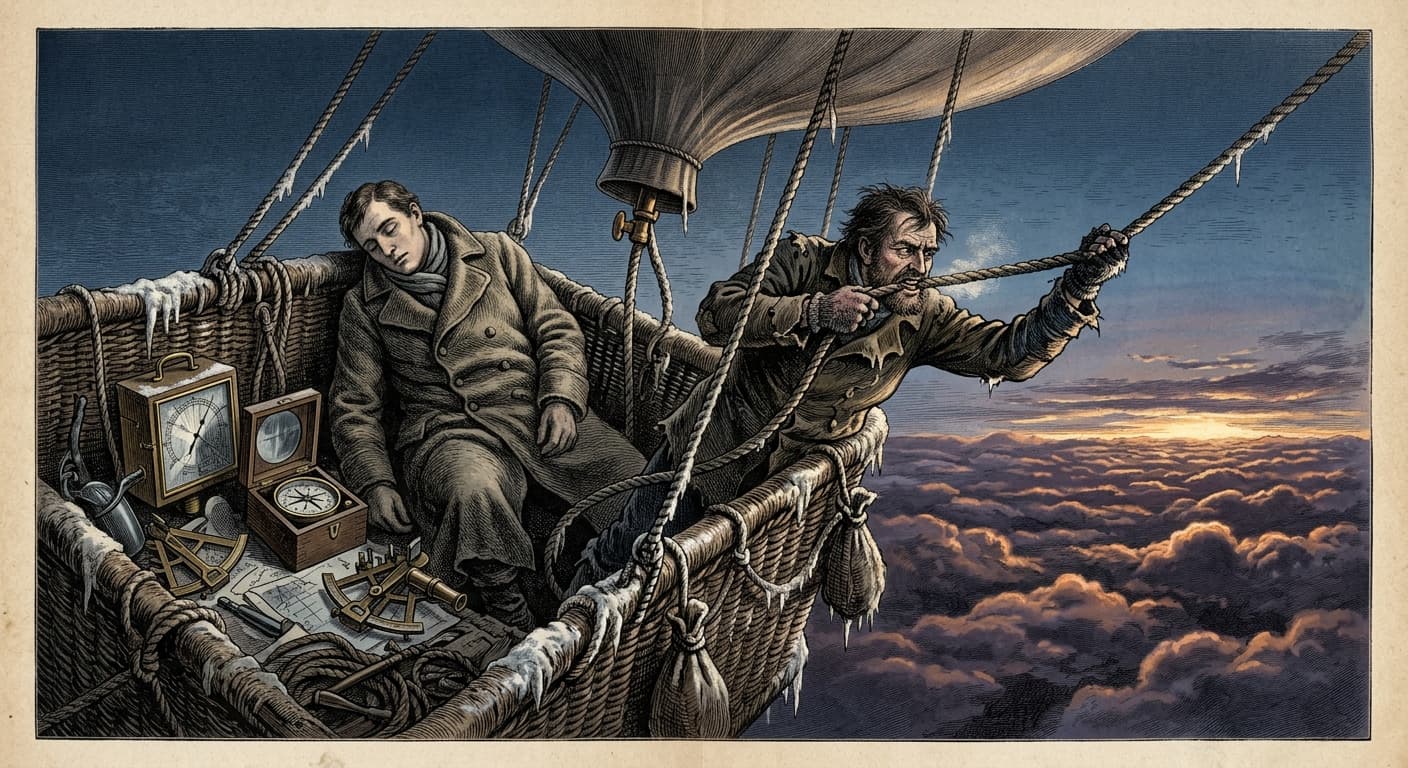
Fascinatingly, Glaisher approached his own impending death with the same meticulous observation he applied to the weather. He noted that his arms had gone completely limp. He tried to speak to Coxwell, but no sound came out. Then, his neck muscles failed, and his head slumped backward. Finally, a deep, creeping darkness overtook him. The scientist had passed out, completely paralyzed by oxygen starvation.
A Desperate Fight for Survival
Coxwell was faring no better. Shortly before Glaisher collapsed, the balloon's valve line—the rope required to release gas and initiate a descent—had become tangled in the rigging above the basket. Coxwell had climbed out of the relative safety of the wicker basket and into the freezing ropes to free it.
When he looked down and saw Glaisher unconscious, Coxwell realized they were in mortal danger. The Mammoth was still rising rapidly, approaching an estimated 37,000 feet (over 7 miles high). The air was incredibly thin, and the temperature had plummeted to a bone-chilling -5 degrees Fahrenheit (-20 degrees Celsius).
Coxwell tried to climb back down to the basket to release the gas, but his hands had turned completely black from frostbite. They were frozen solid; he couldn't grasp the ropes. In a final, desperate act of survival, Coxwell threw his arms over the edge of the ring to support his body, leaned forward, and caught the valve cord in his teeth.
With his lungs burning and his consciousness fading, Coxwell violently jerked his head backward. The valve clicked open. Gas hissed out into the freezing void. The balloon finally stopped its relentless climb and began to fall.
The Legacy of the Mammoth
As the balloon descended into richer, oxygenated air, Glaisher suddenly woke up. True to his unflappable nature, his first words upon regaining consciousness were a calm inquiry into his instruments, acting as if he had merely taken a brief nap. Coxwell, nursing his frostbitten hands, simply informed him that they had been on the brink of death.
The descent was terrifyingly fast, but Coxwell managed to regain enough function in his hands to pilot them to a safe landing in a field in Shropshire. Against all odds, both men survived, and the scientific instruments remained largely intact.
The 1862 flight of the Mammoth remains one of the most astonishing feats of 19th-century science. Glaisher and Coxwell brought back unprecedented data that proved temperature does not drop uniformly with altitude, laying the foundational knowledge for the discovery of the stratosphere.
Their near-fatal journey stands as a testament to the era's relentless thirst for knowledge—a time when scientists literally reached for the stars, armed with little more than wicker baskets, glass thermometers, and breathtaking courage.