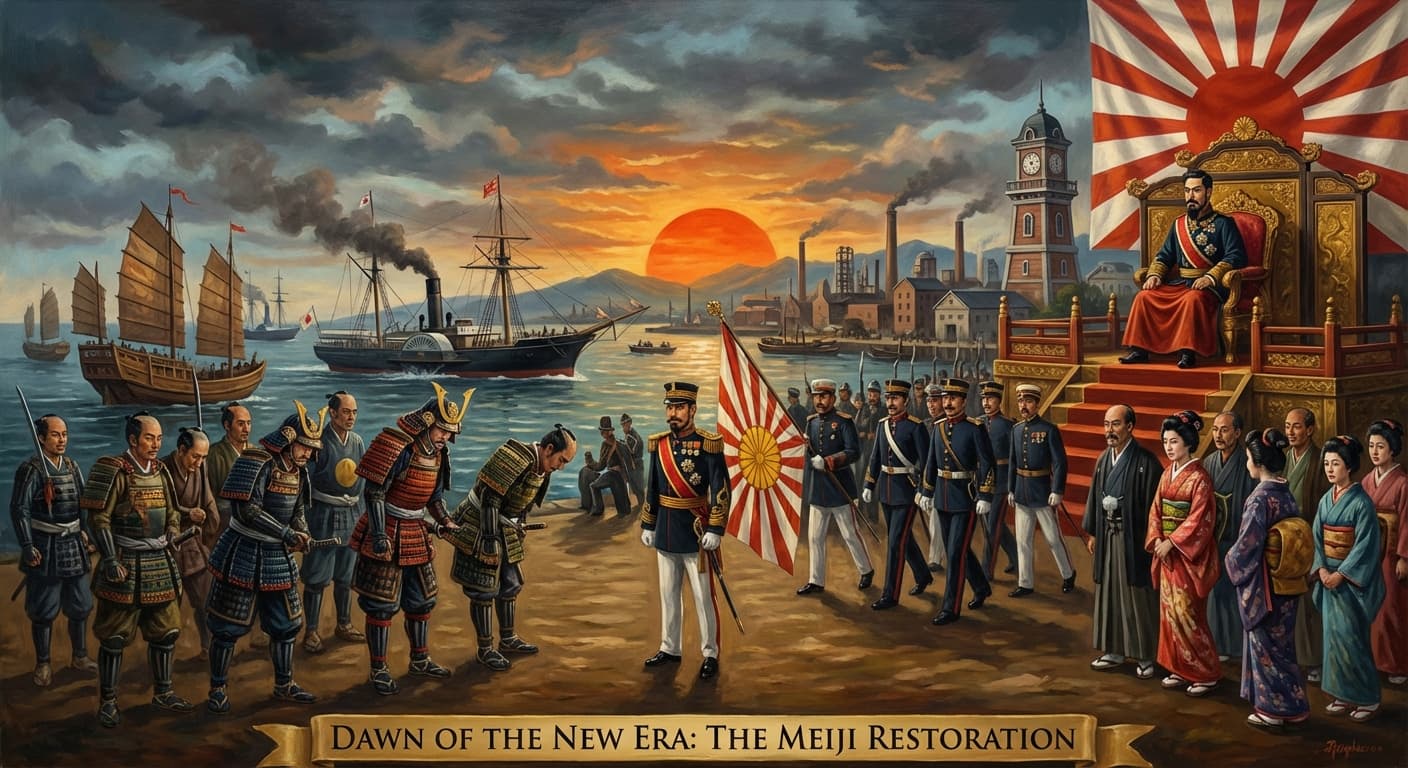
The Sun Rises Anew: Japan's Meiji Restoration and its World-Shaking Transformation
Imagine a nation deliberately cut off from the world for centuries, steeped in feudal traditions, then, almost overnight, catapulting itself into the modern age to become a global power. This isn't fiction; it's the astounding reality of Japan's Meiji Restoration, an epochal shift in the 19th century that saw an ancient empire shed its past and embrace a future with breathtaking speed and determination. For history buffs intrigued by profound societal change, the Meiji Restoration offers a spectacular case study in national reinvention.
For over 250 years, Japan had been governed by the Tokugawa Shogunate, a military dictatorship that enforced a strict feudal system and an equally strict isolationist policy known as Sakoku ("closed country"). Under Sakoku, foreign travel was forbidden for Japanese citizens, and virtually all foreign trade and contact were limited to a single Dutch trading post in Nagasaki. This period fostered a unique and stable culture but left Japan technologically and militarily behind the rapidly industrializing Western powers. Beneath the surface of apparent tranquility, however, were growing internal stresses: a samurai class struggling with debt, a merchant class gaining wealth but lacking political power, and a general discontent with the Shogunate's authority.
The tranquil isolation was shattered in 1853 when Commodore Matthew C. Perry, commanding a squadron of U.S. Navy "black ships," sailed into Tokyo Bay. Perry, backed by superior firepower, demanded that Japan open its ports to trade. Faced with the stark reality of Western military might, the Shogunate had little choice but to sign the Treaty of Kanagawa, followed by other unequal treaties with various Western powers. This perceived weakness, coupled with a deep-seated nationalism and a growing reverence for the long-marginalized Emperor, ignited a powerful movement.
The rallying cry became "Sonno Joi!" – "Revere the Emperor, Expel the Barbarians!" Various samurai factions, particularly from the powerful southern domains of Choshu and Satsuma, formed alliances and began challenging the Shogunate. This culminated in the Boshin War (1868-1869), a civil conflict that saw the Shogun's forces ultimately defeated. In 1868, Emperor Meiji, a young and symbolic figurehead, was "restored" to power, marking the official end of the Shogunate and the beginning of the Meiji Era (meaning "Enlightened Rule"). The imperial court moved from Kyoto to Edo, which was renamed Tokyo ("Eastern Capital").
What followed was an unprecedented period of radical reform. The new Meiji government, comprised largely of young, visionary samurai who understood the necessity of rapid modernization, moved swiftly. They abolished the feudal domains and established a centralized administrative system, effectively dismantling the centuries-old samurai class (a move that led to some brief rebellions). A modern conscript army and navy were established, replacing feudal levies. Education became compulsory, modeled on Western systems. Perhaps most crucially, Japan embarked on a rapid and state-sponsored program of industrialization, building railroads, telegraph lines, modern factories, and adopting Western technologies and business practices. A new constitution was promulgated in 1889, establishing a parliamentary system (the Diet) with the Emperor at its head.
The speed and scope of the Meiji Restoration were astounding. In just a few decades, Japan transformed from an isolated, feudal society into an industrial and military power capable of challenging Western nations. This newfound strength would soon be demonstrated on the world stage, notably in the First Sino-Japanese War (1894-1895) and the Russo-Japanese War (1904-1905), where Japan decisively defeated larger, established powers. The Meiji Restoration not only saved Japan from Western colonization but also set it on a path to becoming a major imperial power in its own right, a path that would have profound consequences for Asia and the world in the 20th century.
The Meiji Restoration stands as a testament to a nation's ability to adapt, innovate, and redefine itself under immense pressure. It was a complex and often brutal process, yet its success in modernizing Japan without entirely losing its cultural identity remains one of the most remarkable stories of the 19th century. For anyone seeking to understand the dynamics of globalization, national transformation, and the interplay between tradition and progress, the Meiji Restoration offers an enduring and invaluable lesson.