The King of Filibusters: How a Tennessee Lawyer Conquered Nicaragua
When we hear the word "filibuster" today, we imagine a politician droning on for hours in an empty Senate chamber to delay a vote. But in the mid-19th century, a filibuster was something far more dangerous: a private military adventurer who raised his own army to invade foreign countries, topple governments, and annex territory, all without the official sanction of his own government. The age of Manifest Destiny produced many such characters, but none were as successful, or as delusional, as William Walker, the "Grey-Eyed Man of Destiny."
Born in Nashville in 1824, Walker hardly looked the part of a warlord. He was a slight, soft-spoken man who weighed barely 120 pounds. He was also a prodigy, graduating university at 14 and earning degrees in both law and medicine, followed by a stint as a journalist in New Orleans and San Francisco. Yet, the pen proved too light for his ambition. Swept up in the fervor of American expansionism, Walker decided that if the United States wouldn't annex more territory south of the border, he would do it himself.
His first outing was a farcical disaster. In 1853, he recruited 45 men and sailed to Baja California, Mexico. They captured the capital of La Paz, and Walker grandiosely declared himself President of the "Republic of Lower California." The victory was short-lived. The Mexican government sent forces to crush him, and his "army" was forced to retreat to the U.S. border, starving and in rags. Astonishingly, upon his return to California, he wasn't imprisoned for violating neutrality laws. Instead, a jury acquitted him in eight minutes. To the American public, he was a hero of enterprise.
Emboldened by his acquittal, Walker set his sights on a bigger prize: Nicaragua. At the time, Nicaragua was a crucial transit point for the California Gold Rush, with a route utilized by shipping magnate Cornelius Vanderbilt. The country was also embroiled in a civil war. In 1855, the Democratic faction of Nicaragua foolishly invited Walker to bring a band of mercenaries to help them defeat the Legitimists. It was a deal with the devil.
Walker arrived with 57 men, whom he dubbed "The Immortals." Through a combination of luck, tactical ruthlessness, and the support of more American recruits drawn by promises of land, he effectively seized control of the country. By 1856, the charade of supporting the local faction was over. Walker rigged an election, inaugurated himself as the President of Nicaragua, and was even recognized by the United States government. He dreamed of a Central American empire, re-instituted slavery (which Nicaragua had abolished), and declared English the official language.
However, Walker had made a fatal error: he messed with the wrong billionaire. In his hubris, Walker seized the assets of the Accessory Transit Company, the shipping line owned by Cornelius Vanderbilt. Vanderbilt, the richest man in America, was not one to be trifled with. He didn't send an army; he sent agents to Costa Rica and other neighboring nations, providing funding, weapons, and intelligence to a coalition force dedicated to removing the American usurper. Vanderbilt also successfully lobbied the U.S. government to withdraw support.
Surrounded by the combined armies of Central America and cut off from supplies by Vanderbilt’s blockade, Walker's empire crumbled. He surrendered to the U.S. Navy in 1857 to avoid capture by angry Nicaraguans and was returned to the States. He was greeted in New York as a celebrity, with parades and cheering crowds, but the spell was breaking.
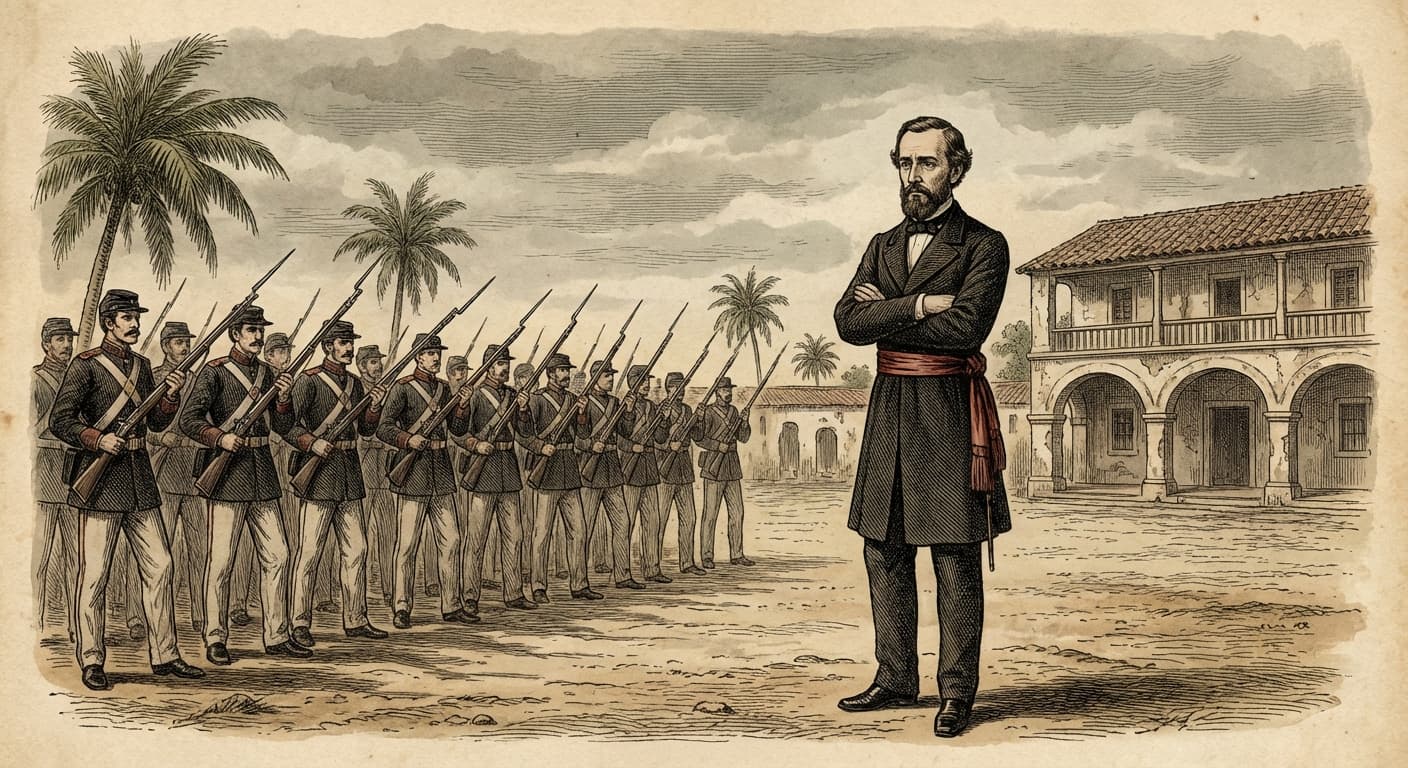
Walker, incapable of accepting defeat, tried to return to Central America twice more. His final attempt in 1860 ended in Honduras. This time, there was no U.S. Navy to save him. He was captured by the British Royal Navy, who, tired of his destabilizing antics, handed him over to the Honduran authorities. On September 12, 1860, the man who would be king was marched in front of a firing squad. He was 36 years old.
William Walker remains a controversial figure—a symbol of American imperialism to Central America and a peculiar footnote of "what-if" history in the United States. His life serves as a bizarre reminder of a time when a lawyer with a god complex and a private army could briefly redraw the map of the world.