The Ironclad Outlaw: The Last Stand of Ned Kelly
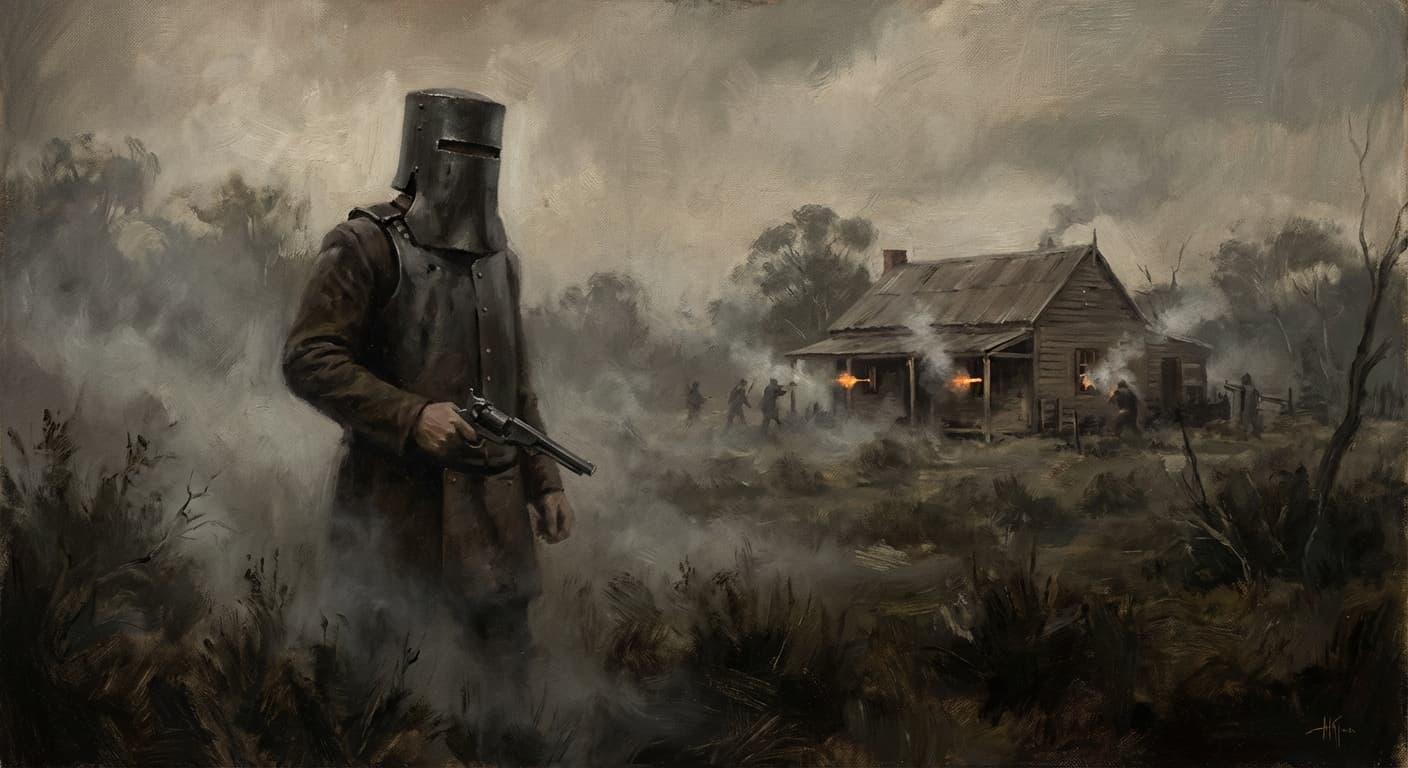
In the misty dawn of June 28, 1880, police surrounding a hotel in Glenrowan, Australia, saw something that defied logic. Emerging from the bush was a figure that looked less like a man and more like a medieval revenant or a metallic monster. He walked stiffly, his head encased in a cylindrical iron helmet, his chest protected by thick steel plating. Bullets fired by the terrified constables struck him, sparking and ricocheting off his body with a dull clang. This was not a ghost, nor a demon. It was Ned Kelly, the bushranger who had beaten ploughshares into armor to wage a private war against the British Empire.
To understand the spectacle of the armored outlaw, one must look at the harsh landscape of 19th-century colonial Australia. It was a world divided between the "Squatters"—wealthy landowners backed by the colonial government—and the "Selectors," poor struggling farmers, many of whom were of Irish convict descent. Edward "Ned" Kelly was born into the latter camp. The son of an Irish convict, Kelly grew up in poverty in Victoria, where police harassment of Irish families was a routine fact of life. By his teenage years, Ned was already acquainted with the inside of a prison cell, but few could have predicted his evolution from a petty horse thief to a revolutionary symbol.
The flashpoint occurred in April 1878, when a police constable named Alexander Fitzpatrick visited the Kelly home to arrest Ned’s brother, Dan. The incident is shrouded in conflicting testimony, but the result was clear: Fitzpatrick claimed he was shot in the wrist, and Ned's mother, Ellen Kelly, was sentenced to three years of hard labor for aiding an attempted murder. Incensed by what he viewed as a corrupt persecution of his family, Ned and Dan fled into the Wombat Ranges, joined by friends Joe Byrne and Steve Hart. The Kelly Gang was born.
The stakes escalated dramatically at Stringybark Creek later that year. When police parties were sent to hunt them down, the gang ambushed them, resulting in the deaths of three policemen. Ned Kelly was now a cop-killer, a marked man with the largest bounty in the British Empire on his head. Yet, as the gang robbed banks across Victoria and New South Wales, they didn't just take money; they burned mortgage deeds, freeing poor farmers from debt. Ned dictated the famous "Jerilderie Letter," a passionate, rambling manifesto justifying his actions and railing against the injustices inflicted upon the poor by the Victorian police. To the authorities, he was a cold-blooded murderer; to the struggling rural class, he was becoming a folk hero.
Knowing a final confrontation was inevitable, the gang prepared for a battle that would be unlike any other. Using mouldboards—the thick steel parts of ploughs used to turn soil—they fashioned suits of armor. In a bush forge, lacking professional tools, they heated the steel and beat it into shape. The resulting suits weighed nearly 100 pounds (44 kg) each. They were cumbersome and crude, but at a distance, they were proof against the Martini-Henry rifles used by the police.
The end came at Glenrowan. The gang had taken over the town, holding civilians hostage in the local inn. Their plan was to derail a police special train coming from Melbourne, causing a mass casualty event that would trigger a regional uprising. However, a released hostage warned the train in time, and the element of surprise was lost. The police laid siege to the inn. In the early morning mist, Ned Kelly, who had briefly slipped out of the cordon, decided to return to rescue his brother and friends. It was then that he walked into the police line of fire, clad in his iron suit. He fired his revolvers, taunting the police to "fire away."
The armor protected his head and torso, but his legs were exposed. A police sergeant, realizing the weakness, fired a shotgun into Kelly's legs, bringing the giant down. The siege ended with the inn burning to the ground; Joe Byrne died of a gunshot wound, while Dan Kelly and Steve Hart reportedly took their own lives inside the inferno. Only Ned survived to face the law.
Ned Kelly was tried and sentenced to death by hanging. On November 11, 1880, at the Melbourne Gaol, the 25-year-old outlaw faced the noose. His reported final words were as stoic as his life had been turbulent: "Such is life." While the 19th century was an era of industrial innovation and imperial expansion, the story of Ned Kelly serves as a reminder of the raw, violent frontier where the modern world collided with the desperation of the disenfranchised. Today, his death mask and his dented, homemade armor remain on display, enduring symbols of the blurred line between villain and hero.