The Iron Coffin: The Suicidal Voyage of the H.L. Hunley
On a freezing, moonlit night in February 1864, the calm waters of Charleston Harbor concealed a weapon unlike anything the world had ever seen. While the Union Navy’s mighty sloop-of-war, the USS Housatonic, bobbed gently on the blockade line, a shadow moved silently beneath the surface. It was not a sea monster, but a machine—a crude, rivets-and-iron tube propelled by the straining muscles of eight desperate men. This was the H.L. Hunley, and before the sun rose, it would change the course of naval warfare forever, marking the transition from the age of sail to the terrifying age of the submarine.
To understand the Hunley, one must understand the desperation of the American Civil War. The Confederacy was being strangled by the Union’s naval blockade, famously known as the "Anaconda Plan." Southern ports were choked off, starving the rebellion of supplies. In this climate of necessity, Horace Lawson Hunley, a wealthy lawyer and marine engineer, financed the creation of a "fish boat" designed to slip beneath the waves and break the wooden hulls of the Union fleet. But the resulting vessel was as dangerous to its crew as it was to the enemy. It was a forty-foot cylinder made from a retrofitted steam boiler, cramped, airless, and lit only by a single flickering candle that served as an oxygen gauge. When the flame died, the men knew they had minutes left to breathe.
Before its famous final mission, the submarine had already earned a dark reputation as a floating tomb. During testing, it sank twice. The first accident occurred at the dock, drowning five crew members when a passing steamer’s wake swamped the open hatch. The second disaster was even more personal; Horace Hunley himself took the helm for a demonstration, only to bury the vessel in the harbor mud, killing himself and seven others. General P.G.T. Beauregard, horrified by the loss of life, ordered the machine abandoned. But the allure of breaking the blockade was too strong. The vessel was raised, the bodies removed, and a third volunteer crew stepped forward, led by the charismatic Lieutenant George Dixon.
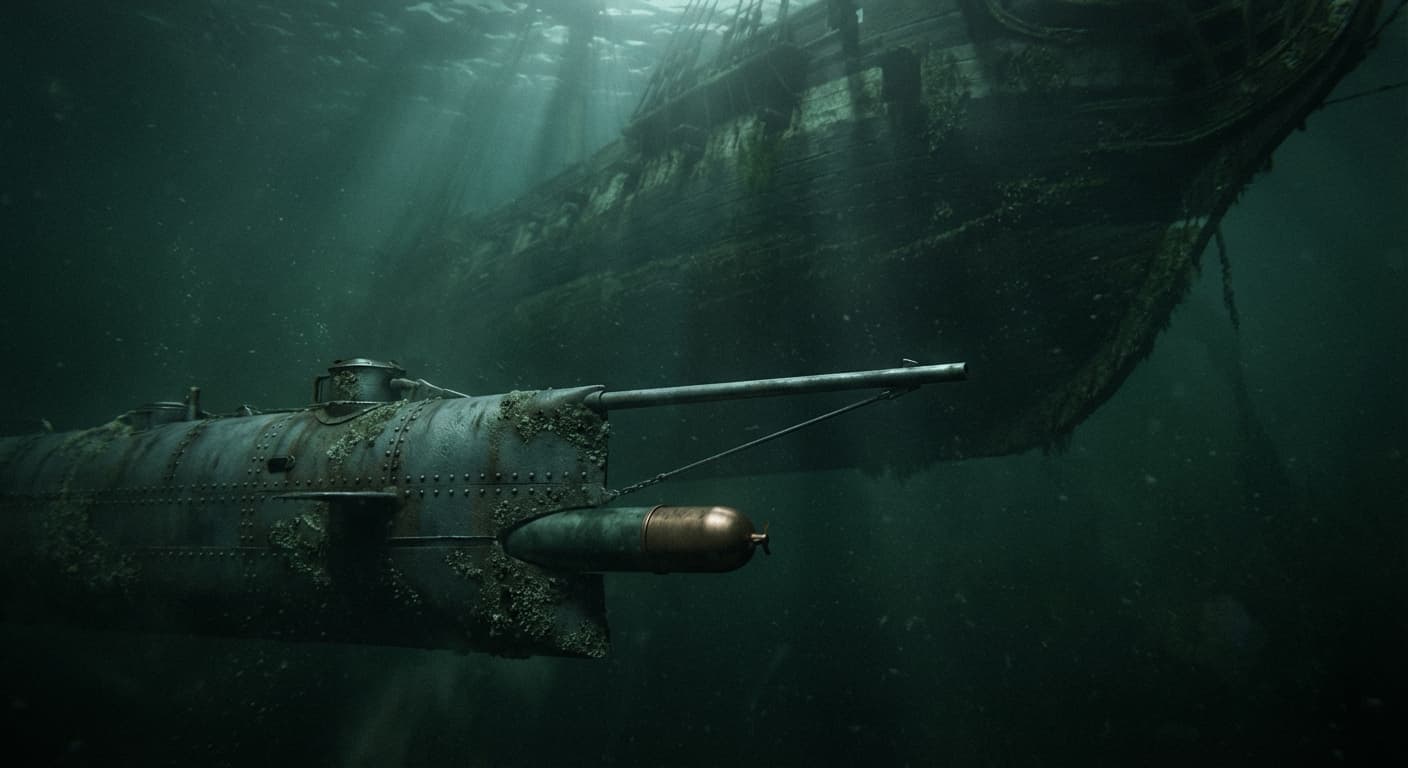
On the night of February 17, the Hunley embarked on its third and final voyage. Armed not with a cannon, but with a spar torpedo—a copper cylinder filled with 135 pounds of black powder attached to a long pole at the submarine's bow—the plan was simple but suicidal. They had to ram the Housatonic, embed the torpedo in its hull, reverse the submarine to pull a trigger cord, and detonate the charge. At around 8:45 PM, the officer on the deck of the Housatonic spotted what looked like a drifting log or a porpoise barely breaking the surface. By the time the alarm was raised, it was too late. The Hunley slammed into the warship.
A massive explosion shattered the silence of the harbor. The Housatonic was ripped open, sinking in less than five minutes and becoming the first ship in history to be sunk by a submarine. But the victory was pyrrhic. The Hunley signaled its success with a blue magnesium light to watchers on the shore, and then it vanished into the darkness, never to return. For over a century, the fate of the submarine remained one of the Civil War’s greatest mysteries. Did the explosion breach its own hull? Did they run out of air? Or was it simply the sea claiming its due?
It wasn't until 1995 that the wreck was discovered, buried in silt, and later raised in 2000 in an engineering feat almost as complex as its construction. Inside, archaeologists found a haunting scene: the crew was still at their stations, their skeletons resting over the hand-cranked propeller shaft. There was no sign of panic, no clawing at the hatches. They had simply drifted into eternity. Among the artifacts recovered was a warped gold coin belonging to Lieutenant Dixon, which he had kept as a good luck charm after it stopped a bullet from hitting his leg at the Battle of Shiloh.
The H.L. Hunley was a technological marvel and a horrifying deathtrap. In its career, it killed 21 Confederate sailors—three entire crews—to sink a single Union ship. Yet, that cold night in Charleston Harbor proved that the oceans were no longer safe for the great wooden titans of the past. The era of surface supremacy had ended, and the silent, deadly threat of underwater warfare had officially begun.