The Great Tea Race of 1866: The Last Golden Days of the Clipper Ship
In the annals of maritime history, few events capture the romance and adrenaline of the age of sail quite like the Great Tea Race of 1866. It was a time when the world was shrinking, yet the oceans remained vast and perilous arenas where commerce and courage collided. While the telegraph was beginning to stitch the continents together, the heavy lifting of global trade still relied on wood, canvas, and the wind. Nowhere was this more evident—or more fiercely contested—than in the annual rush to bring the first harvest of fresh tea from China to the eager teapots of London.
To the modern mind, the idea of a national frenzy over the arrival of dried leaves might seem quaint. However, in Victorian Britain, tea was more than a beverage; it was the lifeblood of social ritual. The first cargo of the new season's tea commanded a massive premium, not just for the merchants who sold it, but for the ship owners who transported it. A bonus of 10 shillings per ton was promised to the first ship to dock in London, but the real prize was the prestige. The ship that won the "Tea Race" would be immortalized in newspapers and betting shops across the Empire. In 1866, this commercial rivalry evolved into one of the closest and most thrilling sporting events of the 19th century.
Five magnificent clipper ships stood at the center of the drama: the Ariel, Taeping, Serica, Fiery Cross, and Taitsing. These were the "greyhounds of the sea," the pinnacle of naval architecture before steam power rendered them obsolete. Designed for pure speed, they featured sleek, narrow hulls and towering masts capable of carrying acres of canvas. On May 28, 1866, the ships lay at anchor at the Pagoda Anchorage in Foochow (modern-day Fuzhou), frantically loading chests of black tea. The Ariel, commanded by the aggressive Captain John Keay, was the first to finish loading, but due to tides and tug availability, the ships departed almost simultaneously. The starting gun had effectively fired on a 14,000-mile sprint across the globe.
The route was a grueling test of seamanship. The clippers had to navigate the treacherous South China Sea, thread through the Sunda Strait, cross the vast expanse of the Indian Ocean, round the stormy Cape of Good Hope, and then catch the trade winds up the Atlantic to the English Channel. For nearly 100 days, the ships pushed their rigging to the breaking point. Captains slept on deck, refusing to shorten sail even in gale-force winds, terrified that a competitor might be gaining a mile somewhere over the horizon. What made the 1866 race so extraordinary was that, despite the vast distances, the ships remained neck-and-neck. The Fiery Cross held a slight lead rounding the Cape, but the Ariel and Taeping were doggedly hunting her down.
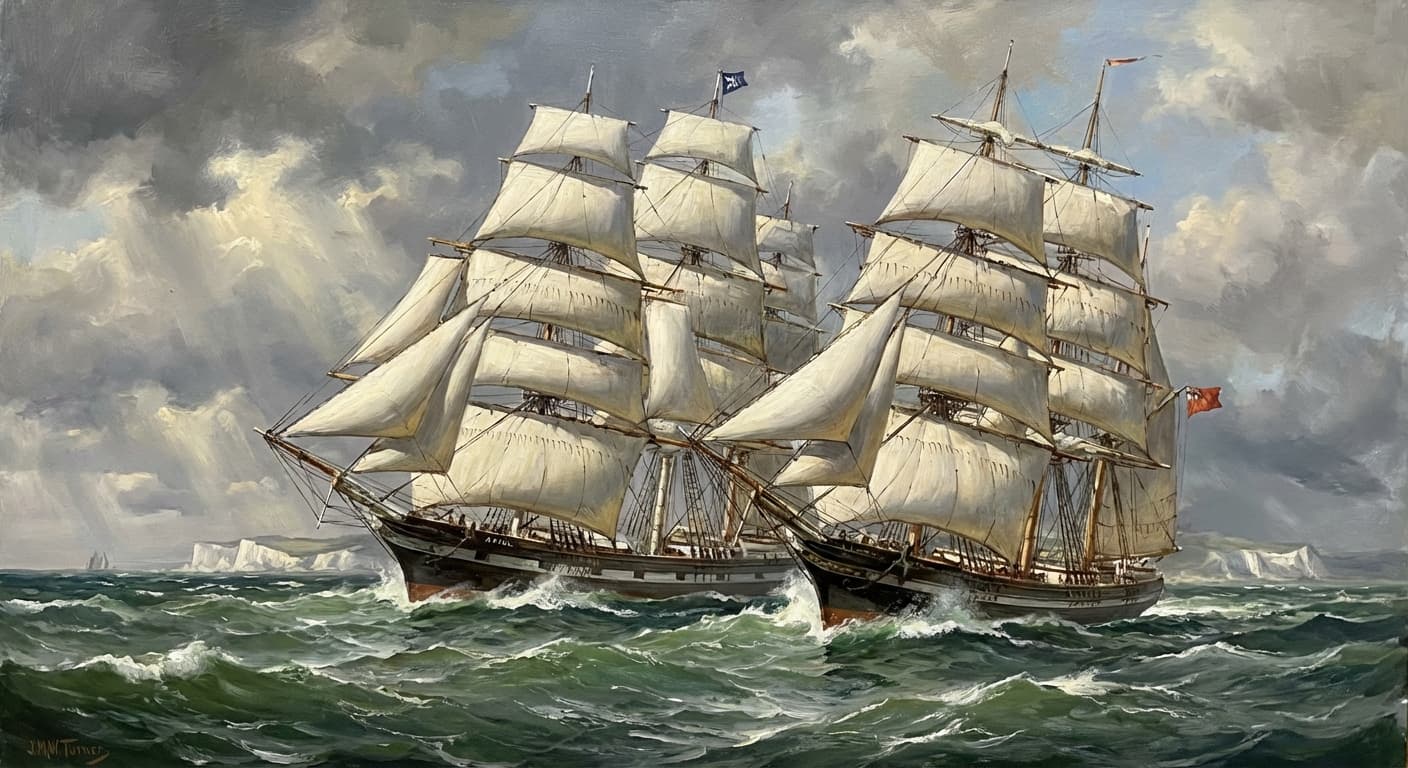
The climax of the race reads like fiction. After three months of sailing without sighting one another, the Ariel and the Taeping converged near the Azores. They had sailed halfway around the world only to find themselves virtually side-by-side. As they entered the English Channel on September 5th, the wind was fierce, and both captains piled on every scrap of canvas they possessed. They raced up the Channel at fourteen knots, with the White Cliffs of Dover serving as the finish line's backdrop. News of their arrival was telegraphed to London, sending the city into a fervor. Crowds gathered at the docks, and wagers were settled in chaotic exchanges.
At Dungeness, the Ariel signaled for a pilot just ten minutes ahead of the Taeping. However, the race wasn't over. The final leg required tugboats to tow the sailing ships up the River Thames to their respective docks. The Taeping, having a shallower draft and a bit of luck with a better tug, managed to squeeze into the London Docks just 20 minutes before the Ariel could enter the East India Docks. Technically, Taeping had docked first, but Ariel had arrived at the river mouth first. In a remarkable display of Victorian sportsmanship (and to avoid a lengthy legal dispute over the prize money), the owners agreed to split the premium. The captains, Keay and McKinnon, shared the £100 prize for the winning master.
The Great Tea Race of 1866 was the high-water mark of the clipper era. It was a fleeting moment of glory. Just three years later, in 1869, the Suez Canal opened, allowing steamships to bypass the long journey around Africa. Steamers, though uglier and smokier, were reliable and not dependent on the whims of the wind. The beautiful white-winged clippers were slowly relegated to slower cargoes like wool and nitrates, eventually disappearing from the seas. Yet, for that one glorious summer in 1866, the world watched in awe as wood and canvas defied the elements in the greatest ocean race history has ever seen.