The Great Stink of 1858: How London's Foul Odor Sparked a Public Health Revolution
The summer of 1858 was one for the history books in London, though not for reasons of conquest or grand invention. It was a summer defined by a stench so profound, so all-encompassing, that it brought one of the world's greatest cities to its knees and forced a radical transformation. This, my fellow history buffs, is the story of The Great Stink.
Imagine Victorian London at its peak: a teeming metropolis, the heart of an empire, a hub of commerce and culture. But beneath the gaslights and grand facades lay a sinister secret: an infrastructure utterly incapable of handling its own waste. For centuries, Londoners had relied on cesspools and a rudimentary system of sewers designed for rainwater, which now, increasingly, funneled human and industrial waste directly into the River Thames – London's primary source of drinking water.
As the city’s population exploded in the first half of the 19th century, so did the volume of effluent flowing into the river. Add to this the relatively new invention of the flush toilet, which, while convenient for individual households, only intensified the problem by efficiently moving waste from homes into the streets and rivers. The Thames became an open sewer, a putrid artery flowing through the heart of the capital, thick with human excrement, industrial pollutants, and the rotting carcasses of animals.
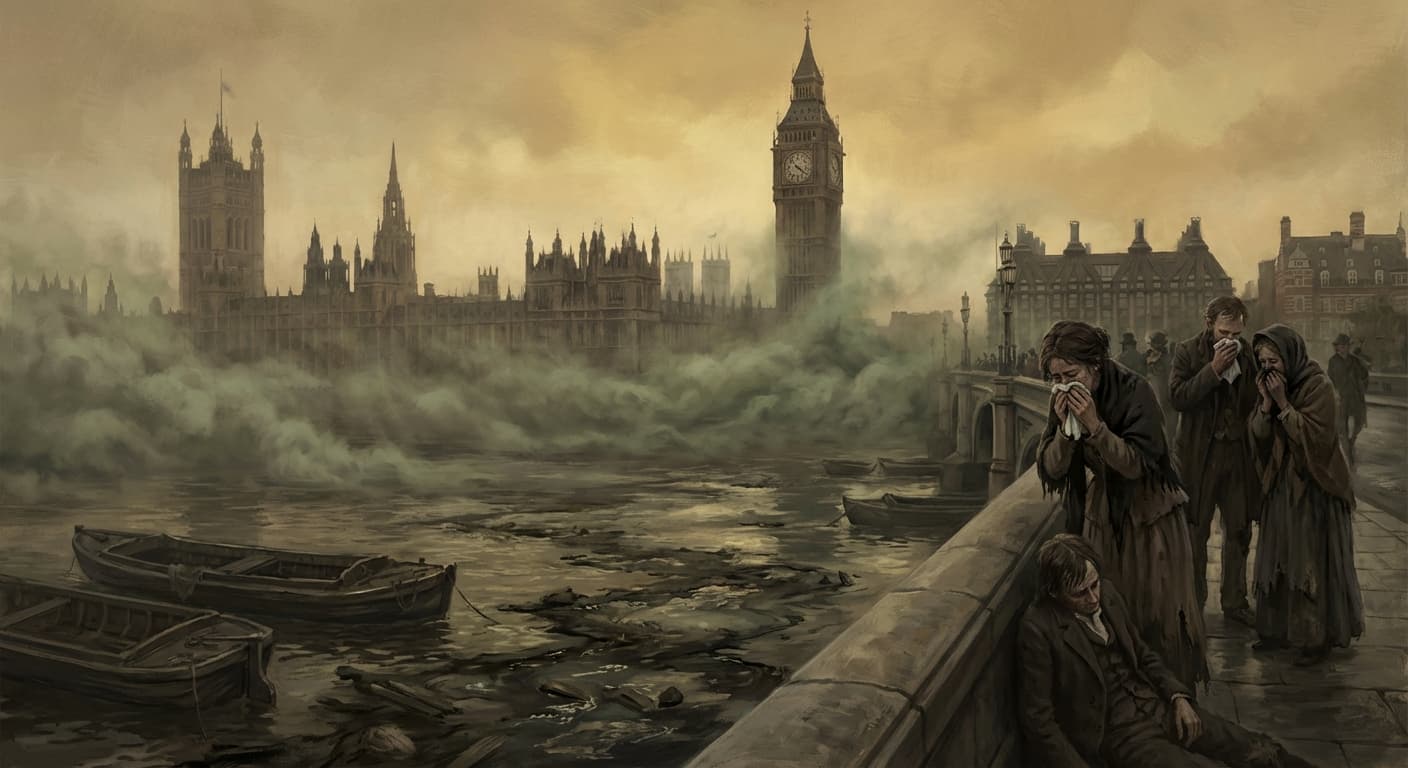
Then came the summer of 1858. An unusually hot and dry season reduced the flow of the Thames to a trickle, concentrating the pollution and allowing the raw sewage to bake under the relentless sun. The stench that rose from the river was beyond description. Contemporaries spoke of a "pestilential breath," a "miasmic fog" that permeated every corner of the city. Charles Dickens famously described it as "a deadly sewer… in the place of a fine fresh river."
The smell was so overpowering that it disrupted daily life. Businesses along the Thames embankment struggled, river traffic became unbearable, and even Parliament itself was paralyzed. Members of Parliament, attempting to legislate in the Palace of Westminster, were forced to douse curtains with disinfectant and hang sheets soaked in chloride of lime over their windows. Lord Palmerston, the then Prime Minister, reportedly considered moving the government entirely out of London. The Great Stink was not merely an inconvenience; it was a public health crisis and a political embarrassment of epic proportions.
This was an era when the dominant theory of disease was Miasma Theory – the belief that diseases like cholera and typhoid were caused by "bad air" or foul odors. While we now know germ theory is correct, the Victorians were, in a twisted way, right to fear the stench. The putrid air was a clear indicator of the bacterial soup brewing in the Thames, and outbreaks of cholera had already ravaged the city multiple times, claiming tens of thousands of lives. The Stink made the connection undeniable, even if the underlying mechanism wasn't fully understood.
Against this backdrop of putrefaction and political paralysis, a visionary engineer named Joseph Bazalgette, Chief Engineer of the Metropolitan Board of Works, emerged as London’s reluctant savior. For years, he had been championing a colossal project to construct a modern sewer system for the city, but it had been stalled by bureaucratic infighting, cost concerns, and differing scientific opinions. The Great Stink, however, finally broke the deadlock. Public outrage and parliamentary discomfort became the driving force for change.
With unprecedented speed, Parliament passed "An Act to make better provision for the main drainage of the Metropolis." Bazalgette was given the mandate and the resources he needed. His plan was audacious: an entirely new, integrated network of intercepting sewers running parallel to the Thames on both sides, diverting waste away from the river to new pumping stations. These stations would then lift the sewage into massive outfall sewers that carried it many miles eastward, to be discharged into the Thames only after the tide had begun to ebb, carrying it out to sea.
Over the next two decades, Bazalgette and his team performed an engineering feat that rivaled the Roman aqueducts. They built 1,100 miles of street sewers connecting to 82 miles of massive main intercepting sewers, often tunneling through dense urban areas and under existing buildings. They constructed four immense pumping stations, including the magnificent Crossness Pumping Station, which became a Victorian architectural marvel in its own right. The entire system relied on gravity, with careful gradients calculated to ensure efficient flow.
The impact was immediate and profound. Within a few years of the system's completion, cholera outbreaks became a thing of the past in London. The Thames, while not immediately pristine, began a slow process of recovery. Bazalgette's sewers effectively removed the primary source of disease from the city, dramatically improving public health and laying the foundation for modern urban sanitation. His work, though often unseen and uncelebrated, directly saved countless lives and remains largely in use today, a testament to its enduring design.
The Great Stink of 1858 stands as a powerful reminder of how a seemingly unpleasant problem can spark monumental change. It illustrates the incredible power of public health infrastructure, the ingenuity of Victorian engineering, and how sometimes, a truly intolerable situation is what's needed to overcome political inertia and build a better world. Next time you flush a toilet in London, spare a thought for Joseph Bazalgette and that unforgettable summer.