The Day the Engines Coughed: The Great Epizootic that Paralyzed North America
Imagine the bustling heart of a 19th-century metropolis: New York, Boston, or Chicago. You expect the cacophony of iron-shod hooves striking cobblestone, the rattle of wagons, the shouts of drivers, and the constant hum of commerce. Now, imagine waking up one crisp autumn morning to find that entire world reduced to an eerie, unnatural silence. The streets are empty of transit. Groceries sit rotting on docks. Coal shipments are stranded at train depots. This was not the plot of a Victorian dystopian novel. It was a very real, very devastating event known as the Great Epizootic of 1872.
The Biological Engine of the 19th Century
To understand the sheer scale of this crisis, we must first recognize a fundamental truth of the 1870s: the engine of the 19th century was not just steam; it was muscle. While railroads connected distant cities, the internal circulatory system of every urban center relied entirely on the horse. Horses pulled the streetcars that brought workers to factories. They hauled the produce that fed the masses. They transported the coal that heated homes and powered industrial boilers. They were the essential living cogs in the machinery of modern civilization.
The Spread of the "Canadian Horse Disease"
The crisis began quietly in late September 1872, in the pastures just outside Toronto, Canada. A highly contagious equine influenza emerged, characterized by a hacking cough, fever, nasal discharge, and extreme lethargy. At first, it was dismissed as a localized nuisance, dubbed the "Canadian Horse Disease." But the virus moved with terrifying speed. Because horses were constantly transported via railways and driven across borders, the illness leaped from stable to stable. By mid-October, it had swept into the United States, paralyzing Detroit, Buffalo, and New York City.
The morbidity rate of the Great Epizootic was staggering. While it was not particularly lethal—killing only about one to two percent of the animals it infected—it incapacitated nearly 100 percent of them. A horse with the flu simply could not work. Almost overnight, the transportation network of North America completely collapsed. Without the equine workforce, cities were forced into desperate improvisation.
A City Brought to a Halt
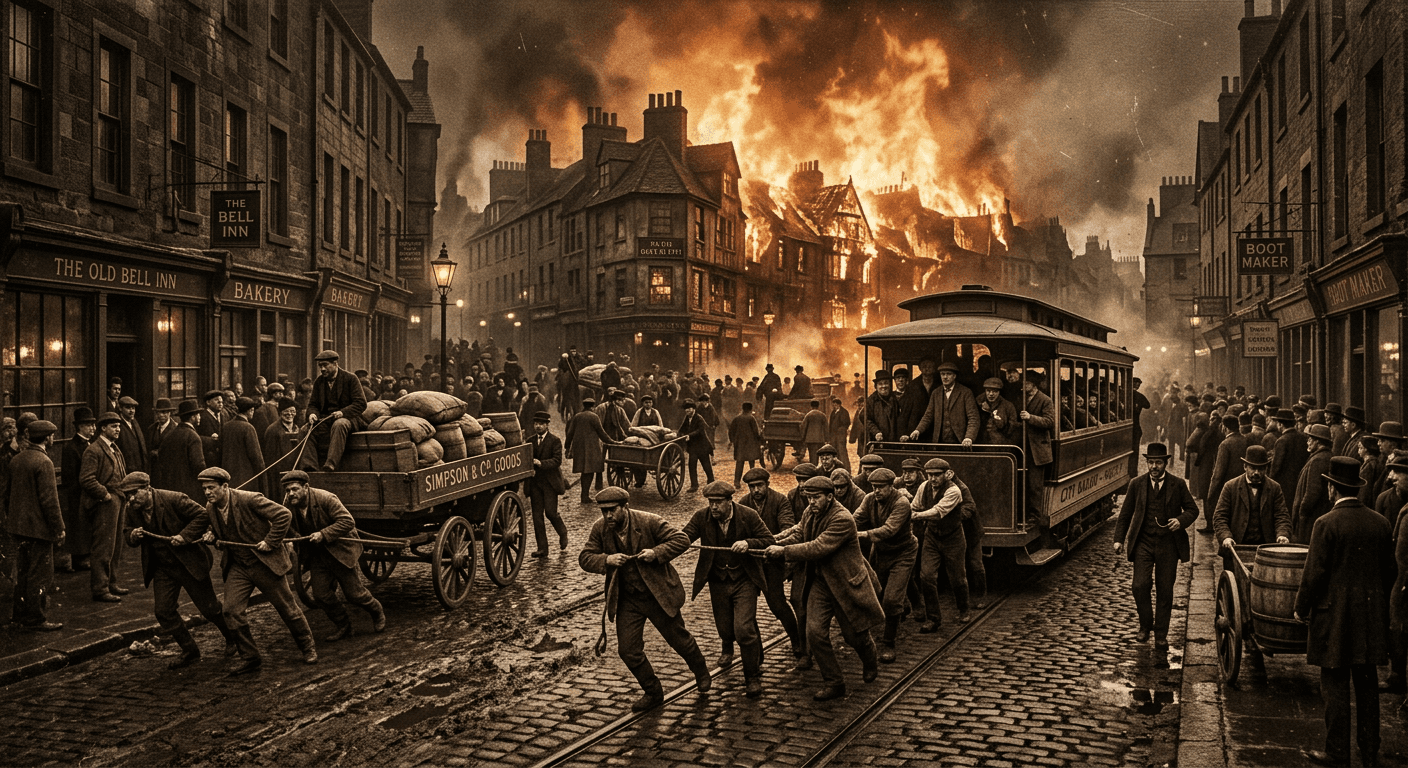
Newspapers from the era paint a surreal picture of urban life during the outbreak. In New York and Chicago, wealthy merchants and prominent businessmen were seen walking miles to work, a rare sight in an era defined by carriage rides. With winter rapidly approaching and coal supplies dwindling at rail depots, desperation set in. Human labor was conscripted to fill the void. Groups of men were hired to drag heavy wagons of essential supplies through the streets, forming what the press grimly called "wheelbarrow expresses." The sight of humans harnessed to streetcars and cargo drays served as a stark, humiliating reminder of humanity's absolute dependence on the animal kingdom.
The Great Boston Fire
But the Great Epizootic was not merely an economic inconvenience; it was a matter of life and death. Nowhere was this more tragically demonstrated than in Boston. On the evening of November 9, 1872, a fire broke out in the basement of a commercial warehouse. Under normal circumstances, the city's fire department would have arrived within minutes, their heavy steam-powered pumpers drawn by teams of powerful fire horses. But Boston's fire horses were incapacitated by the flu.
With their animals too weak to stand, the firefighters had to rely on teams of men to drag the massive fire engines by hand through the cobblestone streets. The delay was catastrophic. By the time the exhausted men positioned their equipment, the blaze had spiraled out of control. The Great Boston Fire of 1872 raged for over twelve hours, consuming 65 acres of downtown Boston, destroying 776 buildings, and causing over $73 million in damage. It remains one of the most expensive property fires in American history—all because a virus had silenced the city's horses.
The Legacy of the Silent Streets
By the spring of 1873, the virus had largely run its course, eventually burning out after reaching the West Coast and parts of Latin America. The horses that survived developed immunity, and the rhythmic clatter of hooves slowly returned to the streets of North America. The crisis faded from the headlines, soon overshadowed by the financial Panic of 1873. Yet, the Great Epizootic left a profound and lasting legacy.
The sudden, terrifying halt of society served as a wake-up call to the vulnerabilities of relying on animal labor. It ignited fierce debates about animal welfare, directly bolstering the early efforts of the American Society for the Prevention of Cruelty to Animals (ASPCA), as the public was forced to confront the appalling conditions in which urban horses lived and worked. More importantly, it accelerated the pursuit of mechanical alternatives. The vulnerability exposed by the equine flu of 1872 spurred inventors and investors to double down on developing electric streetcars, cable cars, and, eventually, the internal combustion engine.
Today, the Great Epizootic is largely a forgotten footnote in history. But for a few terrifying months in the 19th century, it proved that despite all the era's towering achievements in steel, steam, and telegraphy, human civilization was still desperately tethered to the health of the humble horse.