The Great Diamond Hoax of 1872: How Two Scruffy Prospectors Fooled the Gilded Age Elite
In the annals of American confidence games, few schemes rival the sheer audacity and scale of the Great Diamond Hoax of 1872. It was a con that targeted not the gullible masses, but the titans of industry, the smartest bankers in San Francisco, and even the founder of the world’s most famous jewelry empire. It is a story of greed, geological ignorance, and a bag of uncut gems that turned the financial world upside down.
The Bag on the Counter
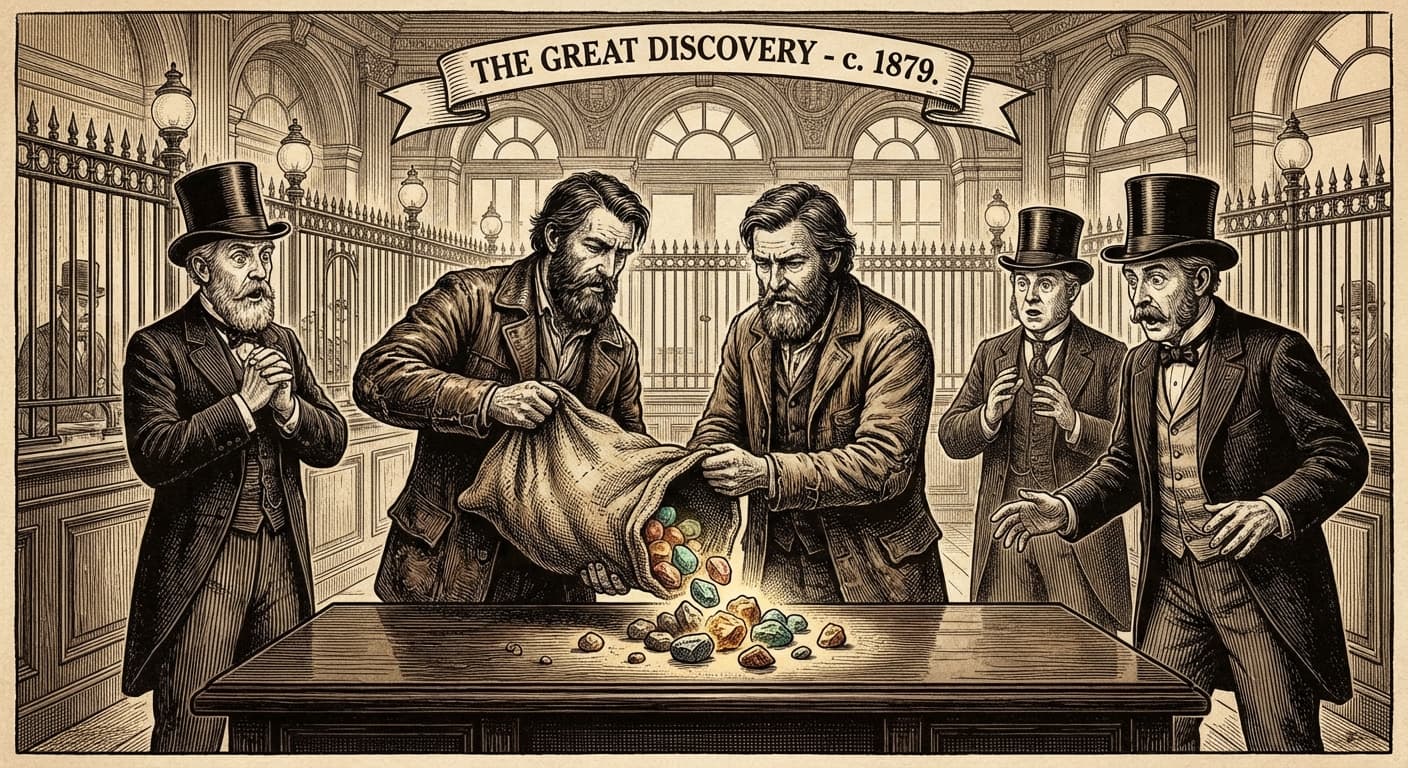
The drama began in early 1872 in San Francisco, the beating heart of the post-Gold Rush West. Two rough-looking men, Philip Arnold and John Slack, walked into the Bank of California. They were cousins from Kentucky, dressed in the dusty garb of prospectors who had spent too much time in the wild. They asked to deposit a small, heavy canvas bag in the bank's vault. They were acting nervous—too nervous.
When a bank bookkeeper asked about the contents, the men were evasive. Eventually, curiosity got the better of the bank's founder, William Ralston. When the bag was opened, it spilled out a dazzling array of uncut diamonds, rubies, sapphires, and emeralds. The prospectors claimed they had stumbled upon a secret mountain of gems somewhere in the desolate American interior. They just wanted to stash their loot and disappear.
Hooking the Whales
Ralston, a man who had made a fortune on the Comstock Lode, smelled an opportunity that dwarfed silver and gold. He wasn't alone. A syndicate was quickly formed, including Asbury Harpending (a financier with a colorful history of Confederate privateering) and even Civil War General George B. McClellan. They were desperate to buy out the prospectors' claim.
Arnold and Slack played their parts perfectly. They feigned reluctance, acting like simple men who were overwhelmed by the complexity of high finance. They agreed to take a representative to the site, but only on the condition that the man be blindfolded for the entire journey from the train station to the mine.
The syndicate agreed. They sent a mining expert, Henry Janin, to the secret location. After a dizzying journey involving trains and horses, the blindfold was removed. Janin found himself on a mesa where diamonds literally lay in the dirt. He kicked an anthill and found emeralds. He spent a few hours and filled a bag. Janin returned to San Francisco and declared, "I would consider any investment at the rate of $40 million a safe one."
The Tiffany Seal of Approval
To be absolutely certain, the investors took a sample of the gems to New York City to see the ultimate authority: Charles Lewis Tiffany, founder of Tiffany & Co. In what would become the most embarrassing moment of his career, Tiffany examined the stones. Perhaps blinded by the sheer volume of gems or the excitement of an American diamond rush, he valued the small sample at $150,000 (millions today).
With Tiffany's blessing, the skepticism evaporated. The investors bought out Arnold and Slack for roughly $600,000. The prospectors took their cash and promptly vanished back to Kentucky. The investors prepared to float a $10 million company to the public.
The Man Who Read the Land
While the financiers were counting their future billions, a government geologist named Clarence King was working on the 40th Parallel Survey. King was a man of science, not speculation. When he heard rumors of the diamond fields, he was puzzled. Based on the geological makeup of the West, diamonds and emeralds—which require vastly different conditions to form—should not be found side-by-side.
Using scattered details leaked by the mining engineers who had visited the site (descriptions of the topography and travel time), King triangulated the location. It was a remote spot near the border of Colorado, Utah, and Wyoming.
King and his team rode out to the site. At first, they found exactly what Janin had found: diamonds in the dirt. But King looked closer. He noticed that the diamonds were found in crevices where a man might poke a stick. He found a diamond with a cut face—impossible in nature. Finally, the smoking gun: he found a stone that clearly bore the marks of a lapidary’s tool.
King realized that the field had been "salted." Arnold and Slack had traveled to London, bought roughly $35,000 worth of reject industrial-grade diamonds and low-quality rubies, and physically planted them in the ground. They had even poked holes in anthills to drop gems inside.
The Crash
King sent a telegram to the syndicate: "The alleged diamond fields are a fraud." The bubble burst instantly. The $10 million company dissolved before it began. Ralston returned the money to his investors out of his own pocket to save his reputation.
As for the con men? They had executed the perfect crime. Arnold lived out his days as a wealthy banker in Kentucky, eventually settling a civil suit for a fraction of his take. Slack vanished into obscurity, allegedly working as a coffin maker in New Mexico. They had proven that even the most sophisticated men of the Gilded Age could be blinded by the oldest glitter in the world.