The Great Berners Street Hoax: How One Man Trolled All of London in 1810
In the modern era of the internet, we think we've perfected the art of the troll. From Rickrolling to elaborate digital pranks, online mischief-makers pride themselves on creating chaos. But the undisputed king of the troll lived more than a century before the first computer was even plugged in. His name was Theodore Hook, and in the autumn of 1810, he pulled off what is arguably the greatest, most elaborately orchestrated practical joke in history: The Berners Street Hoax. With nothing more than a pen, paper, and a wicked sense of humor, Hook managed to bring the capital of the British Empire to a grinding, chaotic halt.
Theodore Hook was a renowned author, composer, and notorious prankster in Regency-era London. He was known for his quick wit and his ability to extemporize entire comic operas on the spot. But his true masterpiece wasn't performed on a stage; it was executed on the streets of London. The entire scheme was born out of a simple, seemingly impossible bet. While walking down Berners Street with his friend, the architect Samuel Beazley, Hook pointed to a completely unremarkable terrace house at Number 54. He bet Beazley one guinea that within a single week, he could make that quiet, unassuming address the most talked-about house in all of London.
The victim of this wager was a respectable, entirely innocent widow named Mrs. Tottenham. Hook rented a room directly across the street from Number 54, providing himself and Beazley with the perfect theater box for the upcoming show. For the next several days, Hook embarked on a writing marathon. He wrote and mailed over 4,000 letters, all claiming to be from Mrs. Tottenham. Hook didn't just write to random people; he carefully targeted every conceivable trade, profession, and high-ranking official in the city, scheduling them all to arrive on the exact same day: November 27, 1810.
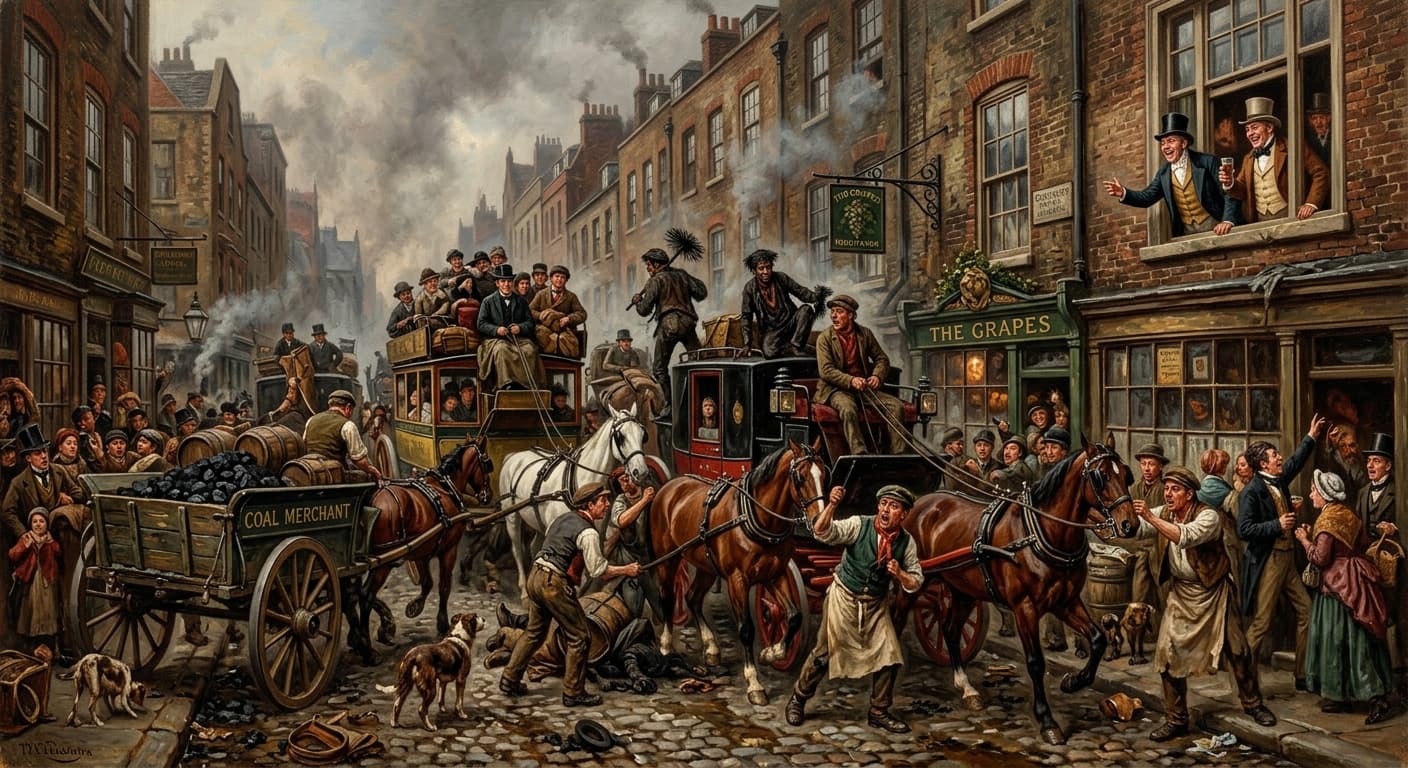
The chaos began just as the sun rose. At 5:00 AM, a bewildered chimney sweep knocked on Mrs. Tottenham's door, claiming he had been summoned to clean the flues. The maid sent him away, but within moments, a second sweep arrived. Then a third. By 6:00 AM, twelve different chimney sweeps were loitering outside the house. But Hook was just getting warmed up. By 7:00 AM, a fleet of heavy wooden carts carrying massive loads of coal began lumbering into the narrow street, completely blocking traffic.
As the morning progressed, the bizarre parade escalated into pure surrealism. Bakers arrived carrying half a dozen massive wedding cakes. They were followed by doctors offering to perform an immediate amputation on the widow, lawyers prepared to draft her final will and testament, and vicars ready to administer her last rites. Dozens of fishmongers, shoemakers, and haberdashers showed up, all demanding payment for goods ordered in Mrs. Tottenham’s name. A hearse even pulled up, complete with a custom-made coffin built to the exact specifications mentioned in one of Hook’s letters.
By midday, the situation had deteriorated into a full-scale riot. Pianos and organs were being dragged through the crowd, only to be turned away at the door. Carts were overturned, fistfights broke out among the frustrated tradesmen, and the narrow Georgian street was completely gridlocked. But Hook had saved his best trick for last. He hadn't just sent letters to merchants; he had written to the highest echelons of British society. The Governor of the Bank of England arrived, having received a frantic letter about a massive fraud. He was soon joined by the Archbishop of Canterbury, the Lord Chief Justice, and the Lord Mayor of London himself. Even the Duke of York, the Commander-in-Chief of the British Army, made an appearance, believing he had been summoned for matters of national security.
From his rented room across the street, Theodore Hook sat with his friend Beazley, watching the madness unfold while safely sipping tea. The police were eventually deployed to clear the area, but the sheer volume of traffic and angry vendors meant the street wasn't fully cleared until late into the night. The city was in an uproar, and the authorities immediately launched an investigation to find the culprit who had dared to prank the highest officials in the land. A massive reward was offered, and though a few people suspected Hook—given his notorious reputation—he had carefully covered his tracks.
To avoid the intense heat of the investigation, Hook quietly packed his bags and took a sudden vacation to the countryside for a few weeks. He never officially confessed to the crime during the immediate aftermath, though the truth eventually leaked out, cementing his legacy as the ultimate maestro of mischief. Today, the Berners Street Hoax stands as a hilarious testament to the power of organization, proving that long before the days of social media, a single determined individual could still manage to break the network.