The Ghost Army That Fought the Future: The Midnight Raids of the Luddite Rebellion
Today, if you struggle to set up a smart TV or stubbornly refuse to upgrade your ten-year-old flip phone, somebody will inevitably roll their eyes and call you a "Luddite." The word has become a harmless punchline, a cultural shorthand for anyone who is simply out of touch with modern technology. But if you were to travel back to the soot-choked skies of 1810s England, calling someone a Luddite meant something entirely different. It meant you were talking about a masked, hammer-wielding insurgent—a member of a secret rebel army that terrified the British establishment so thoroughly that the government deployed more soldiers to fight them than they sent to battle Napoleon on the Iberian Peninsula.
The true story of the Luddite Rebellion is not a tale of foolish people who didn't understand how machines worked. It is the dramatic, desperate, and bloody story of skilled artisans fighting for their very survival against the unchecked greed of early industrial capitalism.
At the dawn of the 19th century, the British textile industry was primarily a cottage industry. Highly skilled weavers, knitters, and croppers worked from their homes or small community workshops, enjoying a respectable standard of living built on years of careful apprenticeship. But the ongoing Napoleonic Wars had decimated the British economy, causing food prices to soar and international trade to plummet. Into this desperate, fragile environment, ruthless factory owners began introducing wide-frame looms and automated spinning frames. These machines were not operated by seasoned craftsmen, but by unapprenticed, unskilled laborers—often women and young children—who were paid a mere fraction of the traditional wages. The master weavers watched their livelihoods and their craft vanish overnight, replaced by the deafening clatter of factory production.
Facing starvation, the workers didn't blindly attack the concept of progress; their grievance was highly specific. They targeted the factory owners who used technology in a "fraudulent and deceitful manner" to bypass standard labor practices and cut corners on the quality of goods. When their peaceful petitions for a minimum wage, reasonable working hours, and government intervention were completely ignored by parliament, the weavers decided it was time to take matters into their own hands. If the law wouldn't protect them, the hammer would.
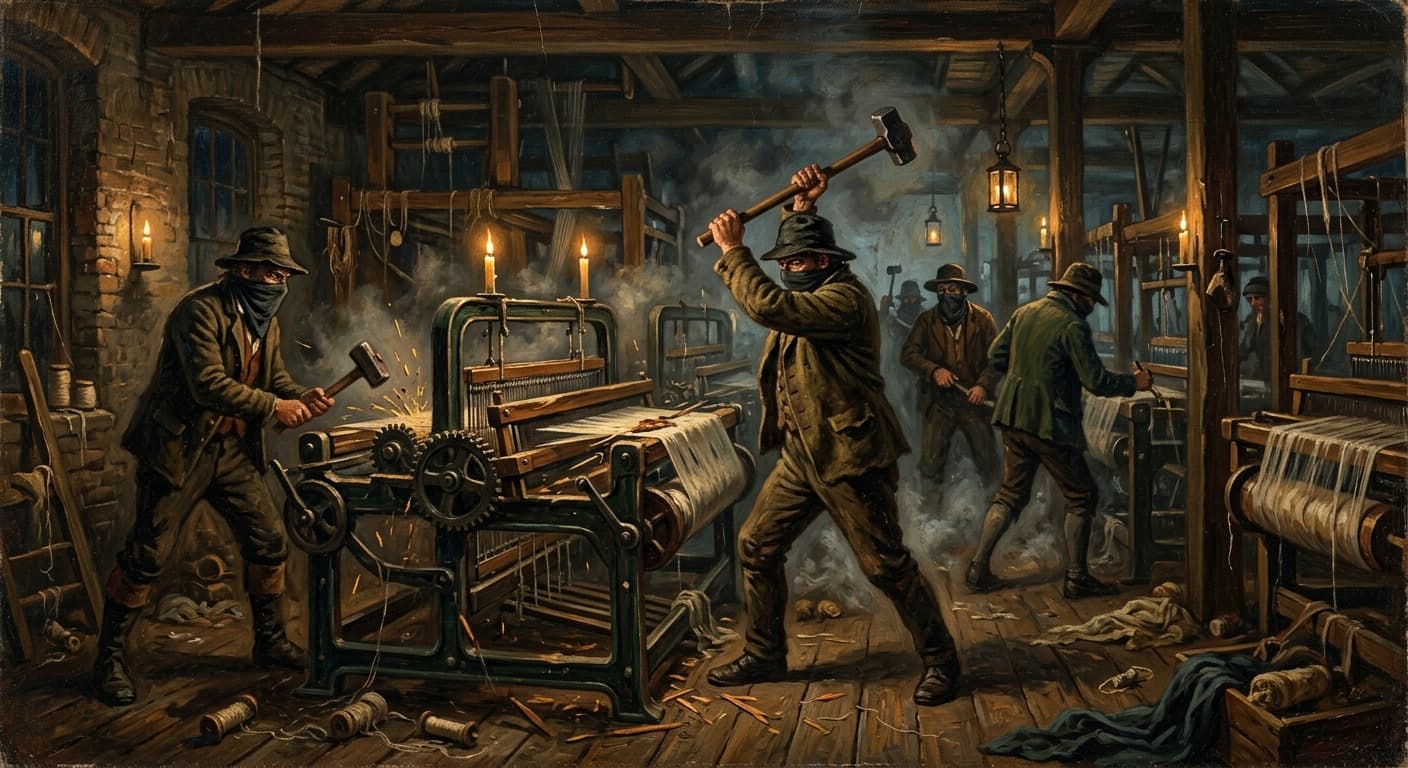
In November 1811, the midnight raids began in Nottinghamshire. Groups of desperate men, their faces blackened with coal dust to hide their identities, descended upon targeted factories under the cover of darkness. Armed with muskets, pistols, and massive sledgehammers, they smashed the offending machinery to splinters, burned the mills, and vanished back into the night like ghosts. They operated with shocking military precision, guided by an elaborate network of spies, secret passwords, and blood oaths.
To strike fear into the hearts of the factory owners, the rebels invented a mythical leader: General Ned Ludd, sometimes known as King Ludd. According to local folklore, Ned Ludd was a weaver's apprentice who had smashed a loom in a fit of righteous rage decades earlier. General Ludd didn't actually exist—he was the 19th-century equivalent of a working-class Batman—but the letters sent in his name were terrifying. Mailed from "Sherwood Forest," these threatening notes promised that "General Ludd's Army of Redressers" would visit the homes of any industrialist who did not raise wages and abandon the new machines.
The most famous weapon in General Ludd’s arsenal was a massive sledgehammer affectionately nicknamed "Enoch." In a brilliant stroke of irony, the hammer was named after Enoch Taylor, the very blacksmith who manufactured the hated wide-frame looms. The Luddites marching to the mills would often chant a grim nursery rhyme: "Enoch made them, and Enoch shall break them."
As the rebellion spread across Yorkshire and Lancashire in 1812, the British government went into a full-blown panic. Parliament hurriedly passed the Frame Breaking Act, a draconian piece of legislation that made the destruction of mechanized looms a capital crime punishable by death. The poet Lord Byron, in his maiden speech to the House of Lords, passionately defended the Luddites and mocked the government's cruelty, asking if they planned to hang men simply for the crime of being hungry. The government's answer was a resounding yes.
The breaking point came in April 1812, when a prominent and ruthless mill owner named William Horsfall was assassinated by a group of Luddites as he rode his horse across the Yorkshire moors. In response, the state unleashed the full might of the British military. Over 12,000 troops were deployed into the English heartland to crush the rebellion. Massive show trials were held at York Castle, resulting in dozens of men being hanged and many more being loaded onto prison ships and transported to the penal colonies of Australia.
By 1816, the Luddite movement had been completely broken by the iron fist of the state. The machines had won, and the harsh, unregulated reality of the factory system became the grim new normal of the Victorian era. Yet, the legacy of General Ludd’s ghost army remains deeply misunderstood. They were not anti-technology simpletons; they were early pioneers of the labor movement. They picked up their sledgehammers not to stop the future, but to demand a future where technological progress didn't come at the cost of human dignity.