The Forgotten Tragedy of the Sultana: How the Deadliest Shipwreck in American History Was Lost to Time
When the subject of maritime disasters is breached, one name immediately commands the room: the Titanic. It is the undisputed king of catastrophic lore, immortalized in countless books, documentaries, and blockbuster films. Yet, the deadliest maritime disaster in United States history did not happen on an iceberg-laden ocean in the 20th century. It happened on a flooded American river in the 19th century, claiming more lives than the Titanic, only to be swallowed whole by the relentless churn of a distracted news cycle. This is the tragic, largely forgotten story of the steamboat Sultana.
The year was 1865. The month of April had been an emotional centrifuge for the American public. General Robert E. Lee surrendered at Appomattox on April 9th, effectively ending the grueling, blood-soaked four years of the American Civil War. Less than a week later, on April 14th, President Abraham Lincoln was assassinated. The nation was simultaneously experiencing the euphoric relief of peace and the crushing despair of losing its leader. News traveled via telegraph and newspaper, and the entire country was captivated by the ongoing manhunt for John Wilkes Booth. It was within this frenzied, exhausted national mood that the Sultana prepared to make her fateful voyage.
The Sultana was a 260-foot-long wooden paddle-wheeler, built in 1863 and designed to carry a maximum capacity of 376 passengers alongside a standard load of cotton. In late April 1865, the vessel was docked in Vicksburg, Mississippi. The federal government was paying steamboat captains a handsome sum to transport recently released Union prisoners of war back to the North. These soldiers had survived the unimaginable horrors of Confederate prison camps like Andersonville and Cahaba. Emaciated, sick, and desperate to see their families, they were human cargo with a lucrative price tag: 5 dollars per enlisted man and 10 dollars per officer.
Captain J.C. Mason of the Sultana, eager to secure a massive payday, made a fatal decision. When one of the ship's four boilers developed a severe leak, a mechanic warned that it required extensive repairs. Fearful that a delay would cause him to lose his human freight to a rival steamboat, Mason ordered a hasty, inadequate patch job. The mechanic slapped a thinner piece of metal over the bulge in the boiler, a temporary fix that was a ticking time bomb.
On April 24, the Sultana departed Vicksburg. The scene on board was a staggering display of overcrowding. Over 2,400 people were crammed onto a vessel meant for fewer than 400. The decks sagged under the sheer weight of the jubilant but frail soldiers. Men slept shoulder-to-shoulder on every available square inch of floor space, including the hurricane deck and the roofs of the cabins. Despite the dangerous overcrowding and a river swollen with spring snowmelt, the mood was joyous. They had survived the war; they were finally going home.
The Mississippi River was experiencing one of its worst spring floods in history, overflowing its banks for miles. The Sultana struggled against the powerful current, its hastily patched boilers working overtime to push the massively overloaded, top-heavy ship upstream.
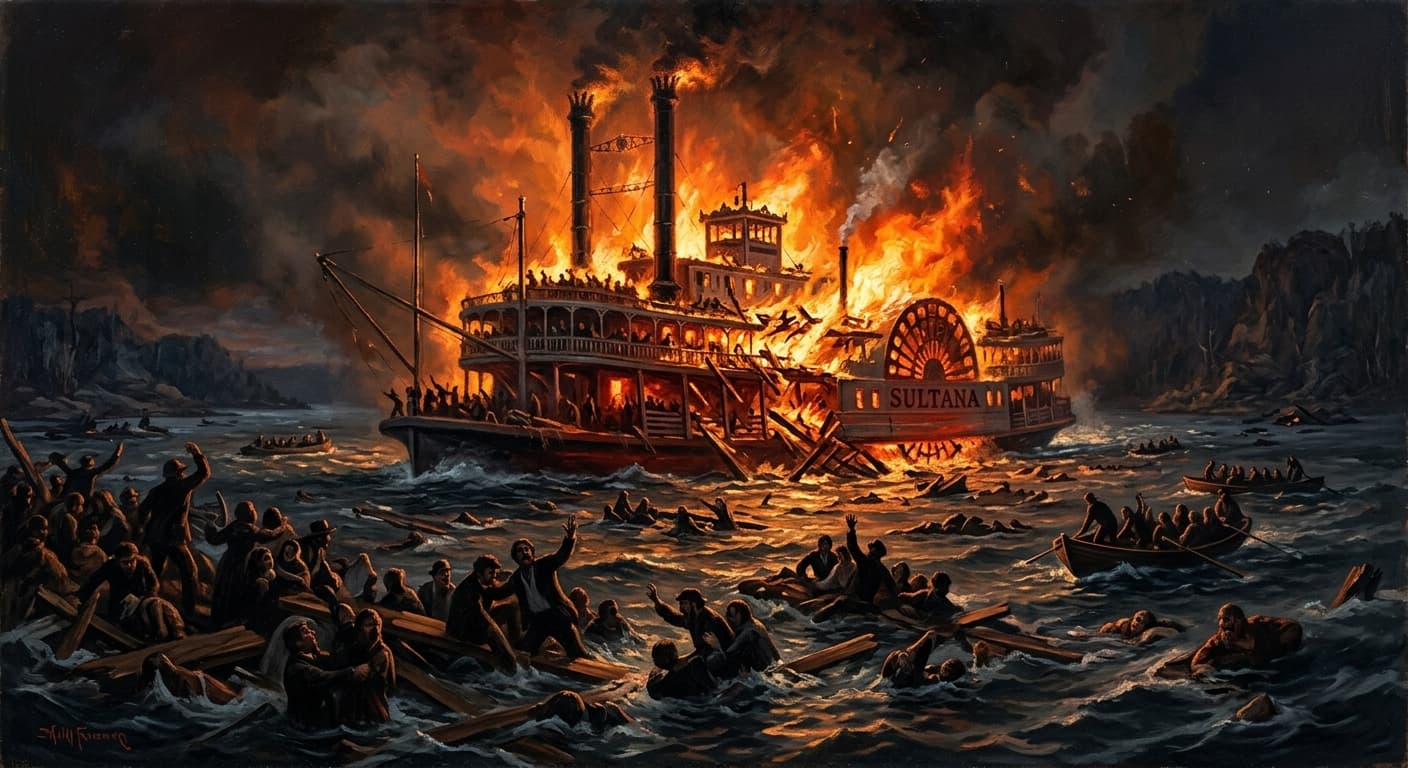
At 2:00 AM on April 27, 1865, just a few miles north of Memphis, Tennessee, the overworked, poorly repaired boilers gave out. Three of the four boilers exploded with an apocalyptic roar. The blast ripped through the center of the wooden ship, instantly vaporizing the pilot house and tearing the vessel in half.
The explosion flung hundreds of sleeping soldiers into the freezing, turbulent waters of the Mississippi. Those who were not killed by the initial blast or the flying shrapnel faced a horrific choice: burn to death on the rapidly sinking, flaming wreckage, or take their chances in the icy, flooded river. Emaciated from months in prison camps, many lacked the strength to swim. Chaos reigned as men clung to anything that floated—doors, window frames, and even dead horses.
Rescue efforts were mounted as the dawn broke, but for many, it was far too late. By the time the fiery remnants of the Sultana sank into the mud of the Mississippi, an estimated 1,800 people had perished. To put that into perspective, the Titanic claimed approximately 1,500 lives. It was an unprecedented loss of life.
Yet, the disaster of the Sultana barely made a ripple in the historical record. Why? The timing could not have been worse for securing a place in the national memory. The tragedy occurred on the very same day that John Wilkes Booth was hunted down and killed in a Virginia barn. The newspapers were utterly consumed with the closing act of the Lincoln assassination drama. Furthermore, after four years of a war that had claimed over 600,000 lives, the American public was entirely numb to mass casualty events. A tragic accident, even one of this magnitude, felt like just another drop in an ocean of grief.
Today, the story of the Sultana remains a tragic footnote, a ghost story of the mighty Mississippi. There is no blockbuster movie, no museum dominating a major city waterfront. But for the history buff, it serves as a powerful reminder of how timing dictates the stories we remember and the ones we forget. The men aboard the Sultana had survived the battlefields and the squalor of prison camps, only to be failed by the reckless greed of a captain and the unfortunate timing of history. Theirs is a story of resilience, tragedy, and the cruel capriciousness of fame—a story that deserves to be pulled from the depths and finally brought into the light.