The Emperor's Butter: How a French Chemist Sparked the Centuries-Long War Over Margarine
In the late 1860s, Emperor Napoleon III of France found himself staring down a logistical nightmare. His empire was expanding, his military was growing, and his urban populations were swelling. Feeding these hungry masses was becoming increasingly expensive, and one particular staple was causing an outsized headache: butter. Butter was a vital source of calories, but it was costly, spoiled rapidly in the field, and was prone to wildly fluctuating prices based on the seasons. Realizing that an army marches on its stomach, the Emperor offered a handsome prize to anyone who could invent a cheap, stable, and palatable substitute for butter.
Enter Hippolyte Mège-Mouriès, a brilliant but slightly eccentric French chemist. Mège-Mouriès had already made a name for himself by inventing a medicine to cure syphilis and a new method for baking bread, but the Emperor's challenge intrigued him. He set up a laboratory on an imperial farm near Paris and began experimenting. The chemist noticed something peculiar during his research: cows that were subjected to prolonged fasting still produced milk containing fat. He deduced that the fat must be coming from the cows' own stored body tissue.
Acting on this biological observation, Mège-Mouriès began rendering beef tallow at low temperatures. He extracted the liquid portion of the beef fat and churned it with skimmed milk and a bit of water. The resulting emulsion was chilled and kneaded until it formed a pearly, white, spreadable substance that tasted remarkably similar to actual butter. He called it oleomargarine, deriving the name from oleum (Latin for oil) and margarite (Greek for pearl), owing to its distinctive pearlescent sheen. In 1869, he patented his creation and claimed the Emperor's prize.
Unfortunately for Mège-Mouriès, his timing was terrible. The outbreak of the Franco-Prussian War in 1870 shattered his plans to mass-produce the Emperor's butter. Commercial production in France stalled, and the inventor eventually sold his patent to a Dutch butter-making company called Jurgens (which would later merge to become the global conglomerate Unilever). While Mège-Mouriès faded into obscurity, dying penniless in Paris in 1880, his invention was about to cross the Atlantic and spark one of the most ridiculous and hard-fought legislative wars in American history.
When margarine arrived in the United States in the 1870s, it was an instant hit among the working class. It was cheap, it lasted longer, and it tasted good enough. However, the American dairy industry viewed this synthetic interloper as an apocalyptic threat. As Gilded Age dairy barons watched their profits slip, they launched a massive, coordinated smear campaign. Dairy lobbyists branded margarine as "the mechanical mixture of the slaughterhouse" and spread horrific—and entirely false—rumors that it was made from diseased stray dogs, sick hogs, and waste gathered from the gutters.
But the smear campaigns weren't enough to stop the frugal consumer. So, the dairy industry turned to the government. In 1886, they successfully lobbied Congress to pass the Margarine Act, which slapped a hefty two-cent tax on every pound of margarine and required expensive licensing fees for anyone who wanted to sell it. Yet, the most bizarre battles were fought at the state level in a conflict that became known as the Color Wars.
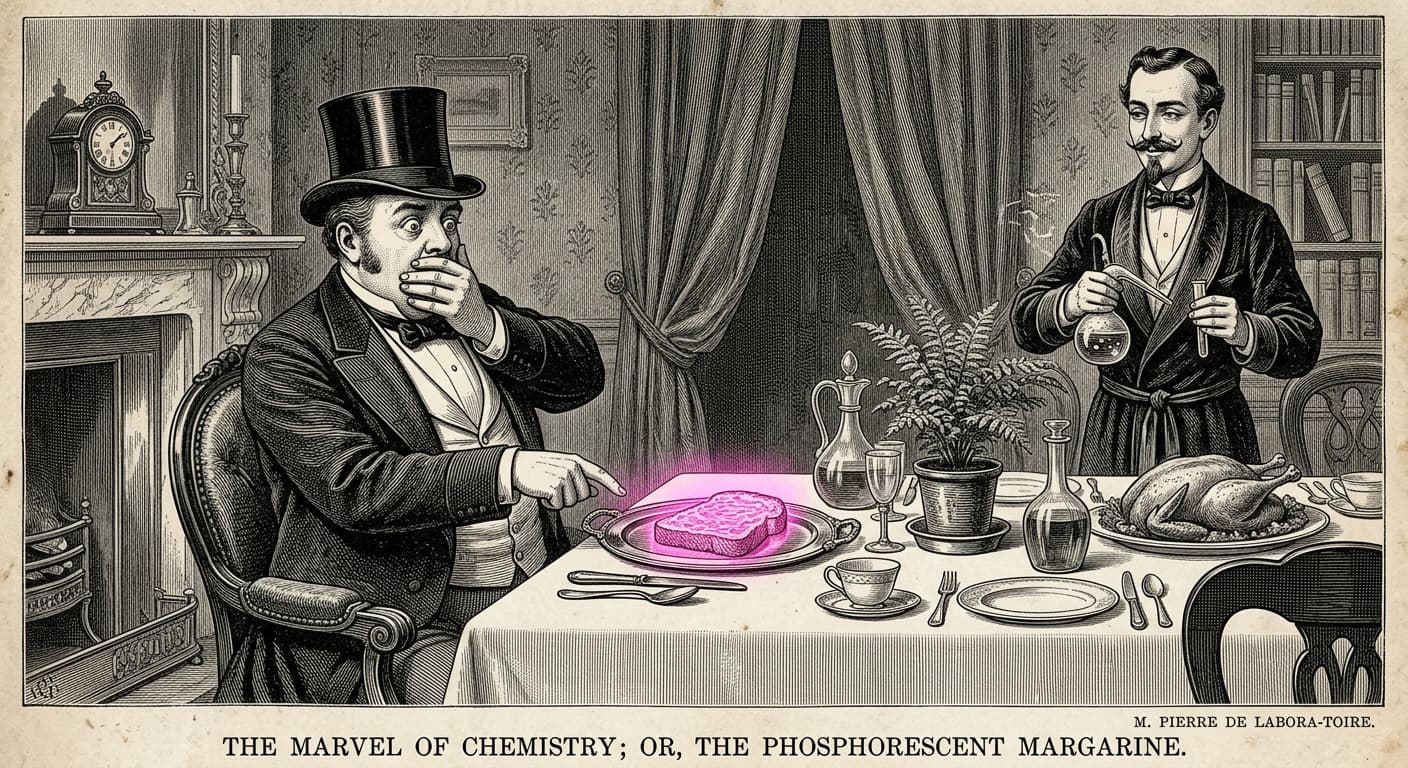
Because natural margarine was white, resembling lard, manufacturers had started dyeing it yellow to mimic butter. Dairy states furiously passed laws banning the use of yellow dye in margarine, forcing it to be sold in its unappetizing natural white state. But some states decided that wasn't punitive enough. In the 1880s and 1890s, states like New Hampshire, Vermont, and South Dakota passed laws mandating that all margarine sold within their borders must be dyed bright pink. The goal was obvious: no self-respecting Victorian family would want to spread neon pink paste on their morning toast.
The Supreme Court eventually struck down the "pink laws" in 1898, declaring them unconstitutional, but the ban on yellow dye remained in many states for decades. This led to a booming black market for bootleg yellow margarine, smuggled across state lines in the dead of night like illicit liquor. To get around the color bans legally, margarine companies cleverly started selling blocks of white margarine with a small capsule of yellow food coloring included in the package. It became a common household chore for 19th and early 20th-century children to vigorously knead the dye capsule into the stiff white block until it looked like proper butter.
Today, the great butter-margarine wars have largely faded from memory, and margarine is a mundane staple of supermarket shelves worldwide. Yet, it remains a fascinating testament to the era. A French emperor's quest to feed his troops spawned not only a multi-billion dollar global industry but also a bitter culture war that saw dairy farmers, corrupt politicians, and bootleggers fighting fiercely over the color of a breakfast spread.