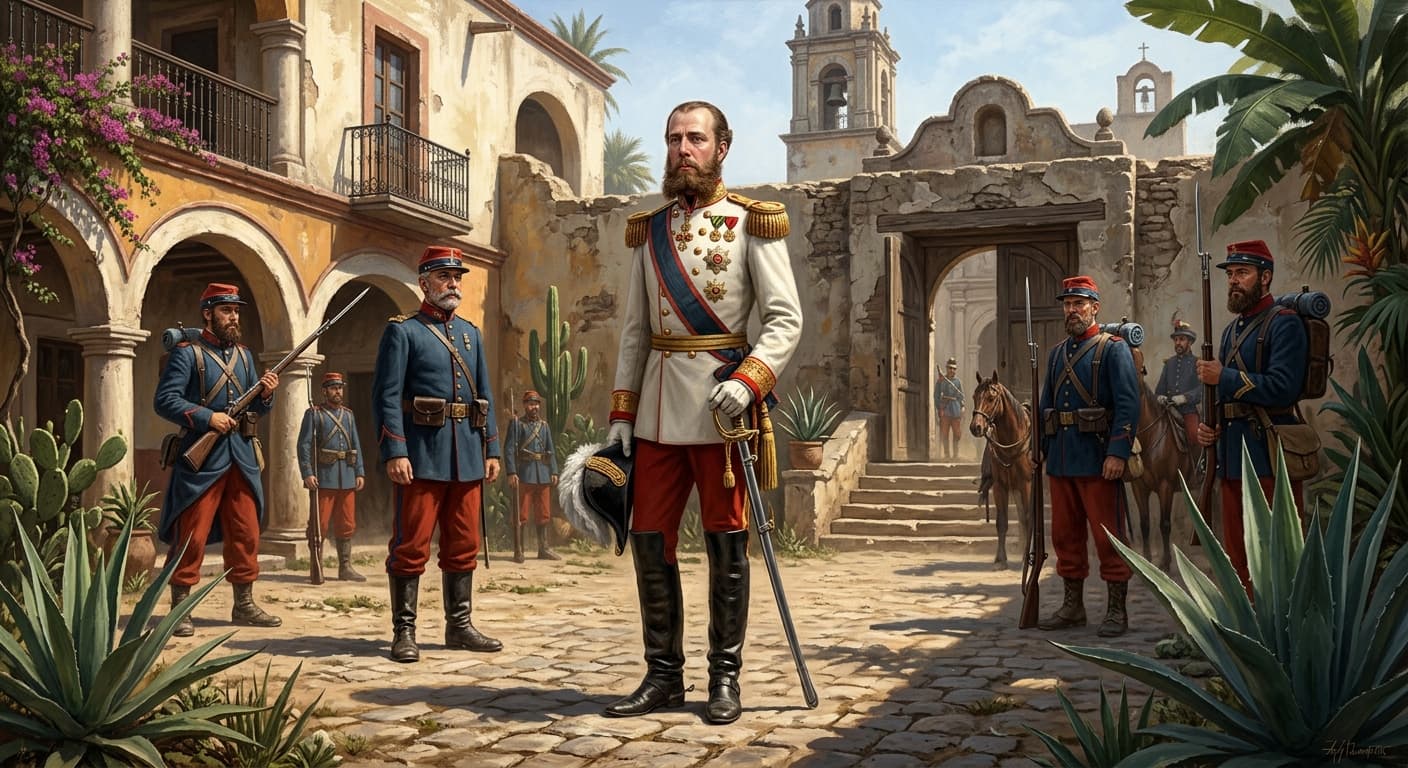
The Doomed Archduke: How a Naive Habsburg Prince Became the Emperor of Mexico
The year is 1864. The United States is tearing itself apart in a bloody Civil War, leaving the Western Hemisphere unguarded. Across the Atlantic, a scheming French Emperor, a cabal of exiled Mexican conservatives, and a hopelessly romantic Austrian prince hatched one of the most audacious and ill-fated geopolitical plots of the 19th century. The plan? To resurrect a monarchy in the heart of the Americas by crowning a Habsburg as the Emperor of Mexico.<br><br>Emperor Napoleon III of France desperately wanted a colonial foothold in the Americas to rival the distracted United States. Using unpaid Mexican debts as a convenient pretext, he ordered a massive French invasion of Mexico in 1861. But a sheer military occupation was not enough; Napoleon needed a puppet ruler to give the conquest a veneer of international legitimacy. Enter Archduke Ferdinand Maximilian, the younger brother of the Austrian Emperor Franz Joseph. Maximilian was a progressive, nature-loving dreamer who felt completely stifled by the rigid conservatism of the Austrian court. When a delegation of Mexican monarchists arrived at his majestic Italian castle, falsely assuring him that the Mexican people had voted overwhelmingly for his sovereign rule, the naive Archduke eagerly accepted the crown.<br><br>Maximilian and his highly ambitious wife, Princess Carlota of Belgium, arrived at the port of Veracruz in May 1864. They fully expected a triumphant, joyous welcome from their new subjects. Instead, they found a war-torn country fiercely resisting a foreign occupation. The legitimate, democratically elected government of Mexico, led by the brilliant and unyielding President Benito Juarez, had simply retreated to the northern deserts to wage a relentless guerrilla war. Despite the visibly cool reception, Maximilian threw himself into his new imperial role with absolute, albeit misguided, sincerity. He immediately commissioned a grand, sweeping avenue in Mexico City, designed elaborate court uniforms, and spent hours wandering his new empire, joyfully collecting exotic botanical specimens while oblivious to the brewing storm.<br><br>The great, profound tragedy of Maximilian's reign was his own progressive idealism. The Mexican conservatives and the powerful Catholic Church had strongly backed his ascension with the strict expectation that he would immediately reverse the liberal reforms enacted by Juarez, particularly the state seizure of immense church lands. Instead, Maximilian horrified his conservative allies by doing the exact opposite. He bravely upheld Juarez's land reforms, officially declared sweeping religious freedom, completely banned child labor, and abolished the cruel peonage system that tied impoverished peasants to wealthy haciendas. He even went so far as to offer Benito Juarez the position of Prime Minister, an offer Juarez flatly and insultedly refused. Maximilian quickly found himself a man without a country, heavily despised by the right for his liberalism, and violently hunted by the left simply for being a foreign invader.<br><br>By 1865, the geopolitical winds shifted fatally and decisively against the fledgling empire. The American Civil War finally ended, and a reunified, heavily armed United States turned its full attention to its southern border. Forcefully invoking the Monroe Doctrine, the U.S. government demanded the immediate, unconditional withdrawal of French troops from Mexico and began secretly funneling highly modern weapons to Juarez's republican army. Facing mounting diplomatic pressure from America and a rapidly looming military threat from Prussia back in Europe, Napoleon III cynically chose to cut his losses. He coldly ordered the French army to evacuate Mexico immediately, effectively abandoning Maximilian to his grim fate.<br><br>As the French forces desperately packed their ships to leave, Maximilian was strongly urged to abdicate his throne and flee back to the safety of Europe. His frantic wife, Carlota, rushed back across the Atlantic Ocean to desperately beg the courts of Paris, Vienna, and even the Pope for urgent military aid. Her desperate, entirely fruitless diplomatic mission ended in a severe mental breakdown from which she tragically never recovered, leaving her institutionalized for the rest of her long life. Despite the sheer hopelessness of his rapidly deteriorating situation, Maximilian stubbornly refused to abandon the Mexican loyalists who had deeply tied their personal fates to his reign. He firmly believed that a true Emperor should never run from his people.<br><br>In the spring of 1867, Maximilian and his few remaining loyal troops made a desperate, heroic last stand at the fortified city of Queretaro. After a grueling, bloody siege, he was shockingly betrayed by one of his own top generals and easily captured by advancing republican forces. Prominent international leaders, including the legendary author Victor Hugo and the fierce Italian revolutionary Giuseppe Garibaldi, alongside numerous European monarchs, openly pleaded with Benito Juarez to spare the Archduke's life. But Juarez, knowing he had to send a definitive, terrifying message to all European powers that Mexico would never again tolerate foreign intervention, firmly refused all international pleas for clemency.<br><br>On the tragic morning of June 19, 1867, the thirty-four-year-old Emperor was slowly led out to the Cerro de las Campanas. Displaying remarkable calm, he politely gave the firing squad a few gold coins, asked them to specifically aim for his heart so his distant mother could bear to look upon his face, and loudly spoke his final words: May my blood be the last to flow for the welfare of this country. Viva Mexico! Viva la independencia! The rifles fired in unison, and the bizarre, tragic dream of the Second Mexican Empire abruptly died with him. Today, Maximilian is remembered not as a ruthless tyrant, but as a deeply misguided romantic, a man who genuinely loved a foreign country that was never truly his to rule.