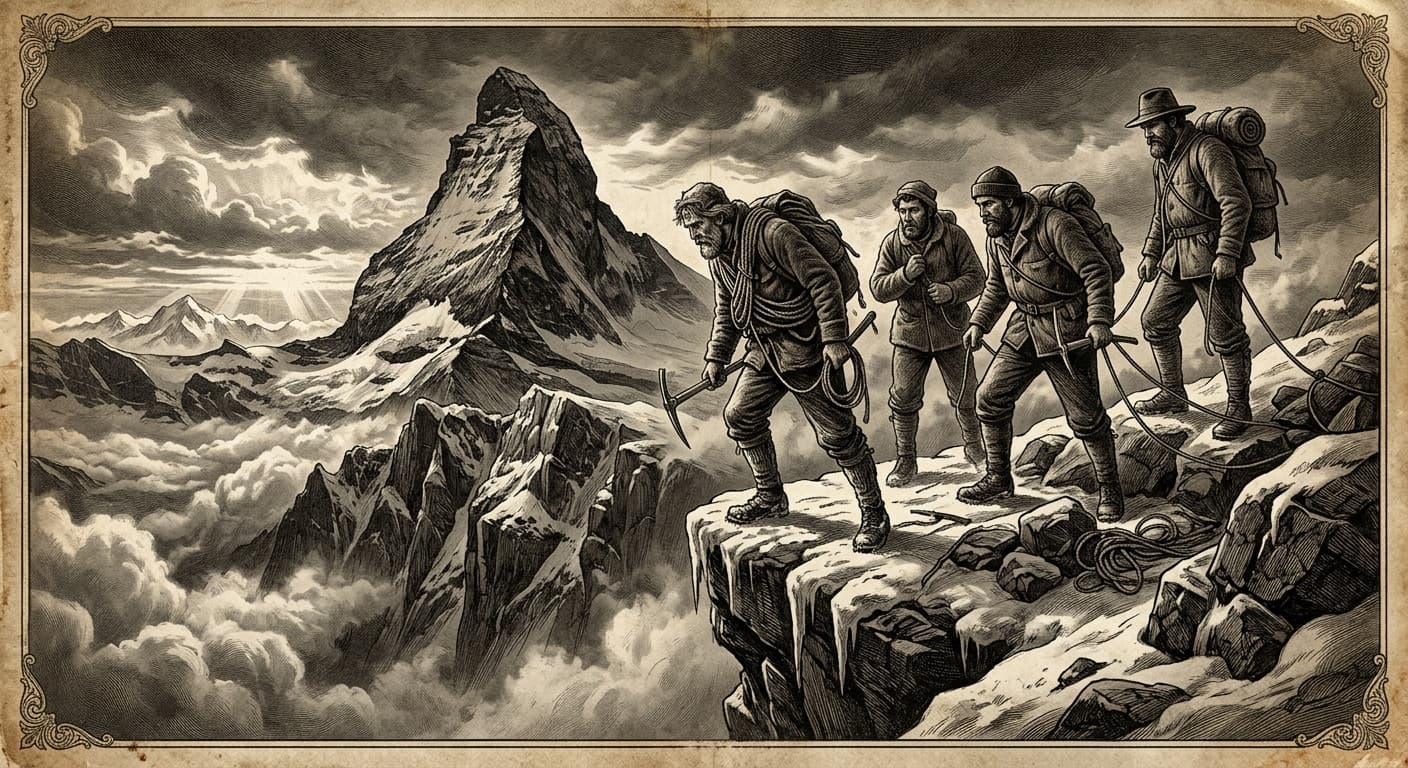
The Triumph and the Tragedy: The Deadly Race to Conquer the Matterhorn
In the mid-19th century, a peculiar madness gripped the wealthy gentlemen of Victorian England: Alpinism. Driven by a mixture of scientific curiosity, romanticism, and a deep-seated desire to conquer the untamable, these amateur explorers flocked to the Swiss Alps. The era spanning from 1854 to 1865 became known as the Golden Age of Alpinism, a period during which dozens of major Alpine peaks were scaled for the very first time. Yet, one mountain remained fiercely undefeated, mocking the ambitions of the greatest climbers of the age. It was the Matterhorn.
Rising to a staggering 14,692 feet (4,478 meters) on the border between Switzerland and Italy, the Matterhorn was a jagged, isolated tooth of rock that looked entirely unscalable. Local legends warned that the peak was haunted by demons and the spirits of the damned. To the burgeoning mountaineering community, however, it was the ultimate prize.
Enter Edward Whymper, a twenty-year-old English wood-engraver who had initially traveled to the Alps in 1860 simply to sketch the dramatic landscapes for a London publisher. Whymper was not a trained mountaineer, but the imposing silhouette of the Matterhorn sparked an immediate and unyielding obsession within him. Over the next five years, he would make seven unsuccessful attempts to summit the mountain, primarily attacking it from the Italian side.
Whymper's obsession soon turned into a high-stakes geopolitical race. His primary rival was Jean-Antoine Carrel, a fiercely proud Italian mountain guide. Carrel believed that the Matterhorn was an Italian mountain and should be conquered by an Italian. Though they had occasionally climbed together, by the summer of 1865, the two men were locked in a bitter race. When Whymper discovered that Carrel had secretly set off with an Italian team to conquer the peak, he felt deeply betrayed. Realizing he had to act immediately, Whymper rushed to the Swiss village of Zermatt to form his own team.
In Zermatt, Whymper hastily assembled a sprawling, seven-man expedition. The team included the highly respected French guide Michel Croz, two Swiss guides named Peter Taugwalder (father and son), and three English climbers: the experienced Reverend Charles Hudson, the young Lord Francis Douglas, and a relatively inexperienced nineteen-year-old named Douglas Hadow.
On July 13, 1865, the team began their ascent via the Hörnli Ridge on the Swiss side—a route previously deemed too steep, but which Whymper correctly theorized was actually a natural staircase of rock. To their immense surprise, the climb was relatively straightforward. On the afternoon of July 14, the team approached the summit. Whymper and Croz unroped and raced each other to the very top, arriving simultaneously.
The Matterhorn had been conquered. Looking over the edge, Whymper spotted Carrel and the Italian team mere hundreds of feet below. To ensure the Italians knew they had been beaten, Whymper and Croz shouted until they were hoarse and hurled rocks down the cliffs. The defeated Italians turned back, leaving the glory entirely to the English and Swiss team.
But the triumph was destined to be agonizingly short-lived.
After an hour of jubilation at the summit, the seven men roped themselves together for the perilous descent. Michel Croz led the way, carefully guiding the inexperienced Douglas Hadow, followed by Hudson, Douglas, the elder Taugwalder, Whymper, and the younger Taugwalder.
Suddenly, tragedy struck. Hadow slipped on a treacherous patch of ice, plunging heavily into Croz and knocking the guide off his feet. The combined weight of the two men pulled Hudson and Douglas down the sheer face of the mountain. Whymper and the Taugwalders instantly braced themselves, clinging desperately to the rock. The rope went taut with a violent jerk.
For a split second, the three surviving men held the weight of their four falling companions. But the force was too great. The rope—a thinner, older line that had been used by mistake—snapped with a sickening crack. Whymper and the Taugwalders could only watch in horrified silence as Croz, Hadow, Hudson, and Douglas slid down the precipice, falling nearly 4,000 feet to their deaths on the Matterhorn Glacier below.
The three survivors were left paralyzed with shock, stranded on the mountain as dusk approached. When they finally returned to Zermatt, the news of the disaster sent shockwaves across Europe. The sheer dramatic contrast of the event—the greatest triumph in mountaineering history immediately followed by its most horrifying tragedy—scandalized Victorian society.
The London press condemned the expedition as senseless and suicidal. Rumors wildly circulated that Whymper or the elder Taugwalder had deliberately cut the rope to save themselves, though a subsequent Swiss investigation cleared them of any wrongdoing. The public outcry was so severe that Queen Victoria even consulted her Lord Chamberlain about legally banning her citizens from engaging in mountaineering, though the ban was never enacted.
The disaster of 1865 effectively ended the Golden Age of Alpinism. The Matterhorn, once considered an impossible monolith, had been reduced to a grim monument of human hubris. Edward Whymper went on to climb in the Andes and the Rockies, but he was forever haunted by the ghosts of the Matterhorn. He summarized the duality of his historic ascent in his memoirs with a chilling final warning: "Climb if you will, but remember that courage and strength are nought without prudence, and that a momentary negligence may destroy the happiness of a lifetime."