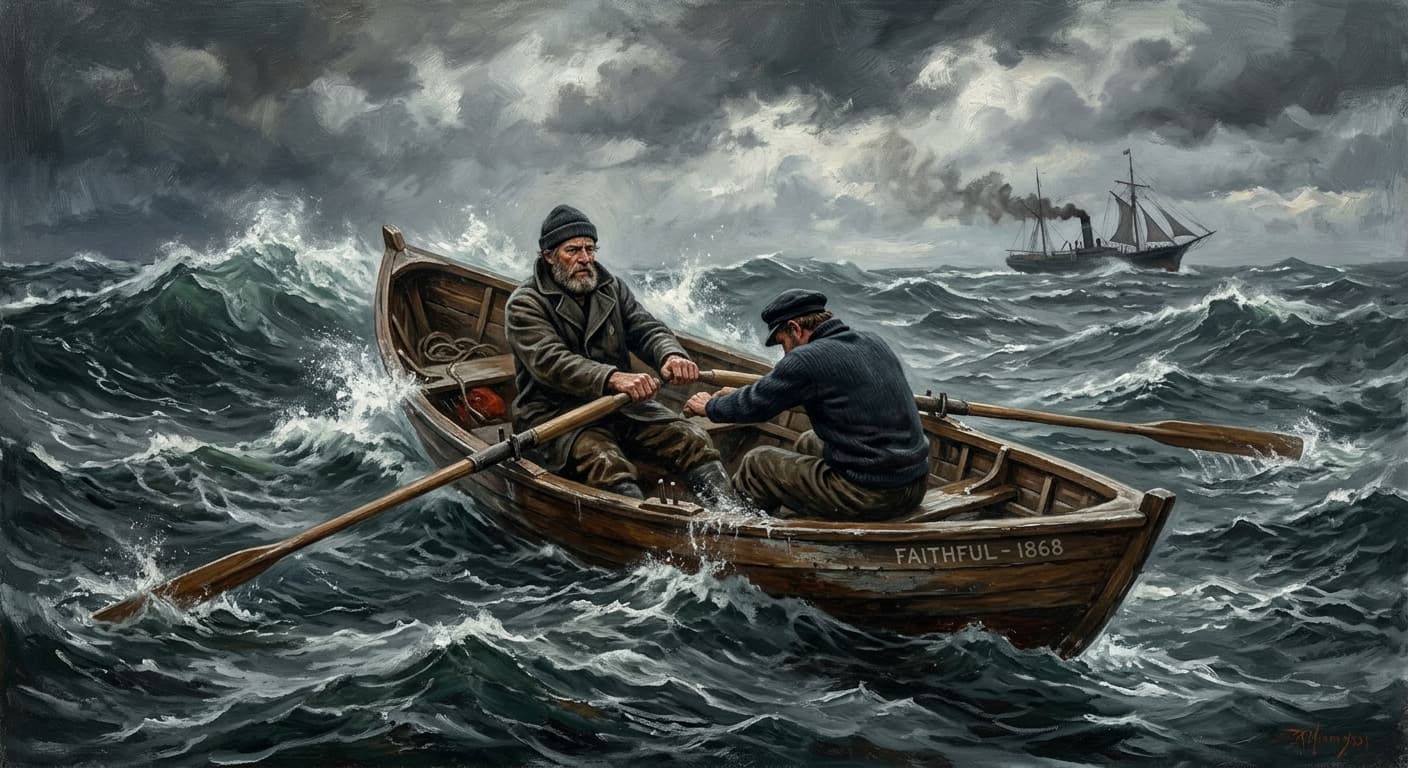
The Clam Diggers Who Conquered an Ocean: The First Row Across the Atlantic
The late nineteenth century was an era defined by humanity's mechanical triumph over nature. Massive, coal-fired steamships were churning across the Atlantic Ocean in a matter of days, turning a once-harrowing crossing into a predictable, luxurious commute. Yet, in the summer of 1896, two men looked at the towering iron leviathans of their day and decided to challenge the wrath of the ocean using nothing but wood, muscle, and a staggering amount of sheer audacity. Their names were George Harbo and Frank Samuelsen, and they were about to become the first people in recorded history to row across the Atlantic Ocean.
Harbo and Samuelsen were not wealthy aristocrats looking for a sporting thrill, nor were they heavily funded explorers. They were working-class Norwegian immigrants making a meager living dredging for clams off the coast of New Jersey. However, both men possessed a deep, lifelong familiarity with the sea and the hardened, calloused hands of lifelong rowers. Inspired by the era's booming obsession with extreme endurance stunts, the duo set their sights on an impossible goal: rowing 3,000 miles from New York to Europe.
The driving force behind their madness was largely financial. Rumors had been swirling that Richard Kyle Fox, the flamboyant publisher of the National Police Gazette, was offering a staggering $10,000 prize to anyone who could successfully row across the Atlantic. While the existence of this grand cash prize is debated by historians—many believe it was merely an urban legend that the men bought into—Fox did agree to sponsor them, offering his name, a tow out of the harbor, and a promise of fame.
To survive the crossing, the clam diggers needed a very special vessel. They commissioned a custom-built, 18-foot oak-and-cedar rowboat equipped with watertight flotation compartments at the bow and stern. Uniquely, they also installed grab-rails on the underside of the hull—a brilliant piece of foresight that would ultimately save their lives. Christened the Fox, the tiny boat was loaded with 60 gallons of water, a rudimentary oil stove, and hundreds of pounds of canned meats, oatmeal, and hardtack. There were no sails, no engines, and no escort ships.
On June 6, 1896, the two men departed Battery Park, New York, to the cheers of an estimated 2,000 spectators. Once they cleared the harbor, the true brutal reality of their undertaking set in. They adopted a grueling, relentless schedule: rowing together for eighteen hours a day and taking turns sleeping in the remaining six. Their beds were nothing but a patch of floorboards covered by a canvas tarp. Within days, their hands were stripped of skin, their bodies were coated in painful salt sores, and they were at the absolute mercy of the turbulent North Atlantic weather.
The most terrifying moment of their journey struck in mid-July. Caught in the ferocious churn of a gale, a rogue wave slammed into the Fox, violently capsizing the small craft and throwing both men into the freezing water. Thanks to the custom grab-rails they had installed on the bottom of the hull, Harbo and Samuelsen were able to cling to the overturned boat, laboriously right it, and haul themselves back aboard. The capsize had cost them their oil stove and a significant portion of their food, forcing them to eat their remaining rations cold for the rest of the voyage.
Despite the near-death experience, they refused to quit. When they crossed paths with passing steamships and merchant vessels, the crews of those mighty iron ships looked down in absolute disbelief at the two ragged men in a glorified canoe. While they accepted some donated water and bread from two passing vessels—including the German bark Cito—they adamantly refused any offers of rescue, insisting on finishing what they had started.
On August 1, 1896, a mere 55 days and 13 hours after leaving New York, Harbo and Samuelsen rowed into the harbor of St. Mary's in the Isles of Scilly, off the coast of England. They had done the impossible. Against all odds, the two clam diggers had conquered the Atlantic.
Their arrival was met with astonishment, though their victory was ultimately bittersweet. The fabled $10,000 prize from the Police Gazette never materialized; instead, Richard Kyle Fox awarded them a pair of gold medals. Exhausted and with little money to show for their superhuman feat, the two men eventually had to load the Fox onto a steamship and work for their passage back to America, quietly fading back into obscurity.
Yet, history remembers their grit. Harbo and Samuelsen’s astonishing transatlantic time of 55 days set an ocean rowing record that remained completely unbroken for an unbelievable 114 years. It was a triumph of the human spirit—a reminder that even in an age defined by the rise of machines, the raw willpower of two stubborn men with a pair of oars could still conquer the world.