The City of Rose and Stone: How a Master of Disguise Unveiled the Lost Marvel of Petra
For centuries, a persistent whisper drifted through the suqs and caravanserais of the Middle East. It spoke of a miraculous city hidden deep within a labyrinth of impassable mountains—a metropolis not built from the ground up, but carved directly into the living, rose-hued rock. To the Western world of the early 19th century, this legendary city was little more than a myth, a ghost of the ancient Nabataean kingdom lost to European memory since the time of the Crusades. But in the summer of 1812, one wildly audacious explorer would use mastery of linguistics and an elaborate disguise to pull the legendary city of Petra out of the realm of myth and into the annals of history.
The man who would unveil Petra was not an army general or a wealthy lord, but a meticulous and brilliant Swiss scholar named Johann Ludwig Burckhardt. Commissioned by the British-based African Association to discover the source of the Niger River, Burckhardt understood a fundamental truth of exploration: to survive in a perilous, uncharted land, you must become part of it. Rather than charging into the desert with an armed escort and a pith helmet, Burckhardt spent years undergoing an extreme and total transformation.
Relocating to Aleppo, Syria, in 1809, Burckhardt completely immersed himself in Arab culture. He mastered the Arabic language, studied the Quran, and learned the intricacies of Islamic law so thoroughly that he was often asked to settle local religious disputes. He shed his European identity entirely, adopting the persona of Sheikh Ibrahim Ibn Abdallah, a learned Muslim trader from India. It was a disguise of absolute necessity; in the deeply tribal regions of the Ottoman Empire, European outsiders were often viewed with intense suspicion and assumed to be infidels seeking hidden pagan gold.
In 1812, while traveling southward from Syria toward Cairo, Burckhardt’s path took him through the rugged, arid landscape of modern-day Jordan. As he conversed with local Bedouins, he began to catch fragments of a tantalizing rumor: hidden within the treacherous mountains of Wadi Musa (the Valley of Moses) lay magnificent ancient ruins, situated near a shrine believed to be the tomb of Aaron, the brother of Moses. Burckhardt immediately suspected this might be the lost city of Petra.
Accessing the valley, however, presented a lethal challenge. The local tribes fiercely guarded the ruins, and asking for a tour of ancient architecture would have instantly exposed him as a foreign treasure hunter—a mistake that would likely cost him his life. Relying on his quick wit and deep cultural knowledge, Burckhardt concocted a brilliant pretext. He purchased a goat and solemnly told his Bedouin guide that he had sworn a holy vow to sacrifice the animal at the tomb of Aaron. To reach the tomb, they would have to pass directly through the hidden ruins.
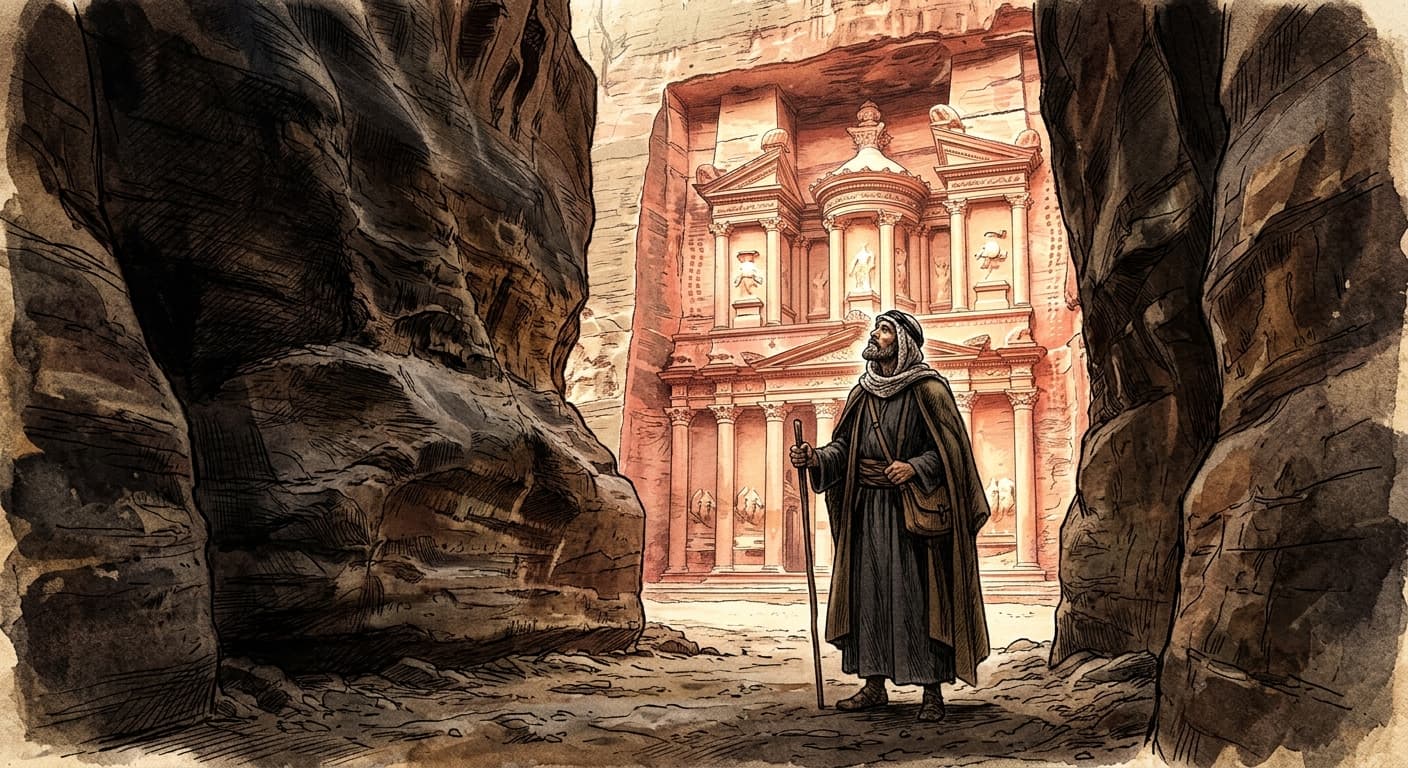
The guide agreed, and on August 22, 1812, Burckhardt was led into a shadowy, claustrophobic gorge known as the Siq. For over a mile, the towering sandstone walls narrowed, blocking out the sun and leaving the travelers in a cool, imposing twilight. Then, quite suddenly, the gorge ended, and Burckhardt was struck by a sight that continues to defy imagination today.
Bathing in the harsh desert sunlight was the Khazneh—the legendary "Treasury." It was a soaring, masterful facade intricately carved into the sheer, rose-red cliff face, combining Hellenistic beauty with distinct Eastern influences. As they pressed further into the valley, Burckhardt was surrounded by an entire city of tombs, temples, and an amphitheater, all hewn from the majestic sandstone by a civilization that had thrived two millennia prior.
Despite the overwhelming shock and awe crashing over him, Burckhardt had to maintain his ironclad composure. He could not afford to linger, take out his measuring tools, or openly sketch the magnificent structures. When he paused to closely examine the intricate carvings of a ruined temple, his guide grew instantly suspicious, accusing him of being an infidel searching for the legendary hoards of gold rumored to be hidden within the ruins. Quick on his feet, Burckhardt laughed off the accusation, hurried to the foot of Mount Hor, sacrificed the goat as promised, and promptly left the valley without looking back.
Burckhardt never returned to Petra. Tragically, he died of dysentery in Cairo just five years later, at the age of 33, before he could ever embark on his primary mission to find the source of the Niger River. Yet, the detailed journals and letters he smuggled out to Europe survived him. When published posthumously, they ignited a massive wave of Western fascination with the Middle East. Johann Ludwig Burckhardt’s daring subterfuge and unparalleled dedication had successfully reconnected the modern world with the breathtaking City of Rose and Stone, leaving behind a legacy as enduring as the rock from which Petra was carved.