The Child of Europe: The Dark Riddle of Kaspar Hauser
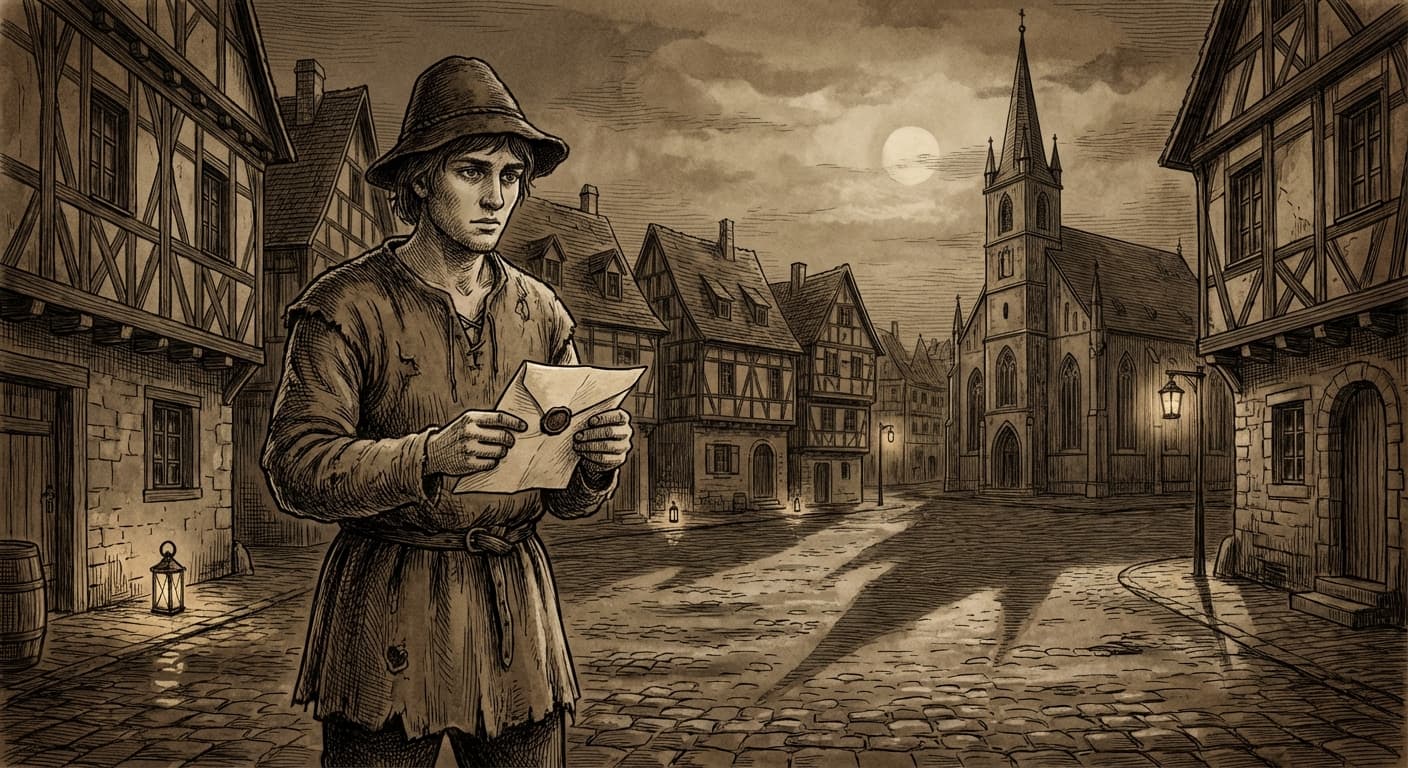
On Whit Monday, May 26, 1828, the shoemakers of Nuremberg, Germany, witnessed a sight that would spark one of the 19th century’s most enduring mysteries. Stumbling into the Unschlittplatz was a teenage boy, roughly sixteen years old, dressed in ill-fitting peasant clothes. He walked with the awkward, rolling gait of a toddler and clutched a sealed envelope addressed to the captain of the 4th Squadron of the 6th Cavalry Regiment. When questioned by the authorities, the boy could only repeat a single sentence: “I want to be a cavalryman, as my father was.” He wrote his name as Kaspar Hauser, but beyond that, his mind seemed a blank slate, devoid of language, social norms, or memory of the outside world.
The Boy from the Dungeon
Once taken into custody, the details of Hauser’s life began to trickle out, painting a picture of horrific isolation. Kaspar claimed that for as long as he could remember, he had been kept in a dark, dungeon-like cell that was too short to stand up in. He had never seen the sun, never heard a human voice, and never seen the face of his captor. His only companions were two wooden toy horses. Each morning, he would wake to find bread and water left for him while he slept. Shortly before his release, a man—whose face remained hidden—entered the cell, taught him to write his name and walk, and then dragged him to Nuremberg before vanishing.
At first, Kaspar rejected all food except bread and water, reacting violently to the smell of meat and alcohol. His senses were hypersensitive; he could reportedly see in the dark like a cat and hear whispers from great distances. To the Romantics of the 19th century, he was the ultimate curiosity: a “noble savage,” a feral child untouched by the corruption of society. He was dubbed “The Child of Europe,” and visitors flocked from across the continent to see him.
A Prince in Rags?
As Kaspar was educated and his vocabulary expanded, the charm of the feral child gave way to dark political intrigue. Whispers began to circulate that Kaspar bore a striking resemblance to members of the House of Baden. A theory emerged that he was the hereditary prince, born in 1812 to Grand Duke Charles and Stephanie de Beauharnais, who had allegedly died in infancy. The conspiracy suggested that the real prince had been swapped with a dying baby to alter the line of succession in favor of a different branch of the family.
This theory gained traction when powerful patrons, including the eccentric British Lord Stanhope, took an interest in the boy. However, as Kaspar became more civilized, he also became arguably more deceitful, leading some to wonder if the entire affair was an elaborate hoax designed by a talented grifter. Yet, if he were merely a fraud, why did someone seem to want him dead?
The Assassinations
On October 17, 1829, Kaspar was found in the cellar of his caretaker’s house with a bleeding wound on his forehead. He claimed a masked man had attacked him and threatened him: “You still have to die ere you leave the city of Nuremberg.” Skeptics believed the wound was self-inflicted to garnish sympathy as his celebrity waned. But the danger seemed to return four years later.
On December 14, 1833, in the court gardens of Ansbach, Kaspar staggered home with a deep stab wound to his chest. He claimed a stranger had lured him there with the promise of a bag containing secrets about his mother. When the police investigated the scene, they found a small violet purse containing a note written in mirror-writing: “I will tell you who I am... my name is M.L.Ö.”
Kaspar Hauser died three days later. The physicians who examined the body concluded that the wound was likely too severe to be self-inflicted, yet the snow in the garden revealed only one set of footprints—Kaspar’s.
The Final Silence
Kaspar Hauser was buried in a quiet cemetery in Ansbach. His headstone bears a Latin inscription that perfectly encapsulates his tragic, baffling existence: Hic jacet Casparus Hauser, aenigma sui temporis, ignota nativitas, occulta mors ("Here lies Kaspar Hauser, riddle of his time, unknown birth, mysterious death").
To this day, historians and scientists remain divided. DNA tests conducted in the 1990s and early 2000s on clothing attributed to Kaspar yielded conflicting results regarding his relation to the House of Baden. Was he a lost prince, a pathological liar, or a victim of a cruel experiment? The 19th century took the secret to the grave, leaving us only with the legend of the boy who came from nowhere and died for reasons nobody knows.