The Butcher, The Baronet, and The Lie: The Absurd Saga of the Tichborne Claimant
If you think modern celebrity scandals and identity theft are uniquely 21st-century problems, the Victorian era has a story that will make you reconsider. It was a time when a grieving mother’s delusion collided with a brazen con artist’s ambition, resulting in the longest, most expensive, and arguably the most ridiculous legal battle in English history. This is the story of the Tichborne Claimant, a saga of shipwrecks, butchers, and a lie so big that half of England decided to believe it.
The drama began with a tragedy. Roger Tichborne, the slender, refined, French-speaking heir to a massive fortune and an ancient baronetcy, vanished in 1854. He had been traveling aboard the ship Bella, which disappeared off the coast of South America with all hands presumed lost. The family mourned, but Roger’s mother, the Dowager Lady Tichborne, refused to extinguish the torch of hope. Driven by a desperate, grief-stricken conviction that her son was still alive, she placed advertisements in newspapers across the globe, offering a handsome reward for news of his whereabouts.
In 1865, eleven years after the Bella sank, a reply came from the unlikely locale of Wagga Wagga, Australia. A butcher living under the name Thomas Castro claimed to be the lost baronet. He had been saved, he said, picked up by a passing ship and taken to Australia where he had lived a humble life, too ashamed to contact his aristocratic family. Lady Tichborne was ecstatic. She immediately wired him money to return to England.
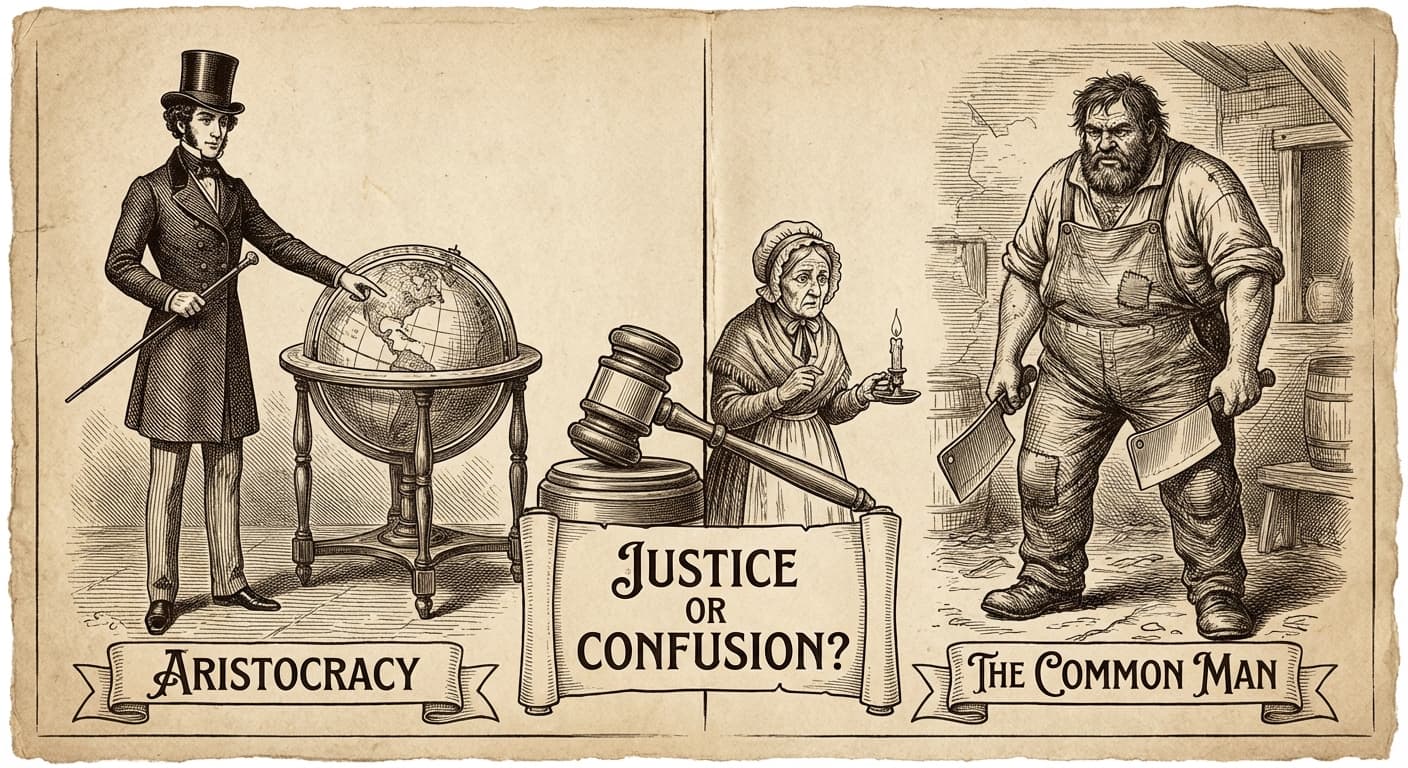
However, when the "Claimant" arrived in London on Christmas Day in 1866, the rest of the Tichborne family was aghast. The man who stepped off the boat bore absolutely no resemblance to the lost heir. Roger Tichborne had been slight, sharp-featured, and dark-haired. The Claimant was an enormous man, weighing nearly 300 pounds, with light hair and a coarse complexion. While Roger was fluent in French and educated in the classics, the Claimant spoke no French, had a thick Cockney accent, and possessed an astonishing lack of knowledge about Roger's life. When asked about his education, the Claimant thought Euclid (the Greek mathematician) was another student at his boarding school.
Despite these glaring discrepancies, Lady Tichborne accepted him instantly. In a heartbreaking display of confirmation bias, she recognized him by his "eyes" and ears, ignoring the fact that the Claimant was practically twice the size of her son. With the mother’s financial backing and recognition, the Claimant moved into the family home, while the rest of the Tichborne clan launched an investigation. They quickly discovered that "Thomas Castro" was likely Arthur Orton, a butcher’s son from Wapping, London, who had deserted a ship in Chile years prior.
The conflict culminated in two massive trials that gripped the nation for nearly a decade. The first was a civil suit in 1871 where the Claimant tried to eject the sitting heir (Roger's nephew) to take the estate. It was a disaster for the Claimant. Under cross-examination, his story unraveled spectacularly. He didn't know the contents of the sealed letter Roger had left for his cousin; he didn't recognize close family friends; and he had tattoos that Roger never had (which he claimed to have removed). The jury was ready to rule against him before the defense even rested.
However, the story didn't end with his defeat. The government arrested him for perjury, leading to a criminal trial in 1873. By this time, the "Tichborne Claimant" had become a folk hero. To the working class of Victorian England, he was the underdog—a rough-edged man fighting against the snobbish elite who wanted to deny him his birthright. They didn't care that he was likely Arthur Orton; they loved that he was shaking up the establishment. Souvenirs, songs, and pottery bearing his likeness flooded the streets.
The criminal trial was the longest in English legal history at the time, lasting 188 days. The judge’s summation alone took a month to read. In 1874, the jury finally declared him to be Arthur Orton and sentenced him to 14 years of hard labor. The "Tichborne Mania" slowly faded, though die-hard supporters insisted on his innocence for years. Orton served his time and was released in 1884, but the world had moved on. In a final twist of irony, destitute and forgotten, he sold his confession to a newspaper in 1895, admitting he was indeed the butcher from Wapping—only to retract it later. When he died in 1898, the coffin plate bore the name "Sir Roger Charles Doughty Tichborne," a lie maintained to the bitter end.