The Tunnel That Defied the Thames: How a Tiny Shipworm Birthed the Modern Subway
In the early 19th century, London was the undisputed capital of global trade, and the River Thames was its pulsating, overcrowded artery. Thousands of ships docked in the port daily, creating an immense, chaotic forest of masts. But this economic boom came with a massive logistical nightmare: the river that brought the world's wealth to London also split the city in half. Bridges were heavily congested, yet building a new one downriver was impossible because it would block the tall-masted cargo ships from reaching the docks. The solution seemed obvious yet daunting—if they could not go over the Thames, they had to go under it.
Attempting to dig a tunnel beneath a tidal river was considered a death wish. Previous attempts by experienced miners had ended in catastrophic failure and deadly cave-ins. The mud of the Thames riverbed was treacherous, shifting, and heavily pressurized by the water above. Enter Marc Isambard Brunel, a brilliantly inventive French-born engineer who found the solution to this monumental crisis not in the halls of academia, but in a piece of rotting wood at a naval dockyard.
While inspecting damaged ships, Brunel became fascinated by the Teredo navalis, commonly known as the naval shipworm. This tiny, destructive mollusk possessed a unique biological mechanism: its head was covered in a hard pair of shells used to bore through solid oak, while simultaneously secreting a smooth, calcified lining behind it to prevent the wooden tunnel from collapsing. In a flash of genius, Brunel realized this exact principle could be applied on a colossal scale to conquer the mud of the Thames.
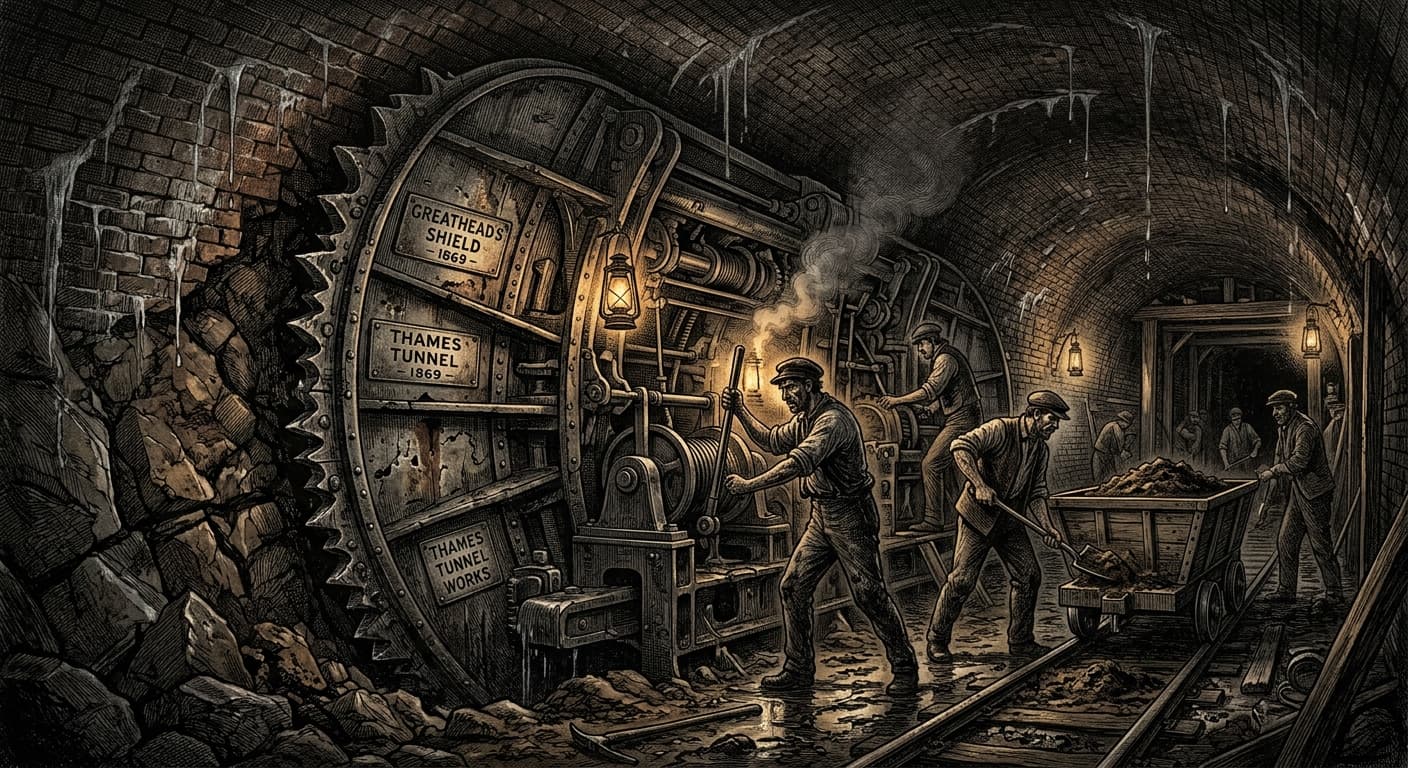
In 1818, Brunel patented the tunneling shield, a revolutionary piece of engineering that would forever change the world of subterranean construction. The device was essentially a massive, multi-tiered cast-iron frame divided into 36 individual cells. Inside each cell, a miner would dig away the earth in front of him. As the men dug, powerful screw jacks pushed the entire iron shield forward into the newly excavated space. Immediately behind the advancing shield, a team of bricklayers would construct the permanent tunnel walls. The shield protected the workers from the crushing weight of the riverbed, acting just like the shipworm's shell.
Construction of the Thames Tunnel officially began in 1825, starting with the sinking of a massive brick shaft in Rotherhithe. But even with Brunel's brilliant shield, the project was a living hell. The River Thames in the 1820s was a biological hazard, functioning as London's primary open sewer. As the miners pushed under the river, they were constantly bombarded by highly toxic, flammable methane gas and foul-smelling black sludge. The poorly ventilated air caused workers to collapse from illness, and sudden bursts of gas frequently ignited from the miners' flickering candles.
The sheer peril of the project reached a horrific climax not once, but twice. In 1827, the river burst through the tunnel face, sending a terrifying wall of water rushing toward the workers. They miraculously survived, but the project was halted. Then, in January 1828, the Thames broke through again with devastating fury. Six men were killed in the pitch-black, freezing water. Marc Brunel's son, a 21-year-old Isambard Kingdom Brunel—who would later become one of the greatest engineers in British history—was swept up in the floodwaters and barely escaped with his life, sustaining severe leg and internal injuries.
Following the 1828 disaster, funds dried up entirely. The tunnel was unceremoniously bricked shut, leaving the world's most ambitious engineering project as a flooded, abandoned subterranean tomb for seven long years. Many declared the tunnel a massive folly. However, Marc Brunel refused to surrender. After relentless lobbying, he secured a loan from the British government, pumped out the water, installed a new, improved tunneling shield, and slowly resumed the grueling march beneath the river in 1835.
It took another eight agonizing years of fires, floods, and financial ruin, but the Thames Tunnel finally opened to the public in 1843. It was hailed globally as a triumph of Victorian persistence. Curiously, it never became the commercial thoroughfare for horse-drawn carts that Brunel originally envisioned. Instead, it became an eccentric pedestrian tourist attraction, hosting underground fairs, banquets, and souvenir stalls beneath the riverbed. Eventually, the Victorian railway boom caught up to Brunel's masterpiece. In 1865, the tunnel was purchased by the East London Railway, and the pedestrian walkways were replaced with steam train tracks.
Today, the Thames Tunnel remains an active, vital part of the London Overground network, still safely ferrying thousands of commuters every single day within the original brickwork laid by Brunel's men nearly two centuries ago. More importantly, Marc Brunel's brilliant application of biomimicry birthed an entirely new era of engineering. Every modern subway system, underwater tunnel, and subterranean highway built since the 19th century owes its existence to the tunneling shield, proving that sometimes, the answers to humanity's greatest obstacles can be found in the smallest of nature's creatures.