The Bridge That Fell from the Sky: The Hubris and Horror of the Tay Bridge Disaster
The Victorian era was an age of unbridled optimism. Powered by steam and forged in iron, the 19th century was defined by a belief that humanity could conquer nature through the sheer force of engineering. But this relentless pursuit of progress was not without its fatal missteps. Few disasters shattered the myth of Victorian invincibility quite like the collapse of the Tay Bridge in 1879—a catastrophic failure of ambition, cheap materials, and mathematical hubris.
In the mid-19th century, the railway was king. However, for travelers in Scotland, the journey between the major cities of Edinburgh and Dundee was a tedious affair. The gaping estuaries of the River Forth and the River Tay sliced through the landscape, forcing passengers to disembark and take slow, weather-dependent ferry crossings. To solve this bottleneck, the North British Railway company turned to Thomas Bouch, a highly respected engineer who proposed a radical solution: a two-mile-long railway bridge spanning the stormy, tidal waters of the Firth of Tay.
When the Tay Bridge opened in 1878, it was celebrated as a marvel of the modern world. It was the longest bridge on the planet, an endless ribbon of iron lattice girders suspended above the icy waters. The public was mesmerized, and Bouch was universally lauded. Queen Victoria herself crossed the bridge during her journey south from Balmoral Castle in 1879, and shortly thereafter, she knighted Bouch for his magnificent achievement. He was at the absolute pinnacle of his career, but his triumph would be tragically short-lived.
Behind the facade of this engineering triumph lay a terrifying reality. In his quest to keep costs down and secure the contract, Sir Thomas Bouch had cut fatal corners. He relied heavily on cast iron for the bridge's towering columns, a material notorious for its brittleness under tension. Furthermore, the foundry that cast the iron parts was plagued by abysmal quality control; many columns were riddled with imperfections that workers secretly filled with a mixture of rosin and iron filings to hide the cracks. Most damning of all, Bouch had failed to adequately account for wind loading. Believing that the open lattice design would allow gale-force winds to pass through harmlessly, he neglected to consult with leading wind pressure experts.
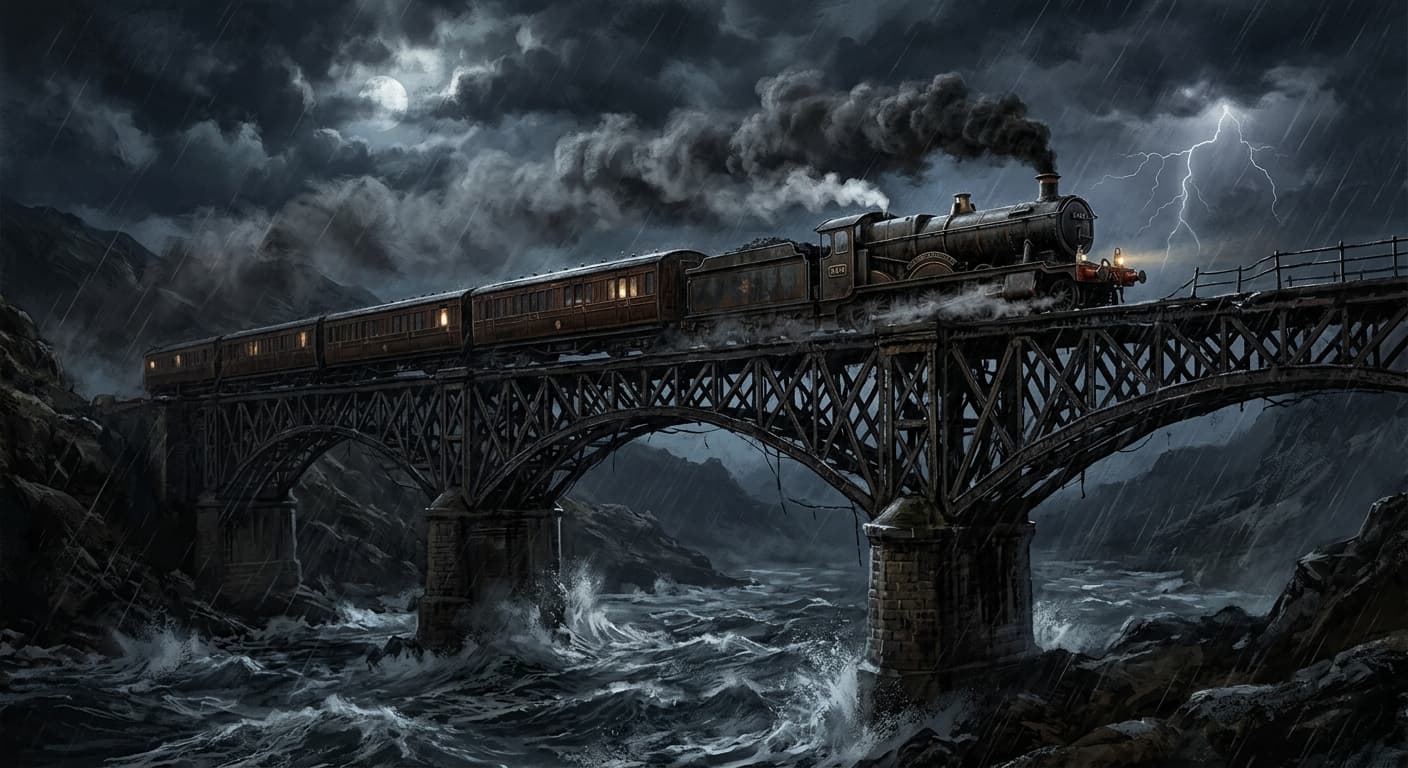
The bill for this hubris came due on the dark, freezing night of December 28, 1879. A horrific winter storm battered the Scottish coast, whipping up winds that modern meteorologists estimate reached up to 80 miles per hour. Despite the terrifying weather, the 5:20 PM passenger train from Burntisland began its crossing over the Tay. As the train reached the high girders—the tallest, most exposed central section of the bridge—the structure could no longer withstand the sheer force of the gale.
In a terrifying instant, the center of the bridge gave way. A mile of ironwork snapped and plummeted into the churning, black waters below, taking the train and everyone aboard with it. Onlookers on the shore reported seeing a sudden flash of fire from the engine, followed by an eerie, horrifying silence as the train vanished into the abyss. There were no survivors. An estimated 75 passengers and crew members perished in the icy depths of the estuary.
The nation awoke to a profound shock. The disaster struck at the very heart of Victorian confidence. An immediate Court of Inquiry was convened, and the findings were devastating. The bridge was described in the official report as "badly designed, badly constructed and badly maintained." Sir Thomas Bouch was held entirely responsible for the tragedy. His reputation was utterly destroyed, and he died less than a year later, many say of a broken heart.
The Tay Bridge Disaster left an indelible scar on the 19th century, but it also forced a radical reckoning in the world of civil engineering. The catastrophe ushered in a new era of rigorous safety standards. When the nearby Forth Bridge was constructed a decade later, it was built from massive, over-engineered steel tubes—a direct architectural response to the fragility of Bouch's iron lattice. Today, the stumps of the original Tay Bridge can still be seen poking out of the water alongside its sturdy replacement, serving as a haunting, silent monument to the deadly cost of hubris.