The Man Who Thought He Was Jesus' Brother: The Deadly Delusion That Sparked the Taiping Rebellion
In the annals of the 19th century, certain events stand out for their sheer, unfathomable scale. We often speak of the Napoleonic Wars or the American Civil War when discussing conflicts of this era, yet the deadliest war of the 19th century—and indeed, the bloodiest civil war in human history—began not with a political assassination or a territorial dispute, but with a failed exam and a fever dream. This is the staggering story of Hong Xiuquan, the man who believed he was the younger brother of Jesus Christ, and the Taiping Rebellion that nearly swallowed China.
Born in 1814 to a peasant Hakka family in southern China, Hong Xiuquan was his village’s greatest hope. In the Qing dynasty, the imperial civil service examinations were the sole path to power and prosperity. Young Hong was extraordinarily bright, and his family pooled their meager resources to send him to Guangzhou to take the grueling tests. However, the pass rate was less than one percent. Hong failed. He tried again, and failed again. In 1837, after his third catastrophic failure, the twenty-three-year-old suffered a complete nervous breakdown.
Delirious and bedridden for days, Hong experienced a vivid, hallucinatory dream. He envisioned being transported to a heavenly palace where he was washed clean of his worldly impurities. He then met a majestic, golden-bearded man in a black dragon robe who wept over humanity's corruption by demons. Beside this patriarch stood a middle-aged man, whom Hong understood to be his older brother, who offered him a sword to slay the evil spirits. When Hong awoke, his family assumed he had gone mad. He eventually recovered, returned to his life as a village teacher, and tried to forget the bizarre visions.
Six years later, the final piece of the apocalyptic puzzle fell into place. Hong’s cousin urged him to read a dusty Christian pamphlet titled 'Good Words to Admonish the Age,' which a Protestant missionary had handed to Hong years earlier in Guangzhou. As Hong read the translated excerpts of the Bible, he underwent a radical, terrifying epiphany. He mapped the Christian theology directly onto his fever dream: the golden-bearded man was God the Father, the older brother with the sword was Jesus Christ, and Hong himself was the second Son of God. His divine mission was now crystal clear—he had to purge China of its 'demons,' which he identified as the ruling Manchu Qing dynasty, as well as the traditional idols of Buddhism and Confucianism.
Hong’s zealous preaching resonated deeply with the disenfranchised Hakka minority and the impoverished peasants of southern China, who were suffering under famine, corruption, and the aftermath of the First Opium War. What began as a radical religious sect called the God Worshipping Society rapidly transformed into a formidable, militarized revolutionary movement. By 1851, Hong's followers numbered in the tens of thousands. On his thirty-seventh birthday, he proclaimed the establishment of the Taiping Heavenly Kingdom—the 'Kingdom of Great Peace'—with himself as its absolute, divine monarch.
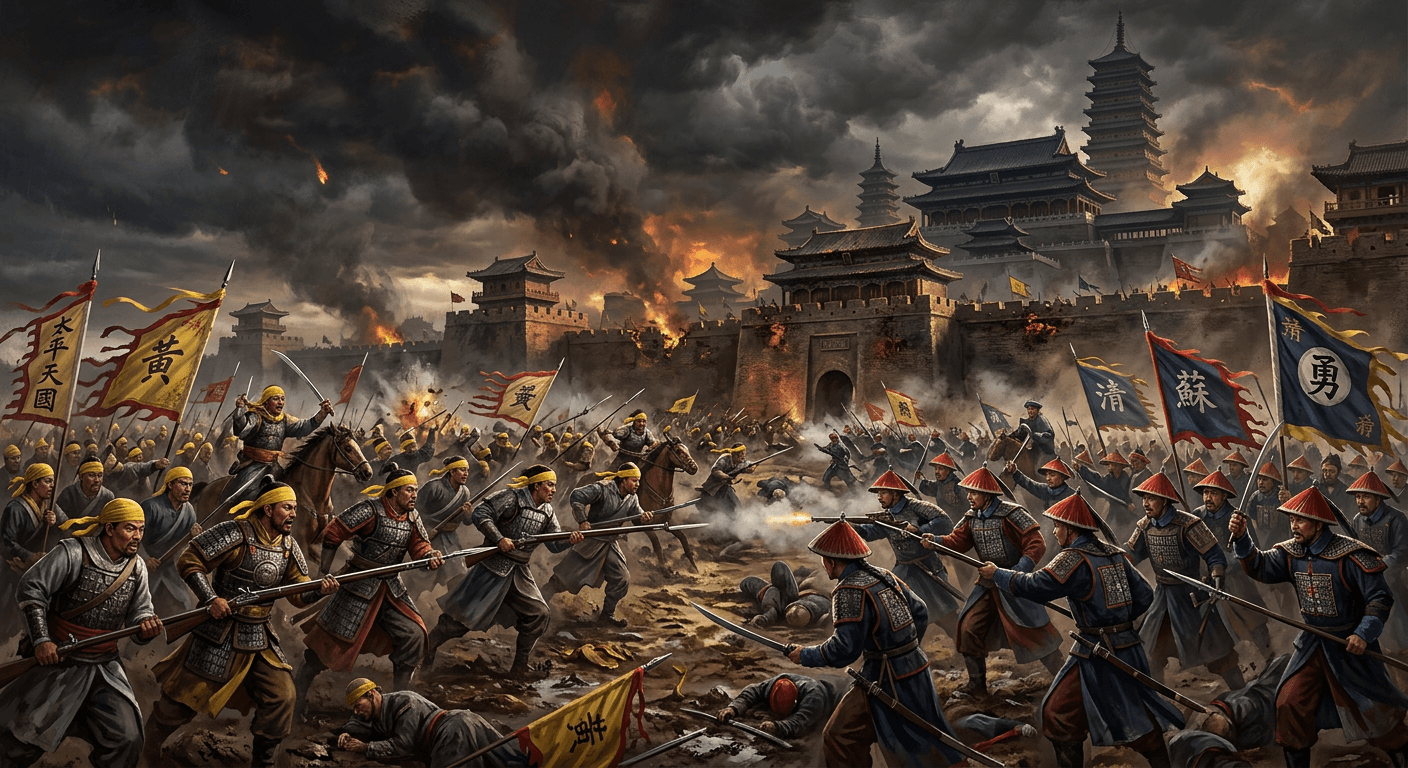
The Taiping rebels were an unstoppable force. Sweeping northward, they captured the ancient imperial capital of Nanjing in 1853, massacring its Manchu population and renaming it Tianjing, or 'Heavenly Capital.' Here, Hong established a radical, utopian society that was centuries ahead of its time, yet violently puritanical. The Taipings abolished private property, creating a classless society. They banned the cruel practice of foot-binding, outlawed opium, and promoted the equality of men and women. However, this equality came with extreme caveats: the sexes were strictly segregated, and even married couples were forbidden from living together under penalty of death. Meanwhile, Hong retreated into his massive palace, taking dozens of concubines and isolating himself from the daily governance of his empire.
The Heavenly Kingdom controlled much of the fertile Yangtze River valley for over a decade, but the movement was doomed by internal paranoia and external alliances. Bloody purges wiped out many of Hong’s top generals as they vied for divine authority. Furthermore, Western powers, initially intrigued by this supposedly 'Christian' rebellion, eventually realized that Hong's idiosyncratic theology and disruption of lucrative trade routes were bad for business. The British and French intervened, aiding the Qing dynasty's forces—most notably through the 'Ever Victorious Army,' commanded by European officers like Charles 'Chinese' Gordon.
By the summer of 1864, the Heavenly Capital was completely surrounded and starving. Hong Xiuquan, refusing to flee, ordered his followers to survive by eating 'sweet dew'—essentially weeds and wild herbs. Hong himself consumed the toxic flora, fell violently ill, and died in June 1864, just weeks before Qing forces breached the city walls and slaughtered the remaining defenders.
The Taiping Heavenly Kingdom was entirely erased from the map, but the cost was almost incomprehensible. Over fourteen years of relentless slaughter, famine, and plague, an estimated twenty to thirty million people perished. It remains a staggering historical testament to the power of belief, illustrating how a single man’s psychological break—fueled by the crushing pressure of a standardized test—could ignite an inferno that forever altered the trajectory of a global empire.