The Demon of the Fog: The Leaping Legend of Spring-Heeled Jack
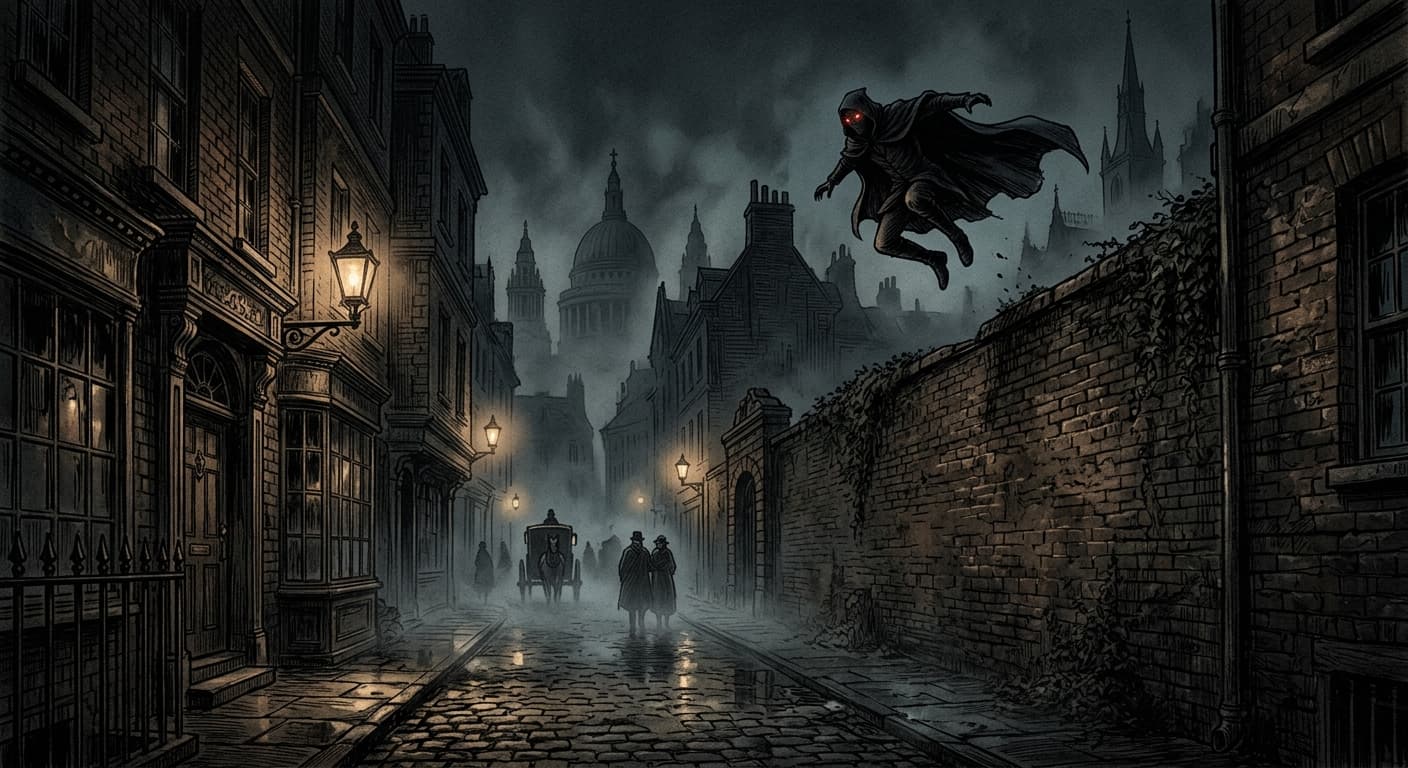
Picture the scene: it is the winter of 1837 in London. The narrow cobblestone streets are choked with thick, pea-soup fog. Gas lamps cast long, eerie shadows against the damp brickwork. Suddenly, from the gloom, a figure leaps over a nine-foot wall with superhuman agility, terrifying a solitary pedestrian before vanishing into the night. This was the dramatic introduction of a figure who would terrorize the Victorian imagination for decades: Spring-heeled Jack.
Before Jack the Ripper stalked Whitechapel, Spring-heeled Jack was the definitive boogeyman of London. But unlike the very real and brutal Ripper, Spring-heeled Jack occupied a bizarre twilight zone between genuine public menace, mass hysteria, and early comic book supervillain. The panic began in earnest in October 1837 when a servant named Mary Stevens was walking to work in Battersea. She reported that a figure leapt at her from a dark alley, gripping her with claws that felt cold and metallic. Her screams drew attention, and the attacker effortlessly bounded away into the darkness.
However, it was the harrowing experience of Jane Alsop in February 1838 that cemented Jack's terrifying legend. Alsop answered a knock at her door to find a man shrouded in darkness, claiming to be a police officer who had just caught "Spring-heeled Jack" in the lane. When she fetched a candle to offer him light, the man threw off his cloak. According to Alsop's official police report, the figure had a terrifying, devilish appearance, with eyes resembling red fireballs. Most shockingly, he vomited blue and white flames from his mouth and tore at her dress with metallic claws. Her family rescued her, but the attacker bounded away, leaving behind a city on the verge of total panic.
The sheer volume of sightings forced the authorities to take action. The Lord Mayor of London, Sir John Cowan, recognized the public terror and held a public session at the Mansion House to read anonymous letters detailing the entity's attacks. Vigilante groups were formed, armed with guns, sticks, and pitchforks, patrolling the streets to capture the leaping demon. Even the Duke of Wellington, the hero of Waterloo, was rumored to have mounted his horse and ridden out armed to hunt down the mysterious attacker.
So, who—or what—was Spring-heeled Jack? The most prominent theory at the time pointed to Henry de La Poer Beresford, the 3rd Marquess of Waterford. The Marquess was notorious for his drunken brawling, cruel practical jokes, and a documented hatred of women. He was known as "the Mad Marquess" and had the wealth to construct specialized mechanical boots and a fire-breathing apparatus to terrorize the public for his own twisted amusement. Furthermore, a witness claimed to have noticed a coat of arms featuring a "W" on the back of the attacker's cloak during one of the early assaults.
Despite the strong suspicions, the Marquess was never formally charged, and he died in a riding accident in 1859. Yet, Spring-heeled Jack did not die with him. Sightings continued sporadically across England well into the late 19th century. In 1877, a group of soldiers stationed at Aldershot claimed they were terrorized by the leaping figure, who allegedly slapped a sentry in the face before bounding over the barracks wall, completely unbothered by the warning shots fired at him.
As the decades passed, Jack's real-world terror faded, and he transitioned seamlessly into the realm of popular culture. He became the star of numerous "penny dreadfuls"—cheap, sensationalized serial literature. In these pages, his persona shifted from a demonic assaulter of women to a dashing, masked avenger who used his incredible leaping abilities to fight crime, essentially making him a Victorian precursor to Batman.
Today, historians and sociologists view the Spring-heeled Jack phenomenon as one of the first modern urban legends, a fascinating case study in mass hysteria fueled by a rapidly expanding newspaper industry. Whether he was a cruel aristocratic prankster, a collective psychological delusion, or an amalgamation of several copycat attackers, Spring-heeled Jack remains one of the most uniquely bizarre and captivating mysteries of the 19th century.